Notes from the Dodge Poetry Fest

Tags

, , ,

My good friend Wendy Taylor Carlisle and I spent four soggy but word-happy days at Dodge a couple weeks ago. I gathered sixty-some pages of notes on the four days of poetry. The website states that almost 20,000 people attended! Student Day claimed a registration of 5,000 high school students from all over the country. I spoke with youth poets from Maryland, New Jersey, and Jacksonville, Florida. Several offered to send poems to The Sound – the newsletter I edit – for the January poetry issue. Here are words from master poets Robert Haas, Naomi Shihab Nye, and Lucille Clifton when they spoke to the young writers:

Robert Haas

Just imagine a place where American High School students and American writers could get together and talk about poetry!

The order in which you present information is crucial. Robert Frost wrote: “Something there is that doesn’t love a wall.” A translation might read, “There is something that does not love a wall.” That simple inversion would lose the poetic beauty of the phrase. It can strike the reader –  yes, but in examining what is meant, the order of the words makes it hard to pin that down…

Sometimes it’s good to take down barriers, sometimes it’s good to put them up. [He says later on referring to a Wallace Stevens poem] – That poem hypnotized me because it felt emotionally true.

Why is poetry so powerful? An answer to that might be: Whole worlds we acquire with a word – just buried inside one word!
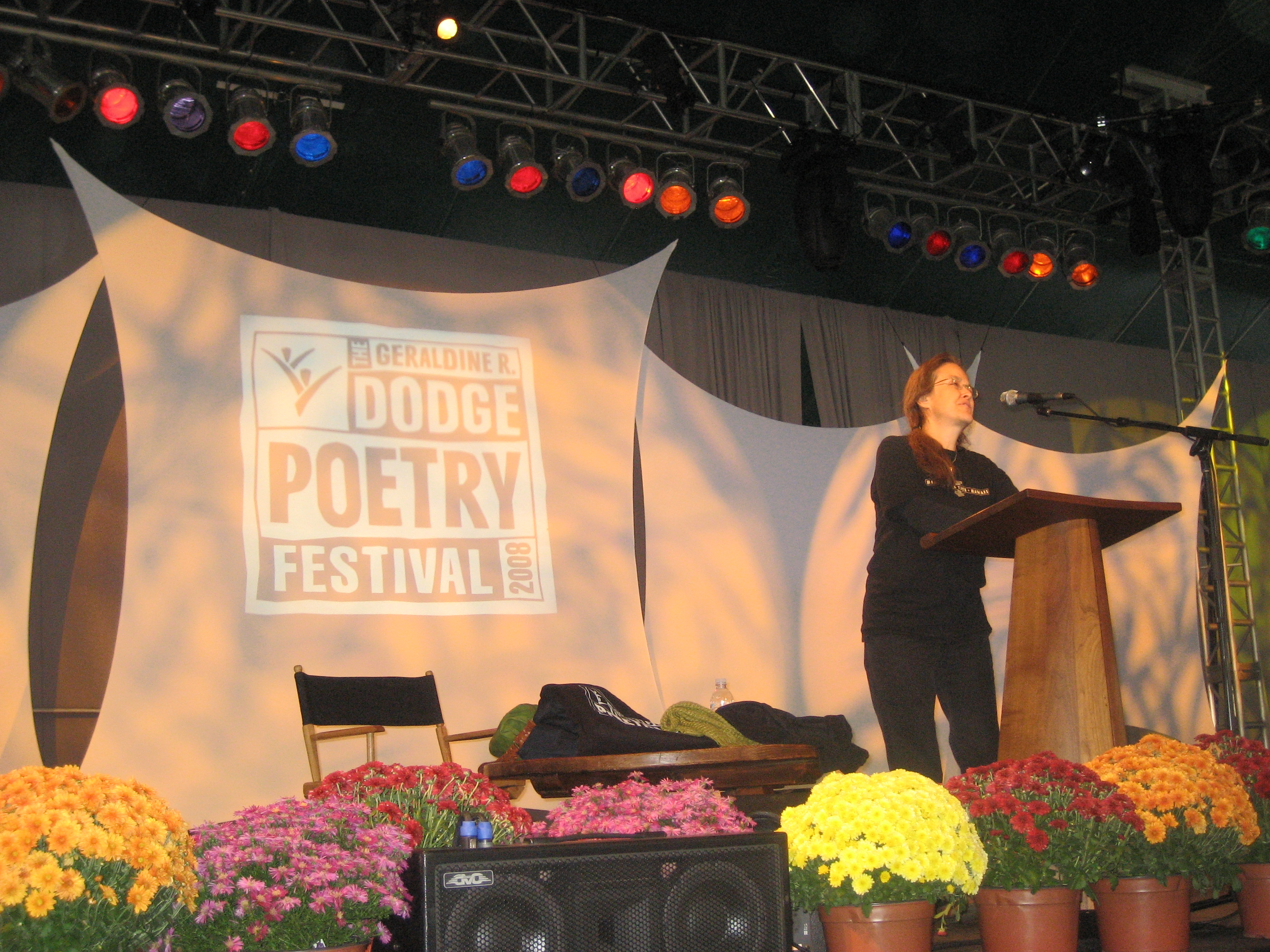
 

Naomi reading at Dodge

Naomi reading at Dodge


Naomi Shihab Nye:

 Here’s an idea: hand out business cards with the names of your five favorite poets.

 Whatever the experience, you can always find a poem that’s been to that moment before you.

 Poetry is the cheapest art. You don’t have to be rich to write,  but you will be rich because the language can give you so much. Time slows down when you write a poem: think of this, notice that…take inspiration  from things on the perimeters of your life, ask questions and wonder. Curiosity helps keep poetry alive. Poets aren’t ever bored. There is so much to think about!


Lucille Clifton:

 There are all kinds of ways of being smart. 

 I want to write about what it is to be human, about us recognizing in each other a kind of sameness. This culture is afraid of difference. There are lots of different names for deity, and deity answers [to them all].

 Walt Whitman didn’t have an MFA. I think one has to feel in order to be a fine poet; connect spirit, feeling, and intellect, or just write greeting cards.

Cleverness is often in the way of poetry!

 If someone doesn’t teach you something, go out and learn it. The more you learn, the more you are able to cope with surprises.

 If you leave reason out sometimes you can have important things, but if you leave heart out, your writing doesn’t live.

Poetry wants to speak for those who have not yet found a voice to speak.

The greatest poet writing in my time is Stanley Kunitz.

Our mission as poets is to let the poem become what it wants to be.
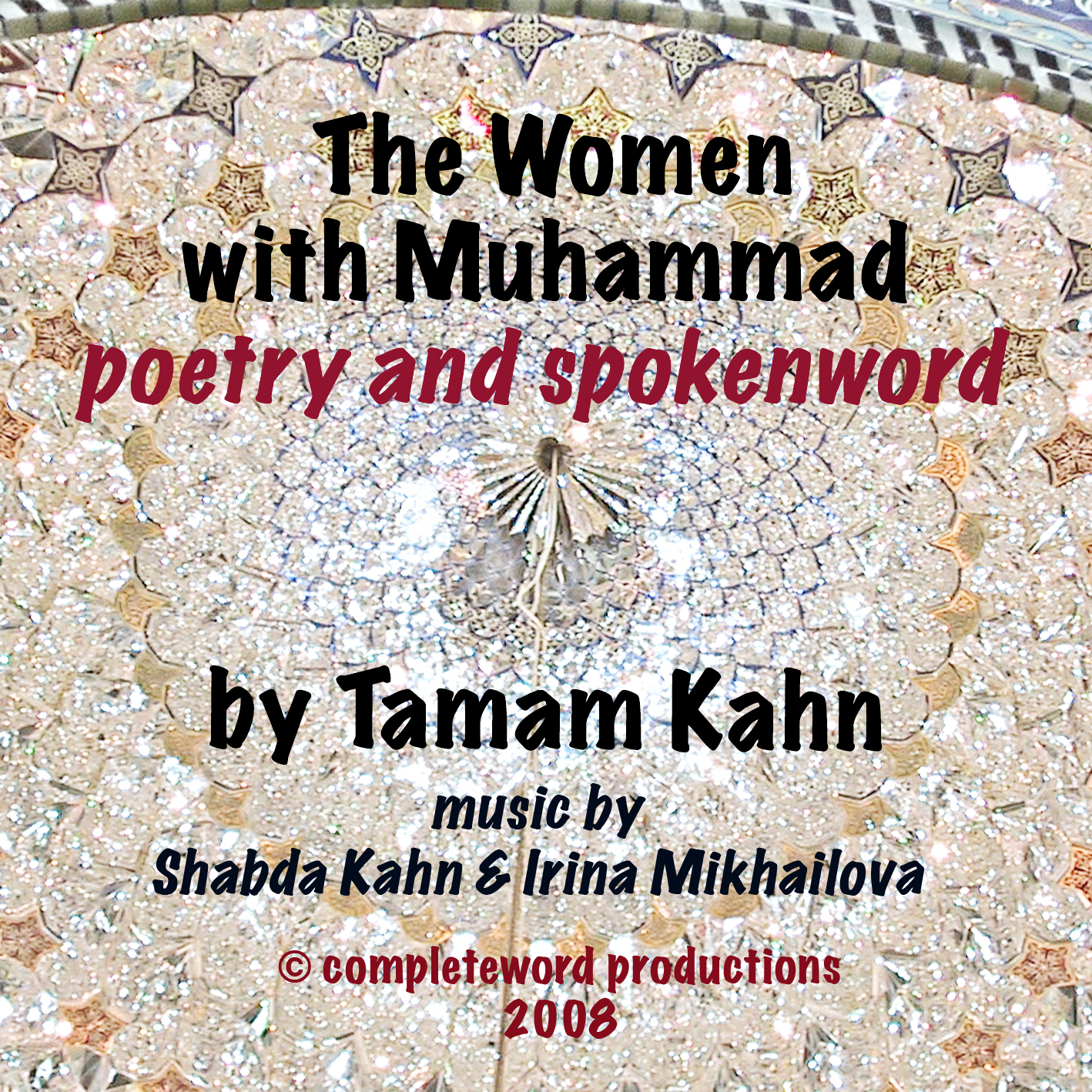


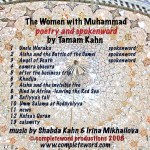
CD release: The Women with Muhammad

Tags

The Woman with Muhammad: poetry and spokenword

Original poems read by Tamam Kahn recorded live at CIIS (California Institute of Integral Studies), December, 2005

Coleman Barks has written about Tamam’s efforts, “Finally we get to meeet the First Women of Islam!” All spokenword beats are courtesy of DJ Solomon. Some poems are accompanied with music by Shabda Kahn and Irina Mikhailova. Recorded by Shabda Kahn, and mixed by Al Shabda Owens. Photo and artwork by Shabda. ©completeword productions, 2008.

Price: $15

Media type: CD


to order contact http://www.marinsufis.com         click on – music for sale and Hear a sample!


Hafsa’s Qu’ran

 Marwan, governor of Medina… sent a courier to Hafsa

asking for the folios but she refused him…

                                                            hadith from Anas ibn Malik


Tell The Governor I say no,
I don’t accept command or bribe
I do not vacillate
and you can leave, now go.


I am the Prophet’s librarian.  And this
is the book: al-Kitab. The only set
of Abu Bakr’s folios, first copy of God’s kiss.
Its ink still hums against my very skin.


The Mother Who Reads, the Prophet’s librarian,
how blessed I am by al-Kitab,
which, after the last companion’s gone
may wash believers in the Word-of-God


Arabic, a printed alembic architecture of light
recorded on palm stalk, on camel’s
shoulder-bone, or held in memory;
copied to parchment then, and
swaddled with a length of green cloth, first


Qu’ran passed from my father
down to Uthman, then to me. Between the leaves
is Revelation. How can someone like you understand,
Marwan? You set yourself to be the one


to grab and shred and burn
this first Qu’ran (may copies rise and multiply),
as soon as I am shrouded in clean cloth
and lowered into earth.

re-writing history

(written by Tamam for the Seven Pillars inauguration weekend)

No less than the prophets, Hagar speaks

He had to take us there, way out in Beersheba,
the land of nothing. His face was a hungry moon,
gaunt and white. He couldn’t look at me.

A woman doesn’t start a nation with a baby
and a mule; not alone she doesn’t, so Sarah helped
with her story of that jealousy that pushed me out

like I pushed Ishmael. I knew before my baby came.
I’d seen the well, foresaw
the black stone, had the tearing pain,

the time of doubt. I ran between
the hills, but that was in a vision. After that the time
had come to run and I was fierce

and mad with thirst for all I left behind and
as I ran I yelled at God, I called on God,
I said – Give it and hold nothing back. After Ishmael

unearthed the Well of Zamzam with his heel,
after the caravans found us, after Mecca
burst awake around us, after

Abraham returned to wake the Ka’ba,
then I could relax. My gift from God
is larger than I am. I doubt they mention it.

Camel-riding

Tags

, , ,

Camel-riding is either very uncomfortable or a real pleasure. It depends. The first time up I gripped tightly to the hand bar and leaned forward.  My saddle was about nine feet off the ground.  the camel lurched forward – right-right, left-left, right-right. The term “saddle sores” was an instant reality. After a difficult hour, it suddenly occurred to me to lean back and open to the movement, as if I were birthing the camel’s rolling gate. I let go and placed my hands on the back of the saddle. Mmmm, this was a ride, a dance, a sailboat tacking on the edge of a breeze. Yes!

seventh century cloth

It’s plain, pinned at both shoulders,
the woman’s hair and face talcumed with dust.
A revolution, exile –
she, rumpled and threadbare,
ahead: a decade of colorless fabric, rough
patches. What does a wife wear
or a daughter
while she changes history?

Something nice, like the tunic
pictured in a textile manuscript,
excavated with tweezers,
flattened and guessed at,
a linen shift with dark woven bands,
running shoulder to hem.

You make up the colors, then see them
brighten in a washing tub, her hands
twisting and wringing out the cloth.

Now see her pull it over her head and arms,
then work it down her wet braids and body
as it settles with a shrug.
Dripping and decorated. Cooler.
Water birds with red legs are hand stitched
in bands at the wrist.
She can walk to the market like this,
barefoot and dripping.

Dress code came later.

Mrs. Muhammad


cloud for 'Asmaa

cloud for Asma'

This is for you, girl —
sent home to the Najd with two white dresses;
when the month of June was over.
You, the pretty one who calls herself the wretch.


This is for the girl — that’s you,
who never got to touch
her husband’s hand
or even be kissed by him.

This is for you, girl —
the fool in a word trap. Trapped.
On your wedding day
you repeat the phrase
his youngest wife, Aisha, said
would make him love you
more. But look, his arm flies up
to hide his face,
and then he’s gone.

This is for you, Asma’ bint al-Numan ibn Abil-Jawn
Mrs. Muhammad until you die.
The fall
is lifelong, to the knees.

(last line is by poet Heather McHugh)

Married to Muhammad

For almost a decade I have felt a growing mandate to demystify the women married to Muhammad. At this time, more than ever, we need to know about the cultural origins of our sisters on the other side of the globe. These untranslated women, who stood in the first light of Islam, have buried stories. Here are several: Khadija is a wealthy businesswoman who hires young Muhammad; Hafsa is saved from divorce by Angel Gabriel, Zaynab, a married first cousin, experiences a moment of passion with Muhammad, Umm Salama saves a vital peace treaty and Aisha tells of death of the Prophet. These are stories known in the Arab-speaking world. My book of poems and history is called Married to Muhammad: Untold History of the Prophet’s Wives. I am fortunate to have good resources: rudimentary Qu’ranic Arabic study; scholarly guidance, travel in the Middle East, and three decades as a seeker on the path of American Sufism.

The project was conceived after an inspired time with Moroccan Sufi women, sharing their bold, joyful gatherings. I began to research the Prophet’s wives, and was drawn into the historically based poem. I respectfully endeavor to glimpse and share the lives of these amazing and powerful women who witnessed Muhammad’s daily life at a time when “Islam” meant peaceful surrender of one’s heart to God.

The Discount Fireworks Poetry Book Tour

The Alligator Handler by Wendy Taylor Carlisle

The alligator handler is grappling, counting the scales on the galloper under him, when he first hears it. He clamps down harder on the colossal mouth, trying to decide—is it coming from under him or is it air escaping from an eighteen-wheeler’s tires, an FM breeze off the freeway, brakes? All around the air syncopates, rhythmic, harmonic, with just a touch of do-wo, urging, “Loosen up. Enjoy the ride.” He catches the beat; bobs his head to saucy, saurian rock n’ roll.

When this gator still had an egg tooth, every Gold Coast kid kept a hatchling in a fish tank on the painted bedroom dresser. Hunkered next to the tube radio, tiny scales decorated with, Souvenir of Florida! Florida Gator!, they outgrew their aquariums hormoned by the Big Bopper, chords covering them like paint. Set free later, the half-grown ‘gators were veneered with R & B. On any post-fifties day, in burrows and holes across the swamp the Alligator Show modulates—belly crawlers and high walkers harmonizing in a wild, wailed melody. Sibilance circles every new-hatched pod. White cranes and pelicans tick over into their own sha na na. Every crusty body croons.

No matter if he ever figures it out. No matter how the big bull, ‘Gold Coast Champ,’ flaking off his scales, Elvis in his heart, tempts him. The handler, listening hard for Slim Harpo, is hanging up his leather gloves. Now he longs only to relax in silt up to his tattoos, to rumble the be bop, hiss the shoop shoop, tune his swampy soul until a choir reaches up & pulls him in.
This poem appears in pigironmalt online journal. From Discount Fireworks,  Jakaranda Press. 2008. Winner of the Bernice Blackgrove Award of Excellence, 2008.

Some events coming up

I’ve been getting the book tour together for Wendy Taylor Carlisle, my good friend from Texarkana, who will be in the Bay Area August 8-21.

We will both be reading together in Sebastopol at Coffee Catz on Friday, August 8, 8PM with Aziz, Whirling Dervish; Gary Haggerty on Oud and saz, and Karim Baer on tar drum. $10.

Wendy will also read at
The Sacramento Poetry Center on August 11.
http://vasigauke.blogspot.com/2008/06/impressive-line-up-for-sacramento.html

Open Secret Bookstore, San Rafael, August 13 – $10.
http://www.opensecretbookstore.com/Events.html

Northpoint Coffee Company, Sausalito August 15

“Thursday Gig” in Los Gatos, August 21.

the other Zaynab

This poem was an eight-minute gift that bobbed up from the ocean of poetry, making the whole day a yes.

the other Zaynab

by Tamam Kahn

I called for her, not expecting an answer
but because her impression–
like a fingerprint on glass­–
was missing from these tales,
her finger sugared with the juice of
a fresh apricot, the one that pressed
for a second or two on that glass mentioned above,
that is, if there was glass at all,
or a rough cup or a heavy Phoenician goblet
or a pane from Yemen, fitted
into the earthen wall
of some Meccan mansion, tinted
maybe a pale rose color,
like the blush on an apricot,
or the heat in her cheek the first time
Muhammad took her hand.