W.S. Merwin & Poetry at Round Top

img_0913_2

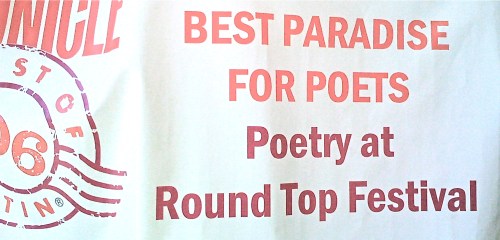
The Round Top Poetry Festival, April 17-19 2009  in Texas – between Austin and Houston –began in a down pour, with emphasis on both words. Imagine a ring-your-socks-out rain that continued for over a day. I bought the last pair of galoshes in my size – white ones! Soggy poets and wet umbrellas. Lightning. Thunder. Then, as if it never rained, Sunday morning the sun lit everything and the gardens were beautiful. Naomi Shihab Nye calls Round Top “paradise for poets,” and since my idea of poet-paradise would include Naomi and W.S. Merwin, I agree. 

img_1710

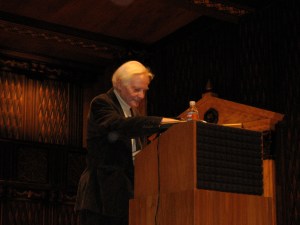
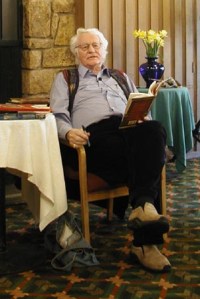
  One unforgettable moment was seeing Paula Merwin leaning across the dinner table, deep in conversation with Dorothy Stafford, widow of William Stafford; the other was the answer W.S. Merwin gave to my question: In the work of translation, is attunement with the poet a serious consideration? I was in the first row, and his word blast scoured my heart and mind. All I remember was the last part, “…for translation, the best way is to LOVE the poem.” Merwin was introduced as “the Complete Poet.”  When he read his poetry his gentle tone and cadence mesmerized the audience. He read long and deeply from his grey book, The Shadow of Sirius. A day or so later, that book won the 2009 Pulitzer prize for poetry, announced April 21. Sirius is not dazzling and clever, but rather casts a solitary even gleam – like gold – that enchants the listener. I feel it is largely important because of the great lifetime of experience and longevity he brings to each poem. In his youth Merwin was mentored by John Berryman and received vital guidance from Ezra Pound. Like Milosz, Merwin shows us the perspective of an octogenerian who is wise and thoughtful. From the poem in the Sirius collection,“Worn Words:” 

…it is the late poems

that are made of words

that have come the whole way

and they have been there.img_0918


From “By Dark:”

When it is time I follow the black dog

into the darkness that is the mind of day


I can see nothing there but the black dog

the dog I know is going ahead of me


 not looking back oh it is the black dog

I trust now in my turn after the years                        when I had all the trust of the black dog…


Kudos to the co-directors, Dorothy Barnett and Jack Brannon, who made it happen. Naomi made us all feel welcome and offered us her brave, engaging poems. Other highlights included Fady Joudah’s translations of Mamoud Darwish, and poetry by Jennifer Clement and Jo McDougall, all extraordinary word-masters. Jennifer lives in Mexico City and runs the glorious San Miguel Poetry Week writers’ retreat. Merwin once said these haunting words about Jennifer: “She writes in English but she dreams in Spanish.” From New and Selected Poems, my new favorite poetry is her Lady of the Broom, forty-eight poems about a woman who died of unrequited love at the end of the 17th century. Find it and read it.

from Jennifer Clement’s Lady of the Broom:

XIXjen2

…Without a mother,

no girl walks safely,

no other will place their body

between her body

and the bear.

Here are some jewels from Jennifer’s workshop: “Study the etymology of a word. Sincere has to do with the Roman language of marble. Flaws in a slab were hidden with wax fill. Those without artifice were sincere... If you use dialog – go to the playwrights!” She appreciated Tennessee Williams especially. One technique he used was to “…have one character ask a question and the other ignore it. Then something wonderful happens.” Coleridge wrote that “poetry is best when it is not totally understood.” [Not advice for beginners!] ~   ~    ~    ~    ~   

img_1706_2

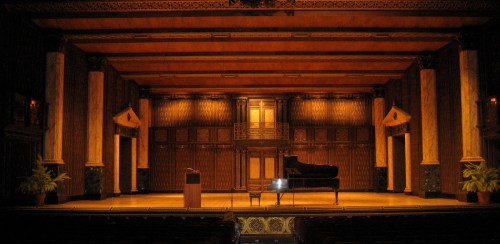
The stunningly elegant hall at Round Top where the readings take place.

Jo McDougall offered a class and gave excellent pointers I will talk about in another post. I met a young poet named Jeff Stumpo whose performance poems were a knock-out. More on him as well.

 The word I came home with is fascicle – [rhymes with bicycle], a small bundle or cluster, as in the clusters of poems bound in blue ribbon and placed under her bed by Emily Dickenson.  <>    <>    <>    <>    <>    <>    <>    <>    <>    <>    


DARWIN, A Life in Poems – Review

DARWIN, A Life in Poems, by Ruth Padel, New York, Alfred A. Knopf, 2009.

Ruth Padel has written a brilliant book. It is a historical biography written in poetry with side notes. The titles are worth the price of the book. They are printed in CAPITAL LETTERS. She said that she gave up tenure in 1985 to write poems. 

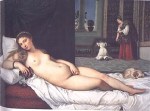
Padel has a poem called, ON ASKING A MUSEUM GUARD TO DRAW THE CURTAIN BEFORE TITIAN’S VENUS titian_venus_urbinom1. She says that Darwin went to see it in the museum, though the one he saw may be a copy. She writes that “the museum hung curtains over paintings of nudes to protect the modesty of women visitors.” Indeed!  All this information is in a very small font running down a column on the left side of the page. Meanwhile, on the poem’s right, she is drawing you into the eyes of this youth, Darwin, as he comes into his sexuality:

Her sudden body. Bare vellum, horizontal:

thighs crossed and lower knee flexed

below the upper calf. He knows the lines by heart:

her fingers curving down and nesting – he can’t see the tips….

The next poem, A DESPERATE WAY TO AVOID PAYING YOUR TAILOR describes how he signs on the H.M.S. Beagle.  His job is to attend the captain as “a gentleman companion, naturalist, and savant, for a survey of South America.”

He pulls away from a career in medicine, SLIDING GIDDILY OFF INTO THE UNKNOWN with the notes printed on the poem’s right this time: “They finally left [Plymouth harbor] on 27 December, 1831. Darwin continued to be badly seasick throughout the five years’ voyage.” Five years, seasick!!@?! Padel is descended from Darwin, and with a persistent eye for detail about his life,  pulls us onto the deck of the ship, into the jungle, and captures his delight in the dizzying new sights. On Cape Verde Island he sees his first tropical vegetation. img_0784LIKE GIVING A BIND MAN EYES 

He’s standing in Elysium. Palm feathers, a green

dream of fountain against blue sky, Banana fronds,

slack rubber rivlets, a canopy of waterproof tearstain

over his head. Pods and racemes of tamerind.

Follicle, pinnacle; whorl, bole, and thorn….

There are Darwin’s passions;  shooting guns, collecting specimens, his beloved family – and his pain; injustice, the  abuse of one human by another, and later the death of his children and his terrible illness from a tropical insect bite that tormented him the rest of his life.

BIBLICAL

…Now it’s lunatic farting, vomit, stomach-and -whole348b

body ache. These midnight demons, weeping and shakes,

must have organic origin – like everything.

Tears streak the greying stubble on his cheeks….

<>     <>     <>    <>     <>     <>     <>

Richard Holmes from the Guardian (British Press) writes, “She has evolved a new species of biography …This is not a mere collection, but a complete miniature biography, told through linked but highly individual poems, a selection of visionary moments: snapshots, epiphanies, symbolic fragments. For biographers, this itself is a challenging revelation of economy and selection.

And from The Economist, posted on her website: “Why does this book work so well? Why are poems a good way of illuminating a life such a Darwin’s? Padel has caught the quintessence of the man’s character as if in a butterfly net.”

For further information –New York Times review, by Charles McGrath, April 17, 2009: http://www.nytimes.com/2009/04/18/books/18pade.html?ref=arts


Youth Speaks: POETRY SLAM

Poetry slam: March 27th! Tonight at the Museum of Modern Art theater in San Francisco nearly twenty  young poets stood on the stage and gave us their poems. Some spoke with ferocity. They were rewarded with high scores. All were brave just to be there, never mind that they were 15, 16, 18 years old, pouring out stories of injustice, angst, and pain. Their stories mirrored life experience of audience members, most of whom roared their support. I liked Carmela Gaspar, a diminutive Asian student who had memorized her long and rapid in-front-of-the-mirror poem with fast zingers like  …palid be / like a malady… that got me wishing I had the words to that poem in front of me. She didn’t hard drive it with lots of four letter words or end the poem with SHIT! like the favorite slam-girl Ebony Donnley, who looked like a young Queen Latifa. Emcee Chinaka Hodge had a good relaxed style and kept the feel-good atmosphere going.museum-bridge112 There were some powerful male poets like Mic Turner, and Travis Eglip, but it was the young women  that held my attention.

Annelyse Gelman, a white girl from “the other side of the Caldecott,” had style (both Rachel and I liked her grey coat) and confidence. I started scribbling her phrases...smiling is just a special way to wince… and  angst is unconditional. I would have given her a few 10’s in her score, if I were one of the judges.  These five judges seemed to go for power in presentation, slam-skill, and the degree of tragedy described.  The points started at 9.1 and went to 10 and above. Every poet had a score of at least 9.1. I liked that. Lots of applause and cheers. Most poets were in the high 9’s.

Youth Speaks is getting much attention nationally. It is 13 years old. I believe I went to one of the first slams, outdoors at Fort Mason years ago.  April 11th the FINALS are at The Opera House!

And April 5th at 11:00PM HBO is presenting Brave New Voices Slam. Check it out. This is the voice of the future, y’all.img_1533_2_2

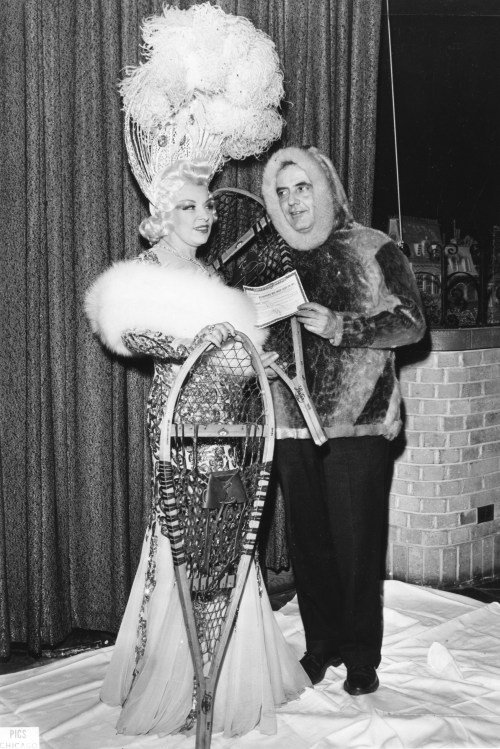
My Dad and Mae West

johnbakermaewest

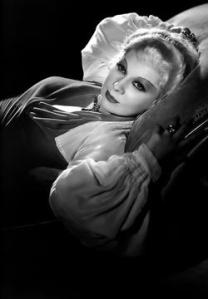
I couldn’t resist downloading this picture. It was a promo for the Quaker Oats Company. My dad, John Baker, had just cinched the legal deal with Canadian lawyers to allow a deed for one square inch of land in every cereal box – Quaker Puffed Wheat and Rice – in most kitchens in America.

OK, but what does Mae West have to do with cereal? She was an icon. mae_west-thumbShe began in Vaudeville and on the stage on New York. By the fifties, when this photo was taken, Mae West had been a a cinema heavy for nearly twenty years. Here she was, holding the deed to one square inch in the Yukon! I wonder what my Dad was thinking…   Mae had great wit and sparked controversy. Actress, comedienne, and writer in the motion picture industry, she pushed the edge. Here’s a selection of scenes that show Mae as a mixture of Bette Midler and Marilyn Monroe:

Too much of a good thing can be wonderful! – Mae West


Sardines, Mackerel, Words and other Food

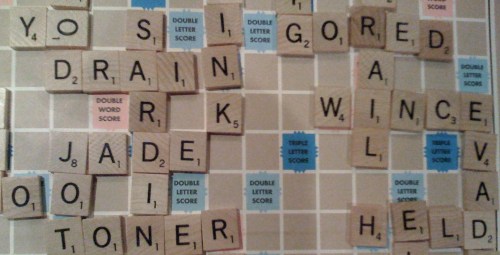
img_0840_21It was good to get the letters sardi_e down as the first move. Shabda had the N there in toner. Scrabble is still an option, if you are willing to put down the book, get off the computer – away from any screen at all, or come inside out of the chilly night.

Sardine is a lead in to my Mark Doty theme of late. Here is an excerpt from a favorite poem in Fire to Fire. The sardine is one of those  small identical fish like Mackerel… sardines remind me of salt and The Costa Brava in Spain, whereas Makerel, as everyone knows, are HOLY.

A Display of Mackerel                              img_0808

They’re all exact expressions

of the one soul,

each a perfect fulfilment


of heaven’s template,

Makerel essence. As if,

after a lifetime arriving                                                        


at this enameling, the jeweler’s

made uncountable examples,

each as intricate


in its oily fabulation

as the one before.

Suppose we could iridesce, 


like these, and lose ourselves

entirely in the universe

of shimmer –

<>     <>     <>     <>     <>     <>     <>     <>     <>     <>

That is only 5 stanzas from the middle of a 17 stanza poem. Look it up. You’ll be glad.

Last week was the final time to see Mark teach or read in the Bay Area. He finished his program at Stanford University with a Colloquium, introduced by Director of the Creative Writing Program and premier poet, Eavan Boland. The subject of the paper he presented was “Memory and Desire,” with respect to Constantine Cavafy and Marcel Proust. One wrote poetry in Greek, the other,  prose in French. Both were held by the work of memory. Mark spoke of “the poetics of space,” the meeting ground between the space occupied by the reader and that of the writer.  After all, where did we store intimacy and daydreams in our childhood? We had secret places – the fort under the stairs, the attic, the tree house. He mentioned that memory is organized by the spaces which hold our intimate moments (more than by sequential time). Cavafy and Proust each set out to construct a “memory palace.” Memory, he goes on to say, “is a way of holding that which is lost” and may be “a stay against dread.” Mark Doty always has me considering new directions of thought.

The talk was geared to a group of Cavafy’s small poems about love  and love-making that occured in a room, afterwards, in the poet’s memory. This work was personal, and concise, not like his famous Waiting for the Barbarians, with the closing lines:

And now what shall become of us without any barbarians?

Those people were some kind of solution.

<>     <>     <>     <>     <>     <>     <>     <>     <>     <>

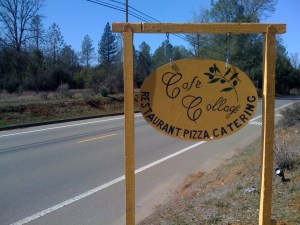
img_0827 Best dining tip: Cafe Collage way out in the middle of – well, north of the North Fork of the Eel River, off Marysville road, off highway 49, there is a village called Oregon House – I never saw it – but the zip is 95962.  I guess I’m an urban girl when I’m so far out in the country that the actual restaurant seems to be a kind of hallucination.  The restaurant is elegant,  the Chef-owner,  Salim Ben Mami, is a gracious and gentle Tunisian, who takes small groups on Culinary Guided Tours of his home country. The word “pizza” on the sign is not a reflection of what is inside.  His menu mentions “fine Mediterranean Cusine.” Pizza is probably a code word to keep the rednecks thinking it’s a normal place to eat. It’s not. The food is sublime! And I am a choosey eater.I had a the best spinach pie I have ever tasted. Shabda had the Moussaka. Being with our great old friends, Ann and Terry, was also delicious.  If you are ever wanting to drive and drive and drive and eat like this, go see Salim. Call first. 530-692-2555.

Mark Doty in San Jose

p1060659_4

Mark Doty read and talked about poetry today in the gigantic library at San Jose State University. I was not disappointed, not even for a minute. It was the whale poem, “Visitation,” that dealt with heft in a completely new way. He comes to view the whale expecting:

     …shallow water

     confusion, some accident to bring

     a young humpback to grief.

In “Visitation” he asks himself the question, “How much weight do we give to joy? The last line of the poem is:

     What did you think, that joy

     Was some slight thing?

~~~~~~~~~~~~~~~~~~~~

But first he read “Citizens:”

     The light turns red and I’m stepping

     onto the wide and empty crosswalk on eighth Avenue,

     nothing between the white lines but a blowing riffle

     of paper when this truck –

It’s the way Mark reminds me of Prospero, first summoning the minutiae of the craft, with a mastery of the elements – earth, air – and those potent polished and swirled words alchemized into a dazzling heartfelt poem… in completion he seems to ordinary down the magnetic field, blessing and releasing those energies back from whence they came by his own humanness, it is that magical touch that brings me back again to listen to this poet. To move with him through the poem and then be invited to visit his process of creation — is profound. Here is something of what he shared. He tells about how he was almost run over, and lost his temper. Something awful about that, being knocked off center. Later he began reflecting on the red truck that almost hit him. He writes something. He asks, “When does it start to become a poem? When we enquire, ‘Why does it matter?’ “

His first words when the truck cut him off were, what are you doing, act like a citizen. This led to his reflection on the fabric of social exchange in America. “What damage has been done to social responsibility? Last year Exon made the largest profit – why is there no money to pay teachers? It’s an absence of citizenship.” So when he says, act like a citizen, he is speaking for others (as well). Then he looks at his own violent reaction:

     If I carried a sharp instrument 

     I could scrape a long howl on his flaming paint job….

     and what kind of citizen does this thought make me…

Then he asks himself why he is still carrying the feeling after it is over  (like the monk in the poem who carry the nun across the stream, put her down, but still holds to the experience.) When our identity gets whacked what do we do with our reaction? This can go very deep. The poem closes with Mark entering the subway “with the devil in his carbon chariot,” and an image of the train

     burrowing deeper uptown

     as if it were screwing further down into the bedrock.

People in the train are weighed down by lack of dignity, tired, carrying a burden. His last words are

     …When did I ever set anything down?

He asks, (in relation to the making of the poem) “What will stay with me? Take your experience and think about why it matters. In the words of Walt Whitman: ‘There are buds beneath speech.’ The poem wants to unfold.”

These poems, “Visitation” and “Citizens,” are in Mark’s prize-winning book, fire to fire.


Wise words from Robert Bly

p1060218_2

I came across an interview with Robert Bly by Peter Johnson of The Prose Poem: An International Journal, Vol. 7, 1998. I’ve been unable to find the poem in its entirety, so the following may be partial, and imperfectly presented here. My apologies! I wanted to share Bly’s  comments and insights about the making of poetry. [Please contact me through the blog if you have the corrected poem!]

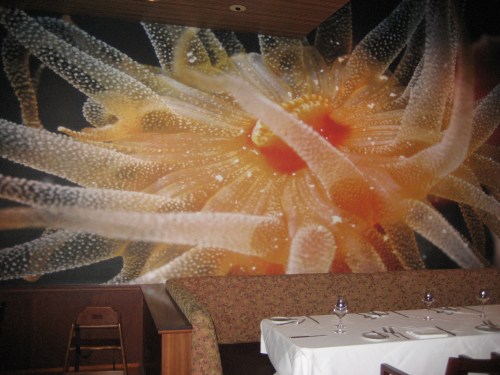
The Large Starfish

Now the ecstasy of low tide, kneeling down, alone. In six inches of clear water I notice a purple starfish– with nineteen arms! It is a delicate purple, the color of old carbon paper, or an attic dress… at the webs between the fingers sometimes a more intense sunset red glows through.  The fingers are relaxed… some curled up at the tips… with delicate rods… apparently globes… on top of each, as at World’s Fairs, waving about.  The starfish slowly moves up the groin of the rock… then back down… many of its arms rolled up now, lazily, like a puppy on its back.  One arm is especially active… and curves over its own body as if a dinosaur were looking behind him. I put him back in… he unfolds – I had forgotten how purple he was – and slides down into his rock groin, the snail-like feelers waving as if nothing had happened, and nothing has.
send2 RB: How did you feel about the similes inThe Starfish”?

PJ: It goes back to what you said about metaphor reflecting your internal state. Obviously, there is nothing ominous about your starfish. It possesses a sense of wonder and connectedness.

RB: I noticed that the starfish’s various arms were doing different things: “many of its arms are rolled up now, lazily, like…,” and the moment you say “like…” the whole unknown world enters in, and you don’t know what you’re going to say. At that moment, as Bill Stafford says, you have to give up all plans and all hope for perfection. Be a good host; let whatever comes in come in. One arm is rolled back a little “like a puppy on its back.” I remember writing that and thinking, “Whoa, that’s wonderful.” A scientist will say, “Some of its arms are in a rolled up position.” Period. The eye has done that. But I added “lazily,” and all of a sudden, something comes in from the part of me that likes lazy people, maybe. And then I say “like…” and now one is really in the soup. Writing, one has to be playful enough to say, “I’ll probably make a fool of myself in this image.” Then you can call on the part of yourself that isn’t precise, but has seen hundreds of these events when you were ten or twelve or fifteen. You don’t know from what era or stage or moment of your life the image is going to come. Had I been feeling reptilian, I might have compared the starfish’s curved arm to a snake. In any case, I love that moment when one asks, “Like what?”
 Then I wrote, “How slowly and evenly it moves.” I’m simply watching the starfish move. But moving like what? I could say it’s moving like a racing car stuck in first, or like a snail. But when I say, “The starfish is a glacier,” then I’m far ahead, and I have time to make a joke, saying it goes “sixty miles a year”; actually most glaciers go only a foot or two. I go on to say that the starfish is “about the size of…” what? A “pail.” Sometimes when I’m writing I’ll put down six nouns at that point: it’s the size of a fist, of a dinner plate that’s been thrown out into the dump, of a hubcap on a Volkswagen, the lid of a can found underneath the water, or the bottom of a pail. “The bottom of a pail” interests me, because all at once we have a pail; moreover, we have the interesting volume at the bottom of a pail, and perhaps some shady light.
img_0810

PJ: Well, certain images have more resonances than others.

RB: Yes, and the making of them is so much fun.

PJ: Being an editor of a prose poem journal, I read work from many poets who try to imitate the Robert Bly thing-poem, and I’m sure they’re having fun, too, but somehow they just can’t make the leaps you make, whether those leaps come through metaphor or juxtaposition of imagery. I think a certain astonishment is missing in many object poems I receive. For example, I published your poem “An Oyster Shell.” Listen to what happens in the first paragraph:

“The shell is scarred, as if it were a rushing river bottom, scratched by great trees being carried down. Sometimes its whitish calcium has been folded over itself, as when molten rock flows out; so something is still angry.” [Bly laughs.]

  So you see what I mean? In your best thing-poems you constantly redirect the reader and reveal strange new associations. I’ve come to see the object poem as being similar to the still life in painting. Every once in a while I come across an astonishing still life, say by the Irish impressionist O’Connor, but, for the most part, many of them leave me empty. Similarly, many of the object poems I receive remind me of a still life without the banana, devoid of any correspondences, any kind of creative, erotic energy.

RB: My leaps have to do with a confidence that psychology gives me that one can see the invisible. If you glance at a human being and you see the layers of calcium on his face, you are looking at some anger underneath that. That’s where the sally in “An Oyster Shell” came from. The fun lies in making unjustified leaps about people and things.

………………………

RB: I think a lot about the word “safety.” One reason I couldn’t write as well when I was twenty-five as I can now is that I didn’t feel as safe then. At twenty-five you think you’re going to do the wrong thing, and you probably are. You meet people who belong to the class system and are hierarchical, and this fear cuts down your ability to play. Instead of playing, you’re looking for the right associations, the ones an educated person might have. I don’t want to make a big thing about this, but for me one of the joys in the prose poem is that I don’t feel as much fear there. I’m writing in a new form, so to speak; I’m not claiming that I’m keeping up to great standards. As I’ve said, the most wonderful thing about the prose poem is that no one has set up the standards yet. The ability to make leaps has something to do with how safe you feel, because if you can’t feel safe, then you can’t go back to your childhood.

PJ: Someone once mentioned that, in a sense, Charles Simic’s poetry could be considered “children’s literature.” Dickens, too, and Virginia Woolf and so many writers probe this area. Another curious point is that many poets have told me that they have encouraged students to write prose poems as well as verse poems in poetry workshops, and that the prose poems have been better. One could suggest that this occurs because it’s “easier” to write a prose poem, but those of us who write them know that’s not true. More likely, it goes back to what you just said. Not intimidated by meter or even line breaks, these young poets feel safer; they can focus on the poem without imaginary mothers or fathers, “the tradition,” looking over their shoulders.

RB: Well, let’s go back to that, but in a different way. What is the proper subject for a prose poem? There is no answer for that, so you have to look at your own life. I lived my childhood relaxed and on a farm, so when I’m with a tree, I feel relaxed. But a friend of mine who’s lived in Manhattan his whole life went for a weekend up to Rye and when he came back, he said, “Why don’t those trees ever say anything?” He’d be better off writing a prose poem in the city, because he feels safe there. Once at a prose-poem workshop in the Village, I asked the students to find some object to write about that was not made by human beings. One poet refused and said: “I’m not going to do that. I don’t care beans about pinecones. Instead I’ll find you a city object to write about!” He came back after lunch with a small bottle cap entirely full of that grungy dirt peculiar to vacant lots; three long white hairs rose out of it. I wrote about that for hours. His message was, “Throw away pine cones. Get a bottle cap.”

PJ: It does seem that you are stuck, or blessed, with the geography of your childhood.

RB: All you have to do is relax into that. Do you remember that little poem David Ignatow wrote about the city? He was asking a wall to bless him. It didn’t:

The wall is silent.

I speak for it,

blessing myself

 He once dedicated a poem to me, complaining about my constant mentioning of leaves falling: “I wish I understood the beauty / in leaves falling. To whom / are we beautiful / as we go?”

That’s great, great. <>img_0589
Poetry Group – oracular pear

I said “Oracular pear, and they looked startled. “Oracular pear,” I said again. Listen to the words.

Mark Doty’s craft talk at The Dodge Poetry Fest, September, 2008.

Saturday September 27, The Library Tent in Waterloo Villiage, Stanhope New Jersey 9:30-10:45,

A Conversation on Craft.  [This is my all-time favorite craft-talk.]

img_0581 Mark began with the poem “Apparition,” about a peacock named Hommer (with 2 “m”s)
at a garden center. He said, “The cry of a peacock isn’t a sound humans can make. It’s between the police car blast – when he pulls you over – and an axe murderer; not speech we can comprehend… A peacock.

…And then the epic
trombone slide-from-Mars cry
no human throat can mime…

from “Apparition” (fire to fire by Mark Doty)

Mark asks:  And what is that shining for? It stands in contrast with the influence of Modernism, say with the focus on the image, William Carlos Williams “so much depends upon a red wheel barrow…” What depends on that? Seems like everything in the perceptual world. Ezra Pound’s poem: “In a Station of the Metro,” the entire poem reads: “The apparition of these faces in the crowd; petals on a wet, black bough.” The haunted faces, all at once part of something but they have come apart.  You don’t get done with thatpoetry.

Show don’t tell. Prune back rhetoric and abstraction. Let the image do the work! But the peacock poem is about extravagance vs. necessity. Leonardo da Vinci said, “Nature never does anything unnecessary.” Hommer – a Chinese drag queen looking like a fish. How did those eyes in the peacock’s tail help it survive? If it looks like a divinity, what a nutty thing for natural selection to do! Is the peahen that difficult to attract?

The poem wants you to be involved with a person thinking about a peacock. Then there is the musicality of the poem.  Oracular pear. That’s not conversational. o-ra-cu-lar – music!  The poem wants you to experience it in a tactile way, that phrase announces musicality and complexity. Oracular pear. That’s elevated speech to ordinary discourse. Fussy language attends to the imperious, metallic topknot. This is a perennial part of the poetic impulse.  We want to have language that rises to the occasion.

He checks if anyone has a question, so I raise my hand, “What is the middle part of the process of crafting a poem?” He replies:

1. You start with a description.

2. You ask yourself, what is it that makes me want to talk about Hommer; sort of – so what?

3. What matters to me now? These are questions about the nature of being here. I remembered a comment from Darwin that those eyes in the feathers were too much. Then something began to happen, to respond to the strangeness. This is the territory for the poem to enter. I like the process of mediation between us and the world – phenomenology, where life meets between there and here. What is the splendor for? So we investigate the given.

We revise and work with poems to train and condition for inspiration.  You are teaching yourself, and that may allow something later to come together.  That will not last, but struggles are hinges that let you get to what you don’t know yet.

For the last draft, I grounded this poem by putting it at the garden center. That brings it more down to earth.

Mark’s book fire to fire, New York, Harper Collins, 2008 was the National Book Award winner for poetry in 2008. Here is an excerpt from this glorious book:

from  “Apparition” by Mark Doty

Oracular pear,
this peacock
perched in  a plywood roost
at the garden center,
magnificent behind a wire fence
marked with his name:
Hommer
(pronounced
without the extra m),
and hand-lettered instructions:
DON’T PROVOKE ME.
He’s the provocation:
of what use
the wroght extravagance
he’s not just now displaying?
Darwin: “The sight of a feather
in a peacock’s tail,
whenever I gaze at it,
makes me sick!”
No reason on earth
even eons of increments
would conspire to this,
and is the peahen
that hard to attract,
requiring an arc of nervous gleams,
a hundred shining animals
symmetrically peering
from the dim
primeval woods?
But if Hommer argues
by his mere presence
for creation, his deity’s
a little hysteric,
rampant attitude
contained in all that glory…
…And then the epic
trombone slide-from-Mars cry
no human throat can mime…

<>                        <>                        <>                        <>                        <>

More Suggestions from Mark at Dodge:

Write a long poem. Separate the “expansive process” from the “contractive.” After you have over-written your poem, then begin to reign it back in.

Rewrite your poem backward line by line (exercise Mark got from CD Wright). It frees up the poem.

On titles: get a title that doesn’t do the poem any damage. Best is a title that does work. “Apparition” provokes the reader. It is a door into the poem.

Read passionately. seek that work with which we can fall in love. Take from that influence. Style is made out of influence. Poetry is the place where your life still matters. You are on the line, putting your heart and soul on the page.

Rilke talks about making doubt your friend. What you don’t know how to say will propel you further. Then turn to artists who say so much that is unsayable.

I love the word “entirely.” Forbid yourself those words, they make easy habits. Break patterns. Confound your usual means, it will confuse and reward you. There are always new discoveries to be made when you pay attention to the world.

<>

Comments are appreciated!

<>          <>          <>          <>          <>          <>          <>          <>

Tamam’s radio interview broadcast: on-line Monday evening

Sources mentioned on the show:

 “Sufism: the Heart of Islam” with Wendy McLaughlin. I mentioned Karen Armstrong, Muhammad, A Prophet for our Time; Martin Lings, Muhammad, His Life Based on the Earliest Sources; and Reza Azlan, No god but God. These all have general material on Muhammad’s wives and daughters. I forgot to mention the classic: Nabia Abbott, Aisha, the Beloved of Muhammad.

If you search farther into the primary sources – Muhammad Ibn Sa’d, The Women of Medina; Al-Tabari, The History of al-Tabari (in thirty-some volumes); A. Guillaume’s translation of Ibn Ishaq’s Sirat Rasul Allah (The Life of Muhammad); and the Alim, CD ROM (for Hadith). Gordon Newby wrote A History of the Jews of Arabia.  From here on, road leads into road…. Ya Fattah (may the way open!)

The CD’s played on the show are: White Shade Cloud and The Woman with Muhammad – to order contact http://www.marinsufis.com   click on – music for sale and Hear a sample! .
~          ~          ~          ~          ~          ~          ~          ~          ~          ~          ~          ~          ~                            

img_0649_2><    ><     ><     ><     ><     ><     ><     ><    ><     ><     ><     ><     ><     ><     ><    ><     ><
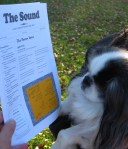
 The Sound – the annual poetry issue   
In this issue, between the digital pages:
<> Featured Poet, Philip Dacey
(On Writer’s Block and On Nonsense and Metaphor and
Shaharazad interviews Philip Dacey)
<> Drinking Poetry: The Dodge Poetry Fest
<> 14 pages of poetry, including High School Poets
<>  photographs by prize winning photographer Laura Plageman

••••••••••••••••••••••••••••••••••••••••••••••••••••••••••••••••••••••••••••••••••••••••••••••••••
Download the Annual Poetry Issue of The Soundhere.
**********************************************************************************
 img_12991 
Walter, discerning reader of good poetry catches a first look at golden
 Farsi translation of the poem “Light’s Voices” – only available in hardcopy. 
Even so, the download is a worthwhile read.

Slumdog Millionaire- classic sufi tale

Tags

143meditatingathumayunstombcomplex

Slumdog Millionaire, a most excellent film, won a Golden Globe last night for Best Drama! The SF Chron. film editor, Mick LaSalle didn’t understand it and also mentioned it was in Hindi. I wonder if he saw it at all, since the characters spoke English. This is a remarkable story that reads like the classic Sufi tale: Layla and Majnun, only the lovers are Latika and Jamal Malik. Her name means “elegance” in Hindi, his name translates to ” handsome king,” (a Muslim name). They are orphans from hell-on-earth, the enormous Mumbai slum. His journey to his “beloved” takes him on the impossible hero’s quest. Each searing and terrible blow carries a gift he can use later on to bring him closer to Latika. Karma and dharma flash back to back, and dazzle the viewer. There is strong violence, but I would see it anyway. This award-winning film is a remarkable success by director Danny Boyle. He talks about it on You Tube: 

http://www.youtube.com/watch?v=HJRzk2WfOAo

It’s all over the internet after the surprise win.

Philip Dacey’s poetics (preview of The Sound – January)

[FLASH – The poetry issue  of  The Sound will be posted here as a pdf on Monday, January 12.]

On Nonsense and Metaphor, by Philip Dacey

 T.S. Elliot believed the modern inclination is for what he terms “melodious raving.” We tolerate poets, he said, who don’t know exactly what they are saying but manage to say well whatever it is they are saying, who sound good and sound well…

 Nonsense is the vehicle of the unconscious. The unconscious is revolutionary. Leaping poetry and deep imagist poetry are nonsense poetry. Robert Bly: “There ought to be a National Crazy Day once a year when we could all act crazy and stop putting the burden of our craziness on other people, who get so much of it they wind up institutionalized.” Nonsense poetry is equivalent to cleaning up your own mess. Yeats’ Crazy Jane and Wendell Berry’s Mad Farmer are eating their own grief…

 Nonsense is an option at any point in the composition of a poem. It may or may not be exercised. It is a wrong turning that is a right turning.

New Yorker poetry event

New Yorker magazine poetry event. October

Metaphor is nonsense. Nonsense is metaphor. “Nonsense as a critical activity is and is about change; is an aspect of and is about the ongoing nature of social process.” (Susan Stewart, Nonsense.) It constitutes a challenge to the established order that has become disordered by reason of its being established, an unresponsive institution. “You must change your life.” [the last line from Rilke’s Archaic Torso of Apollo. Here are the first lines describing Apollo’s statue: ]

 We cannot know his legendary head

with eyes like ripening fruit. And yet his torso

is still suffused with brilliance from inside,

like a lamp, in which his gaze, now turned to low

gleams in all its power…

 Rilke’s angels are agents of nonsense. Nonsense poetry is not coterminous with light verse. The disenfranchised gravitate to nonsense, instinctually. The lingo of subcultures is a retreat that is simultaneously the forging of a weapon for self-empowerment.

“…poetry is a game of chicken played with words instead of automobiles. The aim is to steer as close as possible to nonsense without hitting it.”

[excerpts from “In Praise of Nonsense,” published in Milkweed Chronicle: A Journal of Poetry and Graphics (Fall 1980).

<>          <>          <>          <>          <>          <>          <>          <>          <>          <>          <>                        

Philip Dacey, author of ten books of poetry as well as many chapbooks, lives in New York City. He earned a B.S. from St. Louis University in 1961, an M.A. from Stanford in 1967, and a M.F.A. in 1970 from the University of Iowa. Dacey served as a Peace Corps volunteer in Nigeria in the mid 1960s and has taught at the University of Missouri in St. Louis, Miles College, and Southwest State University in Marshall, Minnesota. In 1985 Dacey was a distinguished poet in residence at Wichita State University. Awards include a Fulbright lectureship in creative writing in Yugoslavia (1988); two National Endowment for the Arts creative writing fellowships (1975, 1980); YM-YWHA’s Poetry Center Discovery Award (1974); three Pushcart Prizes for poetry (1977, 1982, 2001); first prizes for poems in Yankee, Poet and Critic, Prairie Schooner, and Kansas Quarterly, and many regional awards. His poems have appeared in Poetry, Esquire, The Nation, American Review, Paris Review. His books include The Deathbed Playboy (Eastern Washington U. Press,

1999), The Mystery of Max Schmitt: Poems on the Life and Work of Thomas Eakins (Turning Point, 2004), and The New York Postcard Sonnets: A Midwesterner Moves to Manhattan (Rain Mountain Press, 2007). He also co-edited, with David Jauss, the anthology: Strong Measures: Contemporary American Poetry in Traditional Forms (Harper & Row, 1986).