Guest of His Majesty King Mohammed VI of Morocco

Tags

,

IMG_0274

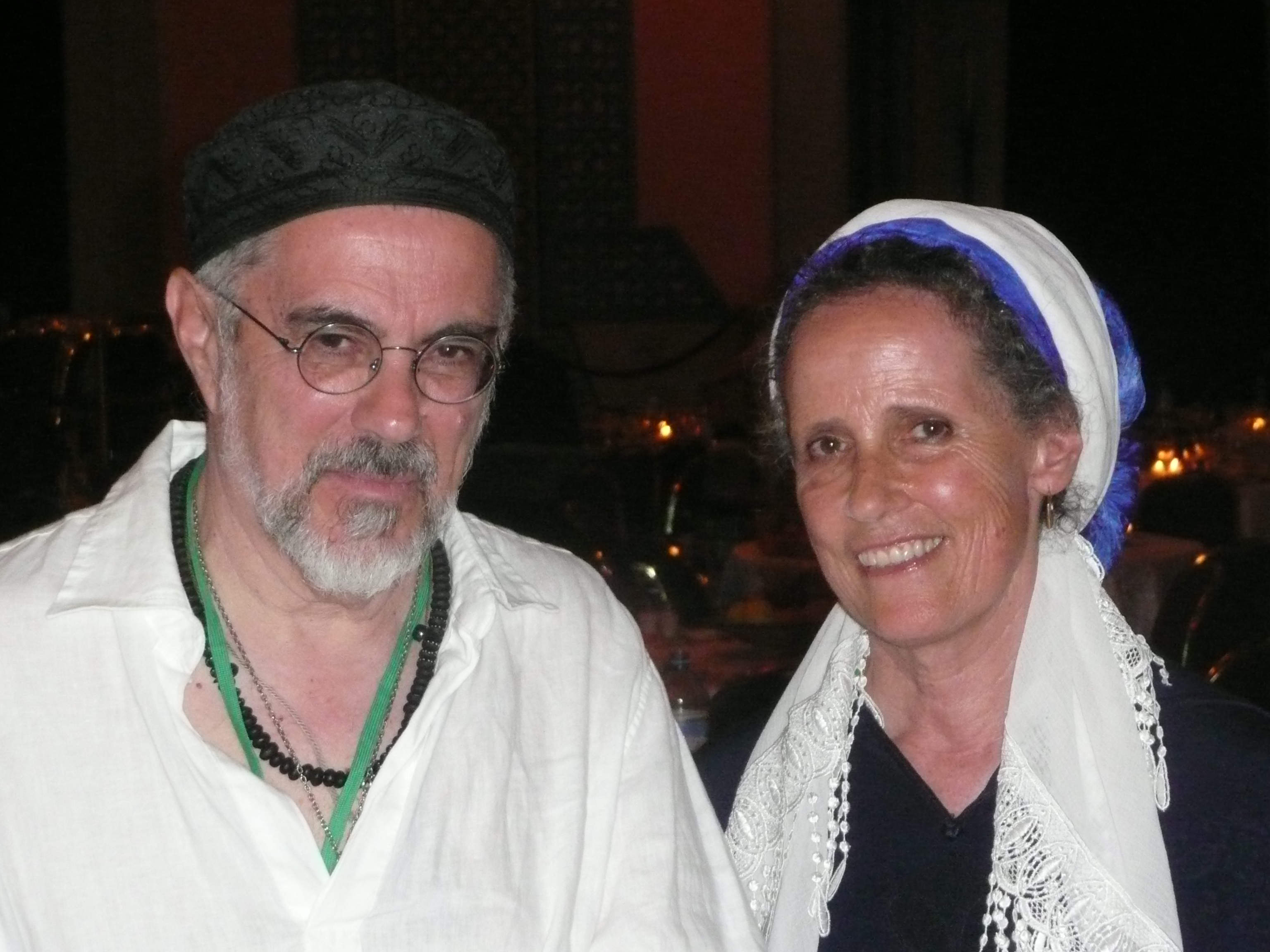
Marrakech Sufi Gathering: The Sidi Shiker World Gatherings of Tasawwuf Affiliates. I just returned from Morocco. The Royal Government paid for airfare, hotel, and food for a week. I was invited to present my poetry to a conference of nearly 2,000 Sufis. It doesn’t seem possible – but it’s true. I was there in the triple digit heat, sharing a tajine, heaped with rich and delicious food or an elevator with people from Lebanon or France.

In 1998, my husband, Pir Shabda Kahn, and I went to the Sacred Music Festival in Fez, Morocco as leaders on a “sacred journey.” We returned the next three years with groups of American Sufis and visited sacred sites and caravan-ed on camels in the Sahara. Our good friend, who made this possible, was a man named Dr. Sidi Ahmed Kostas. Now he is the assistant to Dr. Ahmed Toufiq, the Minister of Religious Endowments and Islamic Affairs for the king. Around the Summer Solstice June 21, 2009, Dr. Kostas and Dr. Toufiq got the go-ahead from King Muhammad VI to assemble a Sufi Conference in Marrakech July 10-12. They had less than a month! I got a personal phone call from Dr. Kostas while in England, waiting to go to Germany and teach from my forth-coming book: Untold: A History of the Wives of Prophet Muhammad. Dr. Kostas wanted me to read my poetry at the conference. I IMG_1270_2said yes.
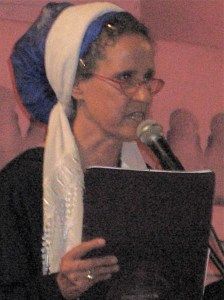
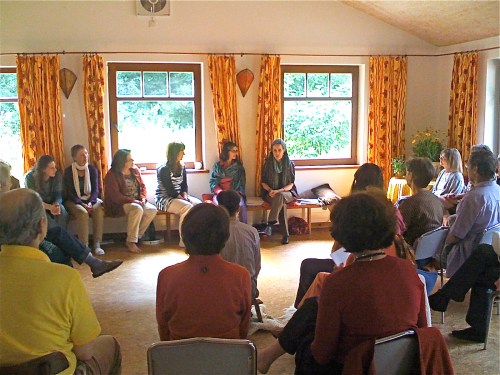
Dr. Kostas set out to invite Sufi groups from all over the world and on 10 days notice almost 2000 people accepted the all- expense-paid invitation of airfare, beautiful accommodations and banquet-meals – from Minister Toufiq on behalf of the King of Morocco. 100 Nigerians. Chinese and South Africans. Americans, Europeans, Middle Easterners. It was the Moroccan travel agent’s nightmare. The conference was tri-lingual, Arabic, French, and English, with simultaneous translation for all presentations. The weather – hot as West African summer; the hotels were well air-conditioned. Marrakech is as sophisticated as it is beautiful.  The reason for this whirlwind was echoed in the words of the presenters. Sufism is recognized as a hedge against fundamentalism in Morocco. Sufi teachers and their followers hold the notion of the true meaning of Islam as ” the inner state that causes the feeling of peaceful surrender to the protection, safety, and healing of the Divine.” The Sufi is one who carries the essence of love, harmony, and beauty, and pays attention to transforming the nafs (ego). He or she may be a warrior of the inner jihad (a phrase that means to contend, to challenge the unrefined self). Sufis are known to stand together and chant, la illaha illallah (There is no Reality but The Reality,) celebrating this in joyful assembly. My definition of Sufi mysticism is: “It is the fragrance over the flower of religion.”

The king, like his father before him, recognized it was in Morocco’s best interest to promote this fragrant fraternity for benefit, and bring together Sufis from everywhere to foster connection and mutual brother-sisterhood.

Dr. Kostas and a photo of the king

Dr. Kostas and a photo of the king

The Ministry further seeks to fund and promote publication and education toward this gentle reflection of Islam in the culture of Morocco.

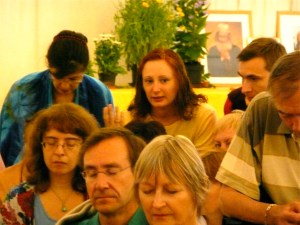
Of the 2000 delegates, there were less than 50 women. Three of us presented; a Moroccan scholar, Dr. Zakia Zouanate, and an American scholar and long-time Sufi friend, Murchida Tasnim Fernandez, and myself.  Several times at the break I was the only woman in the vast, hotel restrooms. The women were a tiny minority, yet

we made our presence felt. I had instant sisterhood with the few women I saw, nodding or introducing myself to Laurence from Paris, Ikram from Fez (in the photo on the left), Hafsa from Scotland, Fatima from Nigeria, Ora from New York.
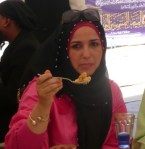
P1090003_2 My poems were translated by Dr. Kostas, as we stood on the stage at the banquet close to midnight Saturday night. Dinner had just ended, but nights in Morocco seem to go on forever. Before I began to read, I thanked the King. (He was absent, but it’s not often you get chance to say, “I want to thank His Majesty, King Muhammad VI for his generosity ….”) Afterward, Dr. Toufiq expressed his appreciation to me for my work on the Mothers of Islam, and told me I was always welcome in Morocco. My friend and fellow poet Abdal-Hayy Moore read his poems as well.The next day, Arabic-speaking delegates called out to me in Arabic, smiled warmly, gave thumbs up or offered me their business cards.

Abdal-Hayy and Tamam: banquet poets

The conference swag was amazing; the women received silver or gold brocade slippers and a stylish silk scarf; the men, an elegant white hooded burnous, a briefcase, leather slippers, an Arabic language Qu’ran, and a beautiful sacred manuscript book.

Because my name ends in a consonant, an Arabic “male indicator,” and my husband’s with the female “A,” our invitations read His Eminence Tamam Kahn and Her Eminence Shabda Kahn. Nice.
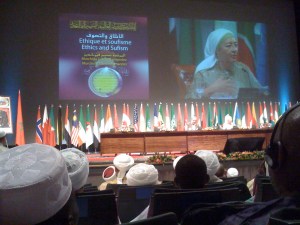
Murchida Tasnim on Sufi Ethics

Murchida Tasnim on Sufi Ethics

On Saturday, the international press was everywhere. I gave two interviews, one to Italian TV and the other to a journalist and photographer from Brussels. You could spot the women reporters in their casual hot weather clothes, while most delegates wore traditional robes called djelabas and some kind of head covering. The Nigerians dazzled – in vivid colored caftans and hats. The day we went to the desert, it was well over 105 degrees and all who went – nearly 2000 of us – ate lunch in tents with ceiling fans and a couple portable ACs. We were there all day. The women staged a take-over and claimed the large tent designated for us and provided with pillows, couches and a computer. Sleepy men left and went elsewhere. At 7:30 we all returned for dinner in a bus caravan accompanied by a police escort all the way into Marrakech, flashing lights and all.

The night before, we were driven to a palm garden just outside the city and entered the circle of tents on red carpets, lined with drummers and men playing long trumpets. We sat in chairs at tables of ten in twelve traditional Moroccan tents placed around a carpeted open space, desert style. The couscous and chicken arrived with a procession of tajine-carrying waiters. After dinner we listened to live Turkish music as the moon rose over the dark palms.

I return with new names and e-mails in my address file, my
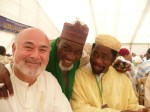
Ahamed, Khalifa, and Sheik Tijani

Ahamed, Khalifa, and Sheik Tijani

luggage perfumed with amber from the souk, and most valuable –the gift of friendship. In this time when most people in the world are withdrawing financial largesse, when programs falter, I was conscious of how generosity on the scale of this event may bring expansion, blessing and God willing, insh’allah, the peaceful benefit of the open hand and heart.

For Italian broadcast of this event and 3 seconds while I answer the question, “What is Sufism?” see:  http://video.sky.it/videoportale/index.shtml?bcpid=1513658495&bctid=29219701001
Marrakech, conference

I’m in the Moroccan desert city of Marrakech, as people from all over arrive. We await the large Sufi Conference sponsored and paid for (airfare, accommodations and meals) by the Royals of Morocco. Sufism in Maroc is a hedge against fundalmentalism, promoting tolerance, inclusiveness and goodwill. It is a mystical tradition, the fragrance from the flower of belief.

We are in a 5 star hotel, and I write from a lobby with fountains and inlaid marble floors. Internet access is patchy, and I sent a few letters from the far corner of the balcony on the 5th floor which overlooks Marrakech, standing in the hot wind in the cooler afternoon, now that the temperature is under 100 degrees. Of course there is airconditioning. I had lunch with my friend Hamza who lives here with his family. Nine years ago he rode on camels with me in the Sahara.

Why am I here? I’ve been invited to read my poetry – from my forthcoming book – at the conference. There are many men, but few women here. It is amazing that anyone could just up and come here with ten days notice. We were in England teaching when we received the formal invitation. So it was easier. Then we were asked on the phone to bring teachers from the Chisti Ruhaniat Sufi Tarika. Cinda Basira and Tansen from England will be joining us Thursday,and Rahima from Germany arrived with us from Berlin. We had breakfast with the Nigerian Tarika. Every few hours more people arrive. I have no idea what will happen. Our good friend Ahamed  – Jonthan Granoff –  just arrived.       Stay tuned. Hu!

Thursday morning, July 9th….

Last night a van drove us to a part of Marrakech I don’t remember at all. At 9 PM we were led through a small, very old keyhole arch down narrow lanes on a soft dirt path. Ancient doors with beautiful detailing appeared in the gray walls on the left and right. Cats. The beginnings of cool air. Then lanterns and a carpet, an open door. Voila! A palace? A restaurant? The ceiling was 4 stories high by American standards, exquisite carved wood. zelige (intricate tile design) walls and white, diaphamous, curtains. We sat at round tables and counted the plates to see how many courses we would eat. A Moroccan ensemble of 12 or so musicians began to play. Bubbley water or plain? Conversation. Prayers before dinner. The Niger / Mali Africans arrived with wonderful headdresses and sat at the next table. We copied them and ate with our hands. They seem like kings. There were maybe eighty of us by this time. More arriving all the time.

Then the olives and eggplant and delicious small dishes, the targe tagine with the meat and apricots, another tagine with chicken, vegetables and couscous. And finally…. fruit.

It was midnight. Ahamed and Pir Granoff wanted to see the square the “square” the Djemaa el Fanaa with the tall  Koutoubia Mosque. I can’t upload any photos, but it was like noon on Saturday in the US. People and bikes and motorbikes were everywhere. Berber boys line-dancing to hand drums. Henna artists, and much to Pir’s delight – piles of cooked snail shells with their occupants steaming in butter.

Today the conference attendees are treated toa visit to the Zawia of Tamslot outside Marrakech. Time for lunch with Khalifa from Nigeria and Shabda. I may not be writing such detailed information now that the conference gets underway. Hu, Hu.

German translation: poetry

IMG_0208The German Summerschool has wonderful translators. I was lucky to have Fatima Be from Zurich, who brought the stories and poems to life in a seamless way. This is the afternoon class I gave for a week, covering the lives and stories of the 7th century women in the household of Prophet Muhammad.
Safiyya’s Sturz

As-salaamu alaykum, rufen sie

und laufen neben dem Kamel her,IMG_0218

Staedter, seine Familie, ausgehungert nach Muhammads

Heimkehr aus der Schlacht! Als sein Kamel strauchelt,

gleitet die Frau aus dem Umhang des Propheten….

Safiyya’s Fall

They run alongside the camel, hungry

for Muhammad home from the rout;

townspeople, his family all shouting,

as-salaamu alaykum! When his animal stumbles,

the woman rolls out of the Prophet’s mantle….

P1080464 During the week of the Summerschool, Natalia sat with the 12 or so Russian speakers and translated all the English into Russian for the classes. She is married to Murshid Saadi and lives in Edinburgh. The number of languages was impressive, as were the variety of countries represented. Prem and Sally were the farthest… New Zealand. Tanzilla is a Bosnian Cultural Muslim.. Gulsina, from Perm, Russia, is a history professor at the university there, in the Urals.
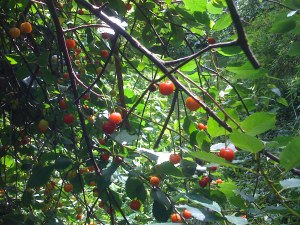

With Summerschool over, we are in the beautiful East German countryside outside Berlin. Nesting storks in the village. We are staying with Rahmana-Rahima in an old parish house next to a cathedral that dates from the beginning of the eighteen hundreds. IMG_0219

It has an immense garden full of apple trees and  fruiting cherries that opens into the fields. 

Shabda and I are preparing to go to Berlin tomorrow and Marrakech, Morocco on Tuesday, where I’ll present poetry at a large Sufi Conference next weekend.

Germany is beautiful, sunsets are after 10:30 PM, and the language still mystifies me!

German countryside: Ruhaniat Summerschool

Proizka Muehle, Germany near Hamburg, deep in the countryside; the birdsongs are dazzling here. Strong and symphonic. The trees are more serious looking than those in the South of England, a darker green and muscular, in order to hold the multitudes of winged singers, the heavy sky.

More than one hundred people are gathered here at the Sufi Summerschool; from Germany, Switzerland, France, Holland, Estonia, Latvia, UK, Poland, New Zealand, Russia, and California. In two hours I’ll teach with a translator, named Fatima, from Zurich. Ten poems have been translated into German for discussion in both languages. I don’t know German and have never been here before, but these poems from Married to Muhammad  have a life of their own– not often the line between two points.

Roethke writes: I am overwhelmed by the beautiful disorder of poetry, the eternal virginity of words… In poetry there are no casual readers.

Songbirds and poppies. Twilight until 11 PM.

Greetings from Germany.

London’s Saison Poetry Library

images

The yellow lift goes up and down in a sleek glass sleeve in front of me. I’m in the Royal Festival Hall lobby with it’s cafeteria and smart modern look. American jazz greats in blow-ups on the wall cycle through a slide show. On the 5th floor is a massive poetry library, The Saison. 5016-4967b94d6da3fThe PR tells me: “The Saison Poetry Library houses the Arts Council poetry collection, the most comprehensive and accessible collection of modern poetry in Britain. The collection, dating from about 1914, consists of most poetry from the United Kingdom and Ireland, a large selection from English-speaking countries worldwide, poetry in translation, poetry by and for children, rap and concrete poetry.” OK I’m going up after I write this.
Today in New British Poetry from Graywolf, I read a wonderful poem by British Poet Gillian Allnut. Here is a brief taste:

96e2bf2f8d2e9e1aa7db7baa216be869_rScherazade

He is languid as a fed lion.

She in her salt and sackcloth gown is gone

into a wilderness of wind at noon

where the wonderful covered well of tales

is a dry waterhole

or a bell

abandoned….

<>     <>     <>     <>     <>     <>

The Lego Poem and Merwin


IMG_0069_2

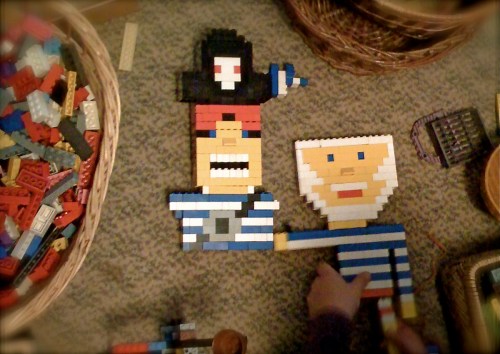
My friends the Oliviers have a massive 40 year old lego collection. On Saturday, Aiden took me upstairs and showed me all of it. I mean he has a lego snake and alligator, a cat and pirates, stuff I’d never seen in my years as a lego mom, the days of flat-out-on-the-rug-building-and-building. I took these photos with my I-camera and started thinking about legos again. I found dozens of You Tube lego film clips, and trivia I never imagined. But the most startling lego info was The Lego Book with Merwin’s poetry. 

getimage.exeTrue. WS Merwin has a poem called “To the Book” contained in a pop-up book called The Lego Poem with inkjet lego designs by Kyung Min Lee. The work seeks to examine “how the interpretation of a language can change the cultural aspect of the poem.” I want to look inside, but I can’t. Here is the picture of the book, though.It is Cloth bound with cut-out windows on front cover. Signed by the artist. Joan Flasch Artists’ Book Collection, 2007, Chicago Il. Then I searched the internet and found the poem:
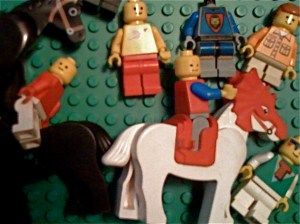


to the book     by W.S. Merwin

 Go on then

in your own time

this is as far

as I will take you

I am leaving your words with you

as though they had been yours

all the time


   of course you are not finished                          IMG_0074_2

   how can you be finished

   when the morning begins again

   or the moon rises

   even the words are not finished

   though they may claim to be


never mind

I will not be

listening when they say

how you should be

different in some way

you will be able to tell them

that the fault was all mine


whoever I was

when I made you up

<>     <>     <>     <>     <>     <>     <>     <>     <>     <>     <>     <>     <>     <>     <>  

Here is piece of poetry legos by Kim Hannula. It’s pretty fine.

The Red Wheelbarrow/ William Carlos Williams                  lego-poetry

So much depends

upon


a red wheel                                        

barrow …                                               


beside the white

chickens.

~     ~     ~     ~     ~     ~     ~     ~     ~     ~     ~     ~     ~     ~     ~     ~     ~     ~     ~     ~     

NOT TO BE MISSED>     The You Tube short in lego-scopic humor “nice pants”  

http://www.youtube.com/watch?v=tlkd45W4TWU&feature=related

+     <>     +     <>     +     <>     +     +     <>     +     <>     +     <>     +     

FOODIE- Legos:

legoeggoHard to believe, but wait, there’s a review from a food critic whose name escaped on a lego truck:
“The shape of each waffle also doesn’t make it ideal for syrup. As we all know, normal waffles have deep grooves which can hold syrup, but the Lego Eggo Waffles have a shape that does the opposite. Sure you could flip the Lego Eggo Waffles over and shoot some syrup into those tight holes, but again, there aren’t enough holes to prevent the syrup from rolling off the waffle.”

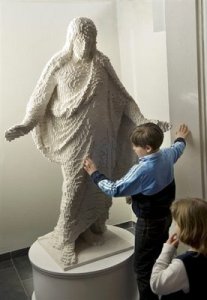
I think this is about as far as I can take this…..  Jesus Lego man

if you have lots of white pieces laying around. Lego blessings to all.   LEGO-jesus3


Lesley Hazleton: the MARY book

IMG_0019

[Sad, painful news in the poetry world! I‘ve been upset, walking around in a gloom after reading about Ruth Padel withdrawing from the Oxford Poetry Chair, perhaps having to do with the road to hell being paved with good intentions. (More on this in the previous post.) I need to write about a British woman author whose words can cheer me up.]

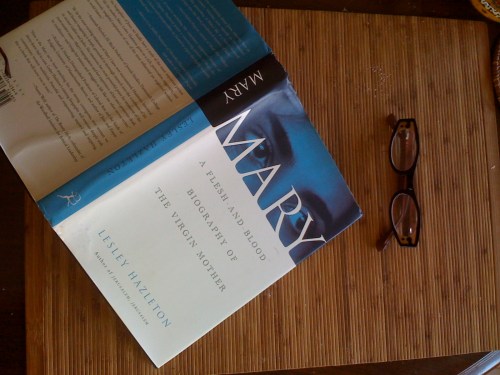
A book to celebrate. It’s my very favorite biography: Mary: A Flesh and Blood Biography of the Virgin Mother. The year: 2004. The author – Lesley Hazleton – rocks!

I didn’t want to put the book down. There may be new books on Mary (referred to here as Maryam), but this is a fantastic read. From the introduction: “There is nothing meek and mild about Maryam. She is neither pale nor passive. Se emerges as far more than we have accepted her as being: a strong woman of ability and wisdom who actively chose her role in history, and lived it to the fullest.” Lesley writes non-fiction as if she were unfolding a page-turning novel on a water slide of words. She wrote as a journalist for a long time and lived in the Middle East. She snoops and story-tracks, burrows and digs into research. She’s a tall, slim, Brit with a voice like Vanessa Redgrave; a former small plane pilot and automotive expert who shared from her book : Everything Women Always Wanted to Know About Cars… on Good Morning America. She says: “Some years ago I spent a starlit night in the sand dunes of the northern Sinai munching on giant olives and listening to Beduin elders recite long narrative poems … This is why we still speak of great story tellers, not great story writers.” Good journalists always drink from the closest source; then one thing leads to another – “Mary…” has 208 meticulous footnotes!tamam photo

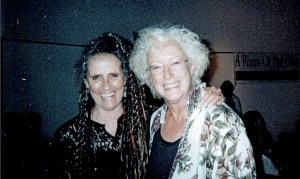
 I meet her at Ghost Ranch near Taos, New Mexico, at A Room of Her Own writing retreat, where she read something from her then soon-to-be-released book, Jezebel: The Untold Story of the Bible’s Harlot Queen. I hope there’s a movie coming from that book.


What I love about Mary is the flesh and blood part. She comes to life. “[She is] – not the gilded image in the convent school, but the wiry, dark-skinned, hard muscled Maryam, barely out of adolescence when she gave birth, her face lined by hard work and harder experience, etched deep by violence and struggle, survival and loss, determination and courage.”

 From a review  in Amazon: “Hazelton’s musings on the Resurrection and on the meaning of Mary’s virginity are dazzling to read and weighty to ponder.” Ilene Cooper

 “Each time a woman gives birth, each time a woman sits between another’s legs and cradles the emerging newborn’s head, each time a woman sings in joy or wails in mourning, seeks out knowledge or teaches it to others… the mantle of Maryam is handed on.”  (All italic quotes from Mary)

<>       <>      <>       <>      <>       <>      <>       <>        <>       <>      <>       <>   

Carol Ann Duffy: Poet Laureate of UK


IMG_0931

Difficult times for Ruth Padel! The Guardian posted shocking news yesterday, May 24th, saying that Ruth Padel had withdrawn from her Poetry Chair at Oxford due to the continued controversy around Derek Walcott’s nomination. One version of the troubling report can be read here. I send Ruth my support and wishes for ease IMG_0963in finding her way on this rocky road …………………………. http://www.guardian.co.uk/books/2009/may/24/ruth-padel-derek-walcott-oxford-poetry  
(My earlier post – last week)  ~How sweet it is! Poet Laureate, and The Oxford Poetry Chair are both now occupied by women. The first position is for ten years, the second, five. The poets are Carol Ann Duffy and Ruth Padel; amazingly good writers. I’ve written here about Ruth Padel and reviewed her book, Darwin: A Life in Poems – [see entry for April 9, 2009]. YES for the Brits. Truthfully, I’m getting ready to spend a short time in London, so I’m reading New British Poetry from Graywolf Press, 2004. Here’s a few lines from Carol Ann Duffy from her playful nod to Little Red Riding Hood, Little Red-Cap:

…He stood in a clearing, reading his verse out loud

in his wolfy drawl, a paperback in his hairy paw,

red wine staining his bearded jaw. What big ears        duffy140x84-1

he had! What big eyes he had! What teeth!

In the interval I made quite sure he spotted me…


…you might ask why. Here’s why. Poetry.

The wolf, I knew would lead me into the woods…

<>     <>     <>    <>     <>     <>    <>     <>     <>

Some words On Carol Ann Duffy from the Press:

“It only took 341 years but, finally, Britain has a female Poet Laureate. Carol Ann Duffy will hold the 10-year post, following in the formidable footsteps of the likes of William Wordsworth, Alfred Lord Tennyson and Ted Hughes. Glasgow-born Duffy, 53, said she had thought “long and hard” before accepting the high-profile job, and gave the final say to her 13-year-old daughter [Ella]. Her response? “She said, ‘Yes mummy, there’s never been a woman.'” Glen Levy, Time Magazine, May 1, 2009.

“Duffy lives with Ella in south Manchester, in a house where the doors are painted with poems – William Carlos Williams on eating plums is on the kitchen door. From here, she can walk to the (remarkably rural) River Mersey, where she wrote most of Rapture sitting on a bench. She says her writing tends to be seasonal, with her ‘sharpening my pencils in September when it starts to get a bit rainy and melancholy and moody. Then I write until about February, until it begins to fall away in the spring.'” The Guardian, May 26, 2007.

THIS IS THE POEM that I love. See for yourself. “acred in hours?”  Oh. Beautiful.

A Child’s Sleep

I stood at the edge of my child’s sleep

hearing her breathe;

although I could not enter there,      IMG_0933

I could not leave.


Her sleep was a small wood,

perfumed with flowers;

dark, peaceful, sacred,

acred in hours.


And she was the spirit that lives

in the heart of such woods;

without time, without history,

wordlessly good…..


                     …The greater dark

outside the room

gazed back, maternal, wise,

with its face of moon.

~          ~          ~          ~         ~          ~          ~          ~

Jamaica Osorio: Hawaiian poet at the White House

Jamaica Interview

May 2010:  Jamaica interviewed by  Henry Curtis

May 2010: Interview (above). I love seeing Jamaica draw from her grounded Hawaiian roots, to shine as she holds her place as a strong American woman poet. This is a very good interview — watch it!

<><><>


November, 2010 — Jamaica just posted this:


May: 2009 <> What happens to the ones forgotten? The ones who shaped my heart from their rib cages, I want to taste the tears in their names…but I    have forgotten my father’s own grandparents middle names, forgotten the color thread God used to sew me together with… I want to teach my future children how to spell “family” with my middle name, Haiole-Melekalani…

art3b

Scroll down for the link to Jamaica’s recitation of her interpretation and inspiration of Kumulipo, the Hawaiian chant of creation, all its inclusion of first life and stars, and the endless

geneologies of self and peoples, self and lands, of earth and sea and sky; spoken  at the White House.

Describing how President Obama approached her in the reception line, she recalled: “He said, ‘You’re the girl from Hawai’i.’ … And it was so amazing that I said I was from Pālolo Valley, (O’ahu) and he could actually nod his head and smile, because he got it,” said the elated 18-year-old, laughing as she savored the notion that the nation’s leader was born and bred just one green valley away from her home. “Mostly when I tell people I am from Hawai’i, they have no idea what’s going on here.” Liza Simon for Ka Wai Ola Newspaper..   http://www.youtube.com/watch?v=TY7fWlmE-0g&eurl=http%3A%2F%2Fochairball.blogspot.com%2F2009%2F05%2Fjamaica-osorios-spoken-word-performance.html&feature=player_embedded

pic.php

This You Tube video http://www.youtube.com/watch?v=d54xhGzwM50 of her from a slam, has Jamaica and another poet giving the Hawaiian and English nearly simultaneously, in a telling of traditional stories with a fresh new slant. Her face and her words call up  deep ancestry.

Standing on the stage at the White House, she spoke her poetry: There is a culture, a people somewhere beneath my skin that I’ve been searching for… After she was congratulated by President Obama, she said that it was humbling to have her words acknowledged by him. Congratulations, Jamaica! Aloha!

NEW SITE!!  (2010)  http://www.youtube.com/user/eJAMAICAtor

GLORIOUS POEM posted 2009 August,  http://www.youtube.com/watch?v=5HFY1s2g070

<>   <>   <>   <>   <>   <>  <>   <>   <>   <>   <>   <>  <>   <>   <>   <>   <>   <>

mothers, grandmothers, and THE SOUND.

P0000075A Mothers Day: this is my favorite ancestor photo, my mother’s mother – Dellie – in a theater production at the turn of the century. I like to think some of her colorful qualities have coursed down in vivid matriarchal streams through my mother, my sister and me, and through all my god-daughters and my niece, Tiphani, and cousin Cici.  My adopted mothers of this and that;

<>Ella Fitzgerald is the mother of  how a woman’s voice can play with the air, bounce it, even.

<>Helen Hayes is mother of my first carnival midway prize, and mother of what a woman can do on the big, broad stage of life.

<>my great-aunt Marie was mother of the high life, champagne and room-service, elevators to her room.P0000095A_2

My own mother (in her wedding dress) gave me her leather-bound Poems of John Keats, with pages cornered on some of the odes: “Heard melodies are sweet, but those unheard/ are sweeter…”

I was my own earth-mother, taught myself to garden, pulled those first carrots, got a cat for the gophers. I became mother of the cat, named Alice. We lived in Nicassio. Band mother, pregnant with tunes and moves, and after some time – the guitar-players’s child!  Flower-child mother. Peace mother.

Oh Mother!

~          ~          ~          ~        ~          ~          ~          ~

This is the last issue of THE SOUND in the awkward morphing moment between the PDF and an elegant Web-journal at thesoundjournal.org Planned launch around July 20, 2009! Watch for more information.

Here is the May Issue: “HONORING THE MOTHER.”   You can download it here