• About Tamam
  • Poems
  • NEW BOOK! Reviews & Praise
  • UNTOLD: Book Trailer & Blurbs
  • Fatima’s Touch
  • Reading Schedule

CompleteWord

CompleteWord

Category Archives: Uncategorized

Ramadan & Reading The Qur’an

03 Wednesday Aug 2011

Posted by Tea-mahm in Kazim Ali, Morocco, Ramadan, Sufi, Uncategorized

≈ 2 Comments

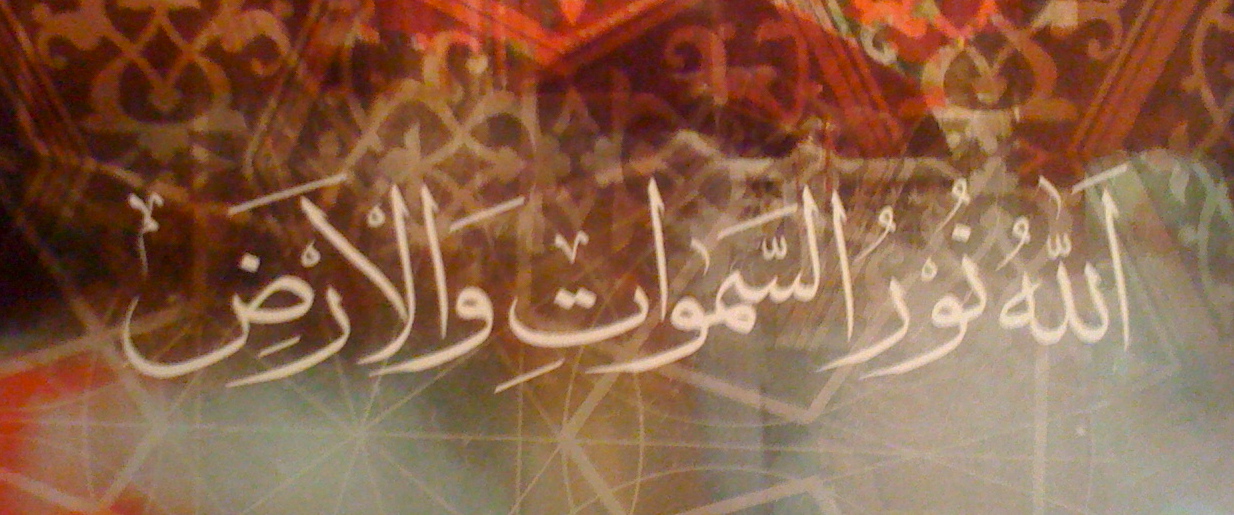
God is the Light of the Heavens and the Earth
Q: 24,25.
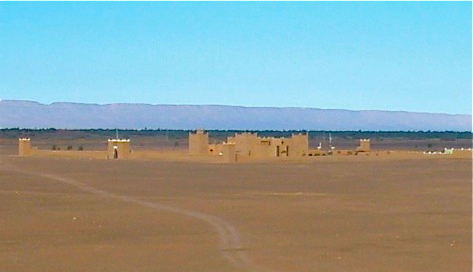
the Sahara Desert near Zagora, Morroco

I’m attuned to Ramadan – and the vast community which is marking the journey of the moon – by going toward this season’s blessings  so apparent to me! I intend to fast from separation from myself, my community, and from the Spirit of Guidance. I do not participate in the food fast. The Quranic verse that I picked on day 1 was Q: 3:84, the one that mentions Abraham, Moses, Jesus,  and others, and says we make no distinctions between any of them. I thought I’d pick a verse every day, but I’m still on that one. I wrote it out in Arabic and went back and forth with my lexicon. My Arabic is very rudimentary, but I love how it feels to pass behind that language curtain. The visual beauty of the letters holds me every time. [See the line from the Verse of Light at the end of this article.]

I’ve always liked the universal implications of this “no distinctions” verse.  Yesterday I was caught, netted by ’unzila ‘alayna from one of my favorite verbs NaZaLa. It us translated as “bestowed upon” but the root has a couple pages of definitions: descend, dismount, alight, go down, come down, dwell. Tanziil means revelation, a rain of blessing. The action seems to be coming from the outside. For me, the “God’s Throne” is inside, in my heart. So this is a curious transmission from the Infinite to finite understanding – all inside my Being, which is God’s Being. The translation goes: Say: we believe in God and what has been bestowed on high upon us, and that which has been bestowed upon Abraham, and Ishmael, and Isaac and Jacob and their descendents… Moses, Jesus and the other prophets: we make no distinction between any of them. And unto God do we surrender ourselves. <>  <>  <>

banner: "COEXISTENCE"

Michael Sells writes: “…Qur’anic Suras are at their most compelling when the exact relationship of one statement to another hangs in a balance, and instead of freezing into some clearly definable meaning, continues to resonate and pose questions that only a lifetime of searching can answer.”* *note: Approaching the Qur’an, by Michael Sells p. 27.

Part of this month of  mornings for me is a piece from Kazim Ali’s new book of journal entries, Fasting for Ramadan Tupelo Press. He is a favorite poet who has a chapter of his own sparkling reflections from each day of Ramadan. Here’s one I like:

Sixth Day: “…I love as well the cold needling rain of spring and the autumn drizzle so thick you can’t feel it but arrive home thoroughly soaked.

The soaking, I think to be covered, suffused, bathed, owned, by something you didn’t even know was around you.

I love the mysteries and the inexplainables. The Kaaba –– black house of God, called the Near Mosque, circumambulated by millions, determining the direction of Muslim prayers, the cube at the heart of the Masjid-e-Haram –– is empty inside.” <>

Best of all, this season –– I appreciate the “A-ha moments. May you enjoy many. Ramadan Karim!

God is the Light of the Heavens and the Earth

the Islamic Cultural Center, Oakland: Hadith talk

18 Monday Apr 2011

Posted by Tea-mahm in ICCNC, Mayor Jean Quan, Sufi, Uncategorized, Untold

≈ Leave a comment

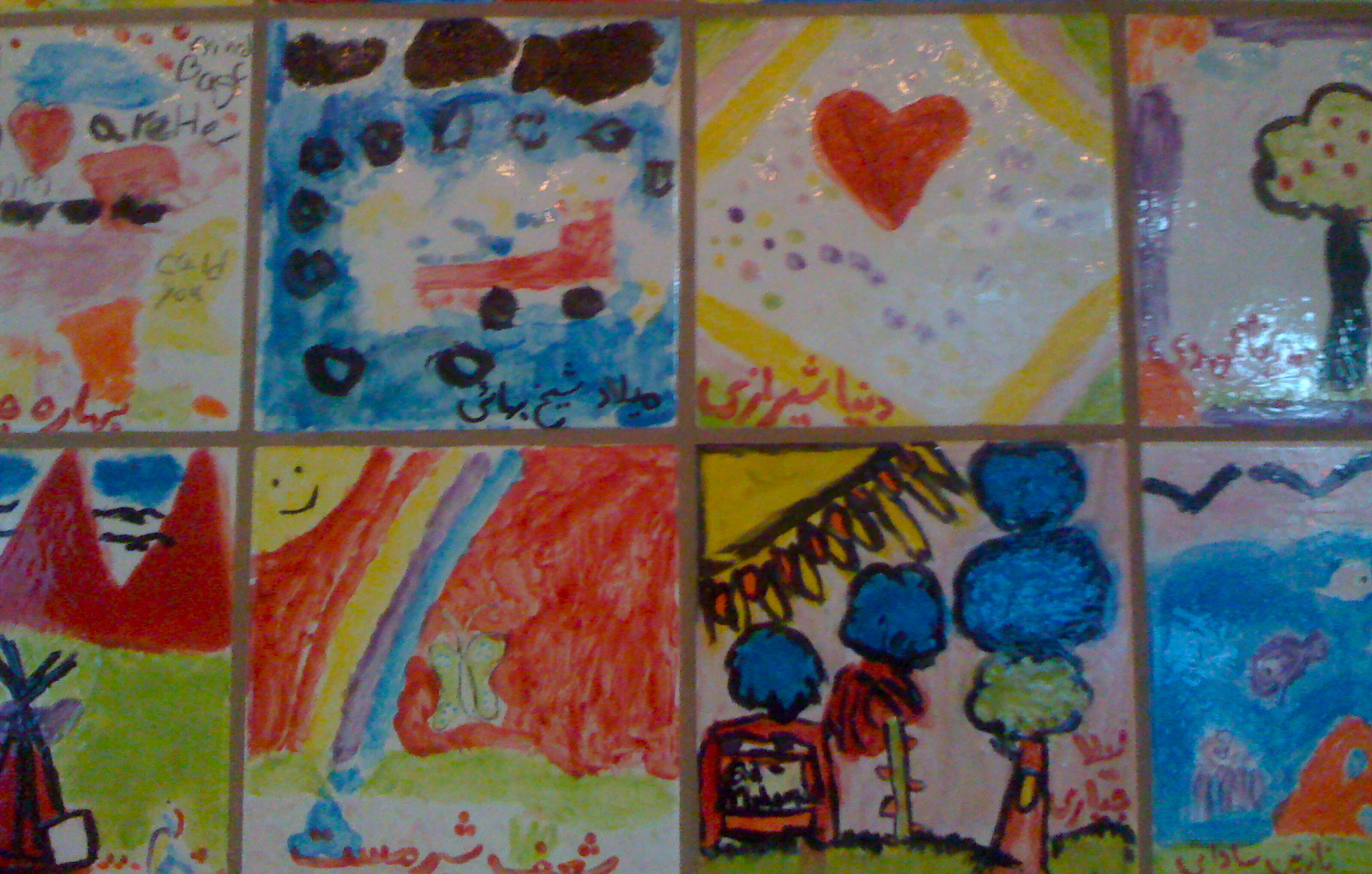
children's art: Islamic Cultural Center

A comprehensive book on HADITH in an easy-to-read format. That is, the transmissions of what Prophet Muhammad did and said. This was compiled and written down centuries ago and is now revisited by an American man born in 1977. I ordered the book and then went to hear him speak.

Jonathan A.C. Brown

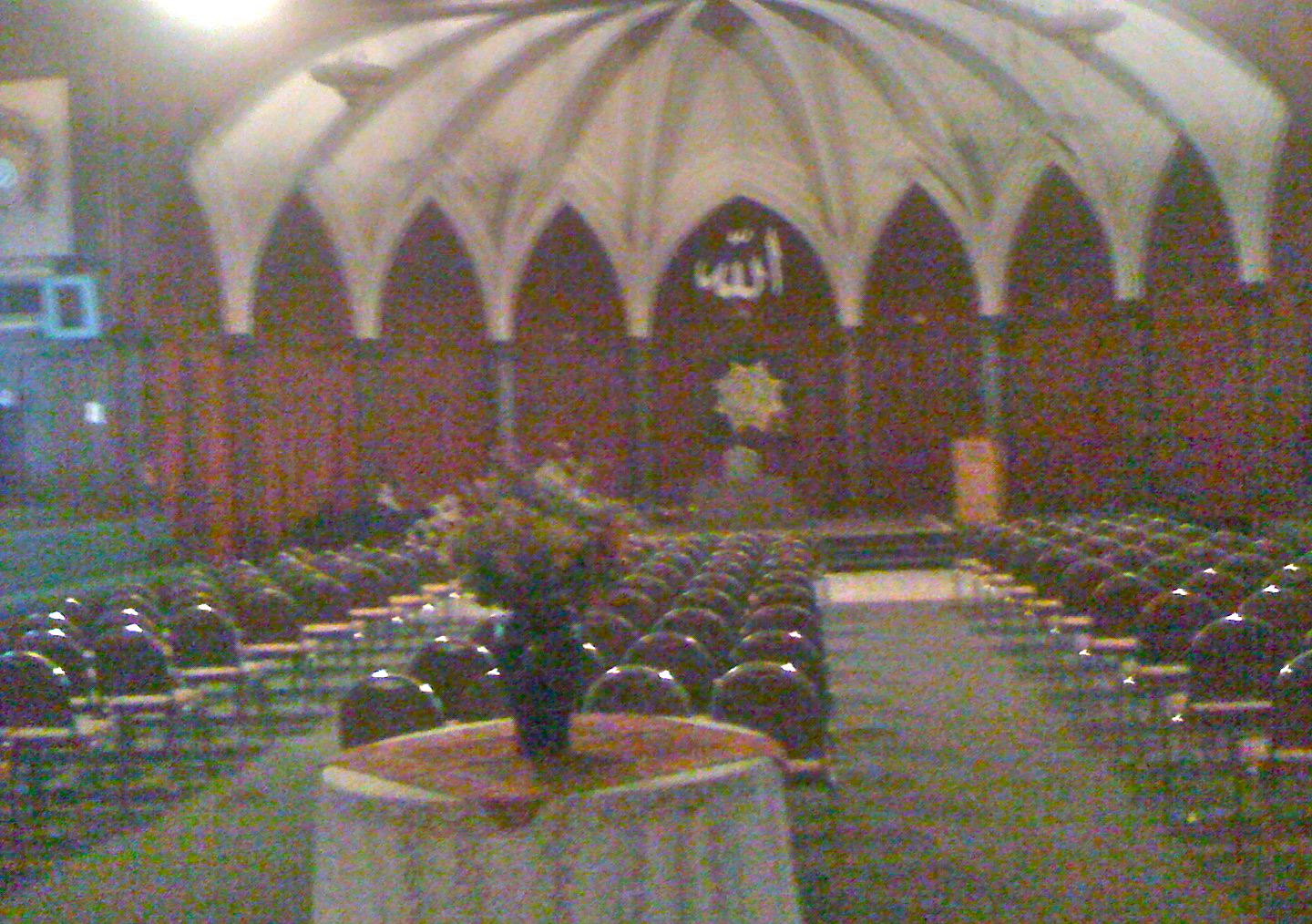
Jonathan A.C. Brown was invited to the Islamic Cultural Center of Northern California (the ICCNC), an impressive building near Lake Merritt in Oakland. I had never been there.

main hall ICCNC

An old Maonic Lodge, what a cool place!

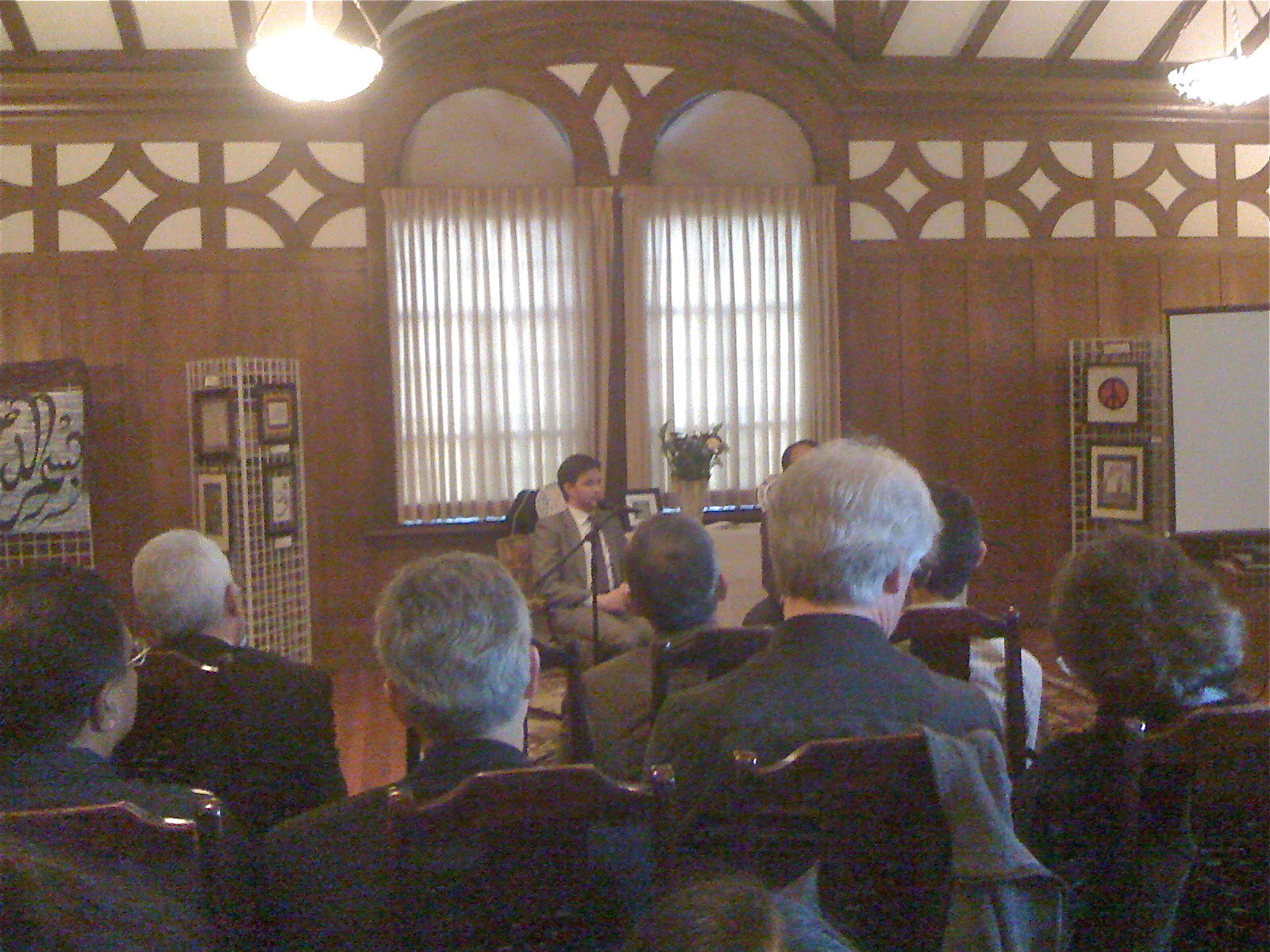
Hamza (Jason van Boom) is Director  of Developing and Marketing for the ICCNC and interviewer for the series: Islam and Authors.  Sounds promising; Islam and Authors.  I like the sound of that series. Hamza said they are considering my book, UNTOLD for a future talk.

Jonathan A.C. Brown, assistant professor of Arabic and Islamic Studies at the University of Washington, is fluent in Arabic, Persian, Urdu, Latin, French, and German. He studied Arabic in Cairo Egypt, has a Ph.D. from University of Chicago and a magna cum laude Bachelor of Arts from Georgetown University.

Brown's talk on Hadith In his talk Brown said, “The real discourse in Islam is what you do with the hadith. Look at it as something alive even if you don’t agree with it (a particular hadith).”

I liked this: “Imagine you are talking for 23 years and someone kept track of what you said.” That describes the context for the hadith quite well. It would follow that there would be contradictions, as happened with Prophet Muhammad.

I look forward to reading this book, Hadith, Muhammad’s Legacy in the Medieval and Modern World, Oneworld (Foundations of Islam series), 2009. Chapter seven is about Hadith and Sufism.

~After the talk my friend Hadia and I went to Pho 84, a small Vietnamese Restaurant on 17th street.

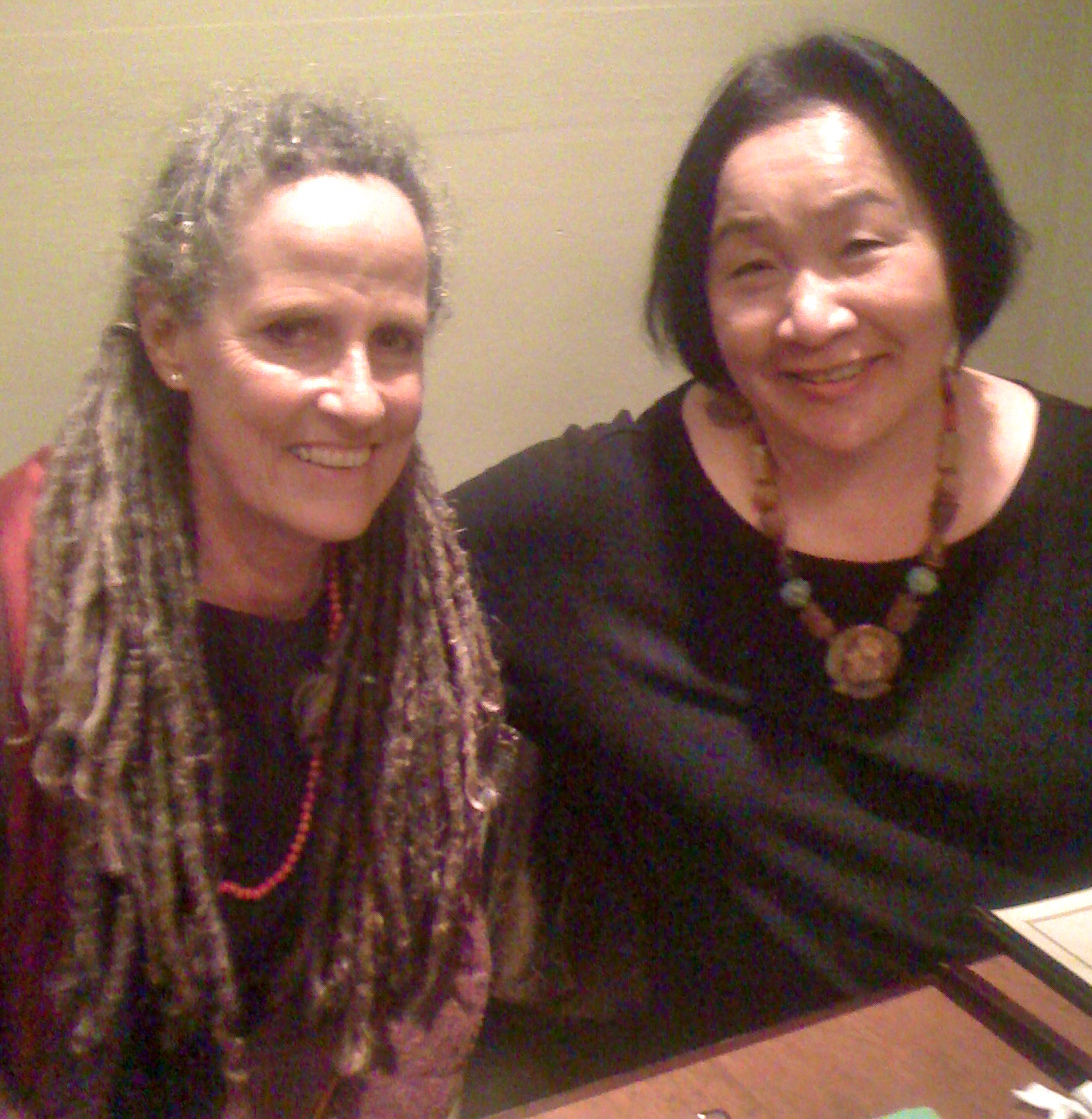
with Her Honor the Mayor

Mayor Jean Quan  and her husband Floyd Huen and a congressman arrived. I introduced myself, and Floyd took the photo of me and  the first woman mayor of Oakland ­– a no-nonsense, friendly person. I wanted a photo to go with the one I have with Mayor Gavin Newsom of SF!

I enjoy the quirky randomness of attending a serious lecture in a city just an hour from my home and ending the evening with Hadia discussing the good old days in Maroc –– then a photo–op with the Mayor of Oakland.

Life is good. <>

The Good Wife’s Guide – 1955

19 Saturday Mar 2011

Posted by Tea-mahm in Uncategorized

≈ 6 Comments

My friend had this article on his fridge, suggestions from the Housekeeping Monthly, 5/13/55. Before you read know –– this is America, the land of the “good wife.” Warning: This may make you queasy.

The Good Wife’s Guide

“Have dinner ready. Plan ahead, even the night before to have a delicious meal ready, on time for his return. This is a way of letting him know you have been thinking about him and concerned about his needs…

Prepare yourself. Take 15 minutes to rest so you’ll be refreshed when he arrives. Touch your make-up, put a ribbon in your hair and be fresh looking.

Be a little gay and a little more interesting for him. His boring day may need a lift and one of your duties is to provide it…

Prepare the children. Take a few minutes to wash the children’s hands and faces (if they are small), comb their hair, and if necessary, change their clothes. They are little treasures and he would like to see them playing the part. Minimize all noise…. try to encourage the children to be quiet.

Be happy to see him.  Great him with a warm smile, and show sincerity in your desire to please him.

Listen to him. You may have a dozen important things to tell him, but the moment of his arrival is not the time. Let him talk first – remember, his topics of conversation are more important than yours.

Make the evening his. Never complain if he comes home late or goes out to dinner…  without you. Instead, try to understand his world of strain and pressure and his very real need to be at home and relax…

Make him comfortable… Have a cool or warm drink ready for him. Arrange his pillow and take off his shoes. Speak in a low, soothing, and pleasant voice.

Don’t ask him questions about his actions or judgment or integrity. Remember, he is the master of the house and as such will always exercise his will with fairness and truthfulness. You have no right to question him.

A good wife always knows her place.”

aimed straight at his heart...

hmmmmmmmmmm………

With this ethic published in the USA within my lifetime, who are we to criticize other cultures? How dare we take a critical view of patriarchal societies? At the same time, American Women, you’ve come a long way!

May liberation from this blatant sexism reach women everywhere! <>

Sally Magdy Zahran ~ 1988-2011

10 Thursday Feb 2011

Posted by Tea-mahm in Announcements, Events, Naomi Shihab Nye, Poetry, Sally Magdy Zahran, Uncategorized

≈ 3 Comments

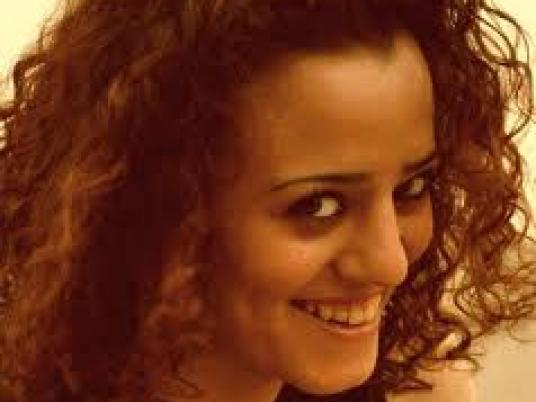
Sally Magdy Zahran

…I would smooth your life in my hands,

Pull you back. Had I stayed in your land,

I might have been dead too

For something simple like staring

Or shouting what was true….

Words from  a poem by Naomi Shihab Nye “For the Five-Hundredth Dead Palestinean, Ibtisam Bozieh”

It’s one thing to see videos of the square in Cairo, but another to put a face to the violence which flashes like a lightning storm here and there, taking precious human life.

There is just one letter in Arabic that separates the words “witness” and “martyr.” Let’s imagine Egypt as a country of witness for democratic change instead one whose streets splash red with the blood of martyrs!  ~May it be so.

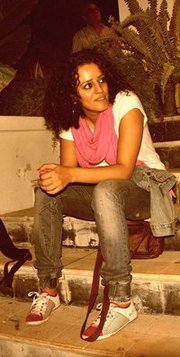
I stared at the vibrant photo – the face of Sally Zahran, age 23, smashed on the back of the head with a baseball bat in Egypt on Friday evening, January 28th by political thugs. That would be Friday morning California time, during the time I drove to the hospital to visit my husband who was recovering from surgery. Or maybe I’d arrived and bent down to kiss my living, breathing beloved (who grows stronger every day.)  My attention was not in Egypt.

Sally grew up in Cairo and was working as a translator there. During the unrest she had traveled far south to Sohag, where her father is a university professor. The small city on the west side of the Nile gets 3,804 hours of sunshine a year according to Wikipedia.

She was never an activist, and had not taken part in political protest. Sohag has both Coptic Christians and Muslims. Magdy may be a Coptic name, connecting Sally to this tradition which links to Prophet Muhammad  by means of his beloved Mariya, the Copt, mother of his son, Ibraham.

“She felt it would be safe to join the protests. So many others were going out on Friday,” said her friend Aly Sobhy.  “She was loved by all who knew her.”

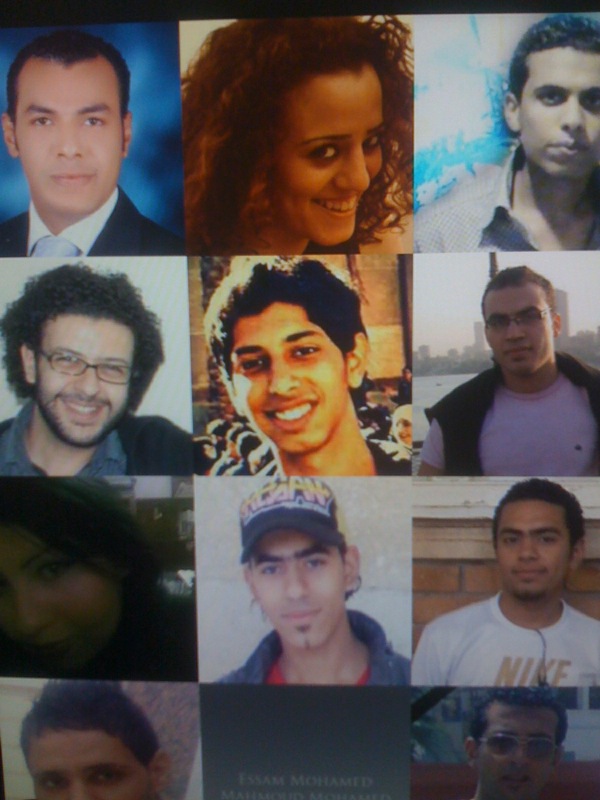
some who have died in Egypt

See “Egypt Remembers” page on line:  <http://1000memories.com/egypt> shows photos and a word or 2 about the dead – nearly all under the age of 30, now martyrs to the cause of democratic change in Egypt.

May this terrible situation be resolved soon.

<>   <>   <>

Lesley Hazelton – the Qur’an – with standing ovation

06 Monday Dec 2010

Posted by Tea-mahm in A History of the Wives of Prophet Muhammad, Lesley Hazelton, Uncategorized

≈ Leave a comment

I have rarely anticipated a video, no – I have to say NEVER looked forward to a video more than this one! Let me take you back to the middle of September. I was in Seattle on my book tour, and was invited to spend an evening with author Lesley Hazelton at her houseboat on Lake Union. While preparing a soufle, my friend read me the script she was working on for this nine-minute talk to the forthcoming TED x Ranier event at Seattle’s elegant Benaroya Hall on 10/10/10. She is speaking on the Qur’an. As of today, this video has more than 114,000 hits on youtube!

The Qur’an seems to magnetize more twenty-first century misinformation, rage, and fear than any other book. I have been among those people –non-Muslims as well as Muslims – who long for well-considered, intelligent, subtle, as well as universal thoughts on this sacred Scripture. It is a puzzle to so many of us.

Lesley draws us into her discoveries, confronting the stereotypes: “Part of the problem, I think, is that we imagine that the Qur’an can be read as we usually read a book, as though we can curl up with it on a rainy afternoon with a bowl of popcorn within reach as though God …were just another author on the bestseller list.”

She set about reading four English translations side by side, with a transliteration and the original Arabic. “Every time I thought I was beginning to get a handle on the Qur’an, that feeling of ­– I get it now! – it would slip away overnight, and I’d come back in the morning wondering if I was lost in a strange land.”

She speaks of paradise. Forget the virgins. “It’s fecundity, it’s plenty. It’s gardens, watered by running streams.” Her delightful and brilliant talk is received with – yes – a standing ovation.

May the way open for careful, and respectful discussion of this sacred book. I invite you to join me in spreading the word of  lesley’s excellent video.

Lesley Hazelton

Lesley Hazelton is author of several books including After the Prophet, the epic story of the Shia Sunni Split and Mary, A Flesh and Blood Biography of the Virgin Mary. Visit Lesley’s blog: < http://accidentaltheologist.com/

Untold and After the Prophet are both discussed here on Bill’s Faith Matters” weblog Kansas City Star:

<http://billtammeus.typepad.com/my_weblog/2010/12/12-1-10.html>

Author Interview

01 Wednesday Dec 2010

Posted by Tea-mahm in Uncategorized

≈ 2 Comments

Monkfish Publishing House interviews Tamam Kahn on her new book:
Untold: A History of the Wives of Prophet Muhammad

Q: What prompted you to write about the wives of Muhammad?

Tamam Kahn: As I traveled in North Africa and the Middle East, I felt authority and earthy power from the women who recited sacred words and sang poetry about Muhammad and his family. I wanted to discover if Muhammad’s wives had that same fierce, elegant energy. I began to read about them. I found that – according to traditional history – they did.

Q: Why do you feel this information is valuable or necessary at this time? What does it have to teach us?

Tamam Kahn: This book is meant to balance History and Her-story.  My wish is that the women in these pages may emerge as vivid individuals vocalizing the first years of what came to be Islam; that they will replace the stiff and submissive stereotypes the media often displays. In this book, we see that Muhammad was married to women born into Jewish, Christian and pagan faiths. “Untold” may inspire us to be curious and keep a flexible attitude, and if we do, we may discover all people have the same hopes, dreams, fears, and disappointments.

Q: Do you consider yourself a Muslim?

Tamam Kahn: I would call myself a spiritual seeker who regards Islam as the path of peaceful surrender to the One. For me, a Muslim is a person who walks that path. This was the “Islam” embraced by the women I write about. I am a follower of the Message of Divine Unity as exemplified by the great Sufis such as Rumi, Hafiz, and Rabi‘a of Basra. They carry a sacred outlook not limited to the form, the time, or the place.

Q: How have Muslims responded to your research and publication?

Tamam Kahn: A California Muslim woman hosting a local radio show wrote me that Untoldbrought these women to life in a way that no standard biography did. Through the poetry, she now imagined them as real flesh and blood women who were courageous, jealous, and fierce – in a very human way. For those who question my right to write about the Prophet’s wives, I would say I have great respect for each woman and admiration for the life they shared. That respect has opened doors that made this book possible.

Q: Does your book have a message for Muslims?

Tamam Kahn: As-salaam ‘alaykum. This book greets you on the path of peace. Come and enjoy the stories of your Prophet and his family.

Q: Does your book have significance for non-Muslims?

Tamam Kahn: This book is about a forgotten piece of history that needs to be brought out and honored. But for me it is not about Muslim and non-Muslim. It’s about our human family and the strength of women. This book may bring ease to a mother whose children attend school with Muslim children, the shopper served by a grocery checker in a scarf, the office worker whose boss has a Muslim name. CNN tells us that nearly one in four people in the world today is a Muslim, although Fox Network said it was one in five.

Q: How has the process of researching, writing, and publishing Untold changed your life?

Tamam Kahn: I’ve spent my life changing my life, so this is just another chapter.  There is a big difference between holding a manuscript and reading from your own book. This book seems to have “a life of its own.” I feel like I’m just tagging along. The directive that these women need to be known is an important one. From the opening poem: “I am here with a message: conversation with these women will never end.”

Q: Can you tell us about the research for Untold?

Tamam Kahn: I was hooked as soon as I began to read contemporary authors, Karen Armstrong and Martin Lings. From there I went to the oldest sources such as Ibn Ishaq. I traveled to Syria and received my own library card from the Al-Azar National Library in Damascus. When I’d researched and written a few chapters, I met with Islamic Scholar Arthur Buehler back in America, and he was moved by what I was doing and offered to help, not only by correcting the Arabic, but also suggesting early scholarly material that was respected in the genre of what is called “the hadith literature.” In that way I had the advantage of an academic checkpoint.

Q: Talk about the form you use in this book – narrative prose interspersed with poetry.

Tamam Kahn: At one point I had seventy poems and notebooks of research on the wives and daughters of Prophet Muhammad. I thought I’d find someone to write the back-story. I asked the wonderful master writer and Poet Laureate of North Carolina, Fred Chappell, what he would do if he were in my place. He suggested a “prosimetrum.” No one I knew was familiar with that term. It was used by Boethius in the fifth century – in his Latin Consolation of Philosophy. Boethius placed poems – each like a tiny well – in the prose narrative thread. The Consolation influenced Western Medieval thought, Dante and Chaucer. The form is generally not in use today, but it served my purpose beautifully!

Q: Who should read this book?

Tamam Kahn: This book is for anyone who wants to transcend stereotypes about Islam. Untoldpaints this early history with a bold, broad stroke, including Prophet Muhammad’s close and colorful contact with Pagan, Jewish, and Christian women who became his wives. Like Reading Lolita in Tehran, Untold depicts Muslim women in a new light, with focus on their intelligence and creative outlook. Book clubs will find this is an optimistic book that empowers women –– the ones who are in it and the ones reading from it! After studying Untold in an Islamic Studies class, one student was inspired to write a term paper about the first wife, Khadija. I leave a trail of research markers, so the book can be enjoyed as simple biography or questioned and investigated further.Untold is for people who discover that they want to know –– who are these women?

For more information or to arrange an interview with Tamam Kahn, please contact: Linda Woznicki at 845-417-8811 or linda@monkfishpublishing.com.



The South: On The Road

11 Thursday Nov 2010

Posted by Tea-mahm in Uncategorized

≈ 1 Comment

I am on the road, in a southern state, in the perfect autumn moment. Sky is blue and the leaves are wearing exciting colors. If I stand still and look up, I can watch them let go and dance down. In the 10 days I am here, I will drive 800 miles and visit 4 bookstores. Two down, two to go.

A few days ago I parked in front of a very large chain bookstore, took my briefcase and purse, and opened a tall glass door. Inside it looked like a cross between expo concourse, university library, and Whole Foods. I stopped eating ice cream a few years ago, so bookstores like this bring out my sorbet sensibility. I can almost taste the delicious, shiny covers.                                                     

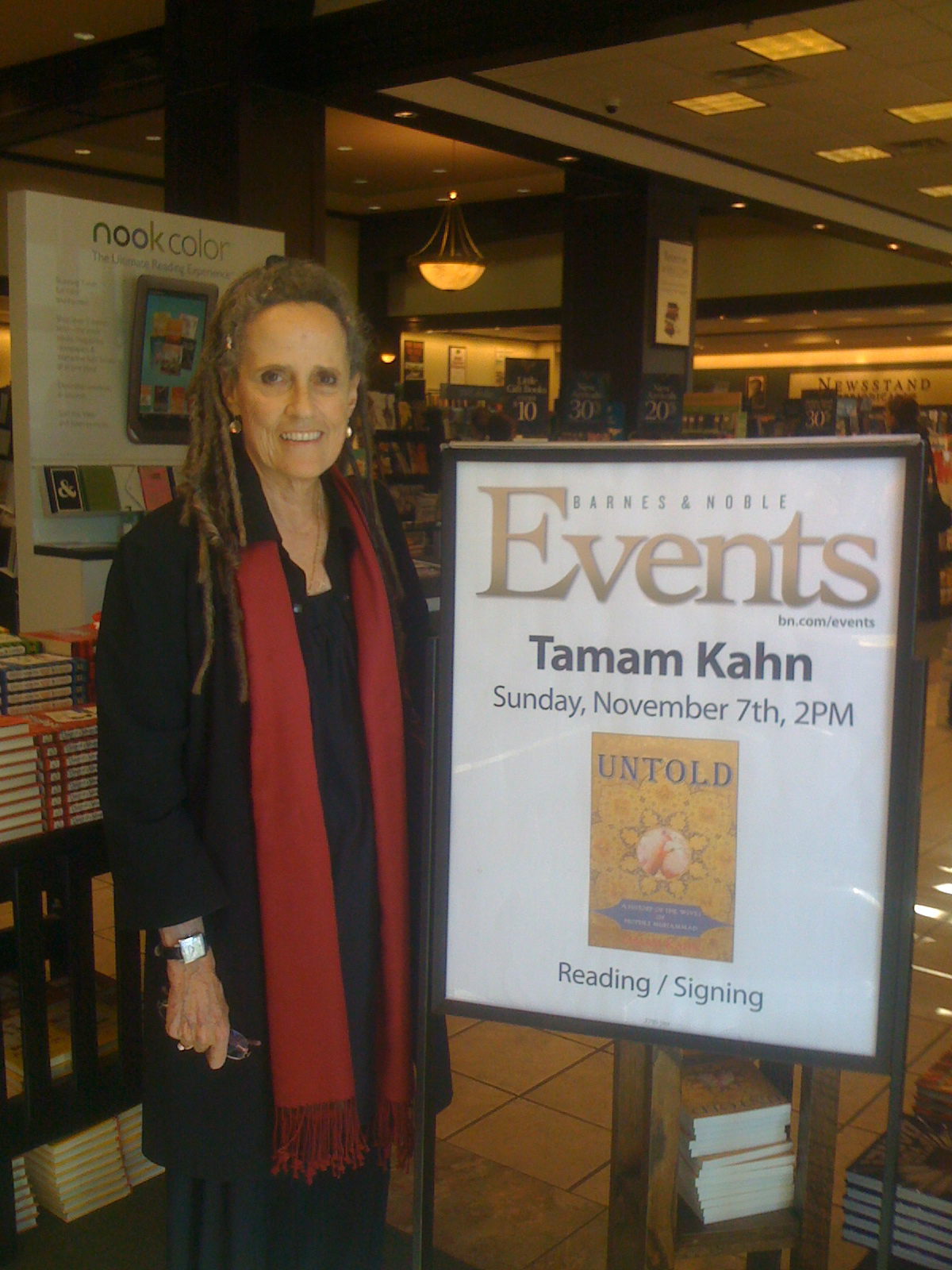
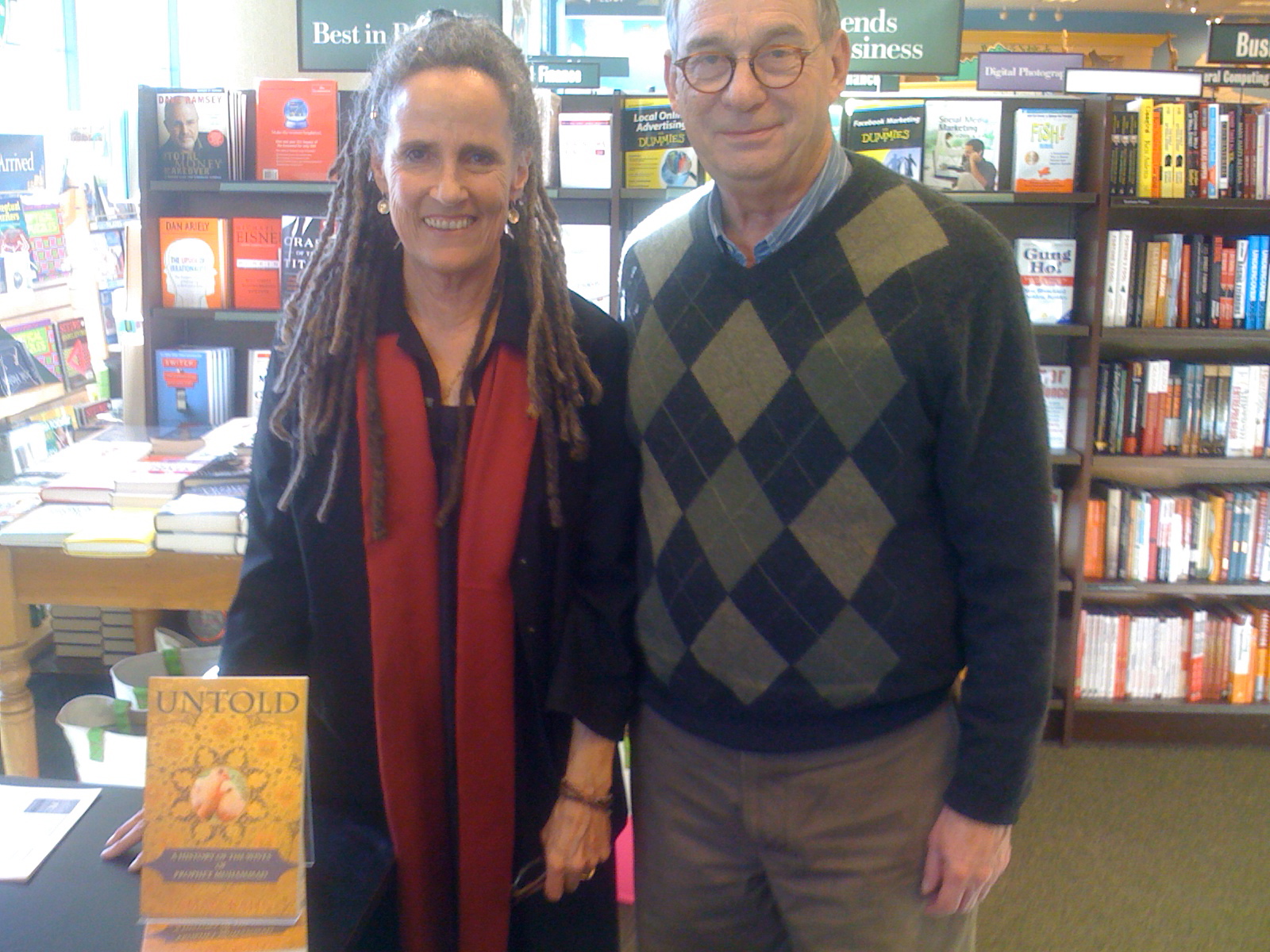
There were long isles of fiction and non-fiction, a large children’s section and food court. It was Sunday afternoon. As I passed the information booth a woman’s voice called out, “Tamam?” I turned to meet Cheryl, my host, who recognized me from my photo. In the next 20 minutes, after stashing my coat and briefcase (one of the perks for bookstore-presenters) I browsed, glancing at the display of my book and the twenty or so white chairs.  Every now and then an elderly person would sit there to rest. I am a lucky author. At least 18 people have come to each of the dozen or so readings of Untold so far. But what if no one shows up, and my friend – once State Poet Laureate and prize-winning author – has no one to introduce me to? Cheryl smiled at me again. “Things run late in this town,” she said, soothingly. Suddenly it was happening. Fred arrived with friends and the first two rows filled up. A couple people sat in the back. Fred introduced me on the wobbly mic. I stepped up to the lectern and tossed out the “raisins” of information about the book and my life. I read some poems. The audience was smiling. They asked good questions. They were still smiling. Sarah Lindsay, an enormously gifted poet grinned at me. I signed books and hugged Cheryl good-by. <>

A few nights later, I drove an hour and a half to a well-known indy bookstore. But, it was Amy Sedaris Time and the place was papered with the delighted news of her performance and reading event the next evening. Her book, Simple Times, Crafts for Poor People was a sensation or she was a sensation or both. The $10 tickets to her event were going fast, and Dave, the man who was to introduce me was quite busy with that, and the downstairs was crammed with chairs and a kind of balcony with a lectern and a hefty mic. I hastily put up the PR that my publicist had sent the store, and scribbled “tonight!” on it, then left for early dinner.   Dave moved the lecturn down from the stage and introduced me. He was kind and helpful. The handful of attendees moved closer to me and the reading began. A smart and attentive fifth-grade girl named Aliya was listening to every word.  I felt deeply honored.

Each of these events is such a unique opportunity to speak to 5 or 40 people, to smell the books and appreciate the kind attention of the bookstore staff, the generosity of my friends and curious passers-by. I am surrounded by thousands of books for an hour. They don’t make a sound.  For those of us that love bookstores, this is reward enough, but then comes the make-my-day moment when the bookseller says, would you like to choose a paperback as a gift from us? (in that case I sold 18 books for them) or “How about our store tee shirt?” green, with the logo – the consolation prize for selling only one book. The man who bought that book asked me to inscribe it to the local library… Nice.

Fatima poems updated

09 Friday Jul 2010

Posted by Tea-mahm in Uncategorized

≈ 3 Comments

Fatima blog

Fatima was the most important of Prophet Muhammad’s children. Here are poems  from the forthcoming book: Fatima’s Touch, Poems and Stories of the Prophet’s Daughter, White Cloud Press, Ashland, OR.2017 by Tamam Kahn. The introduction is in Untold:

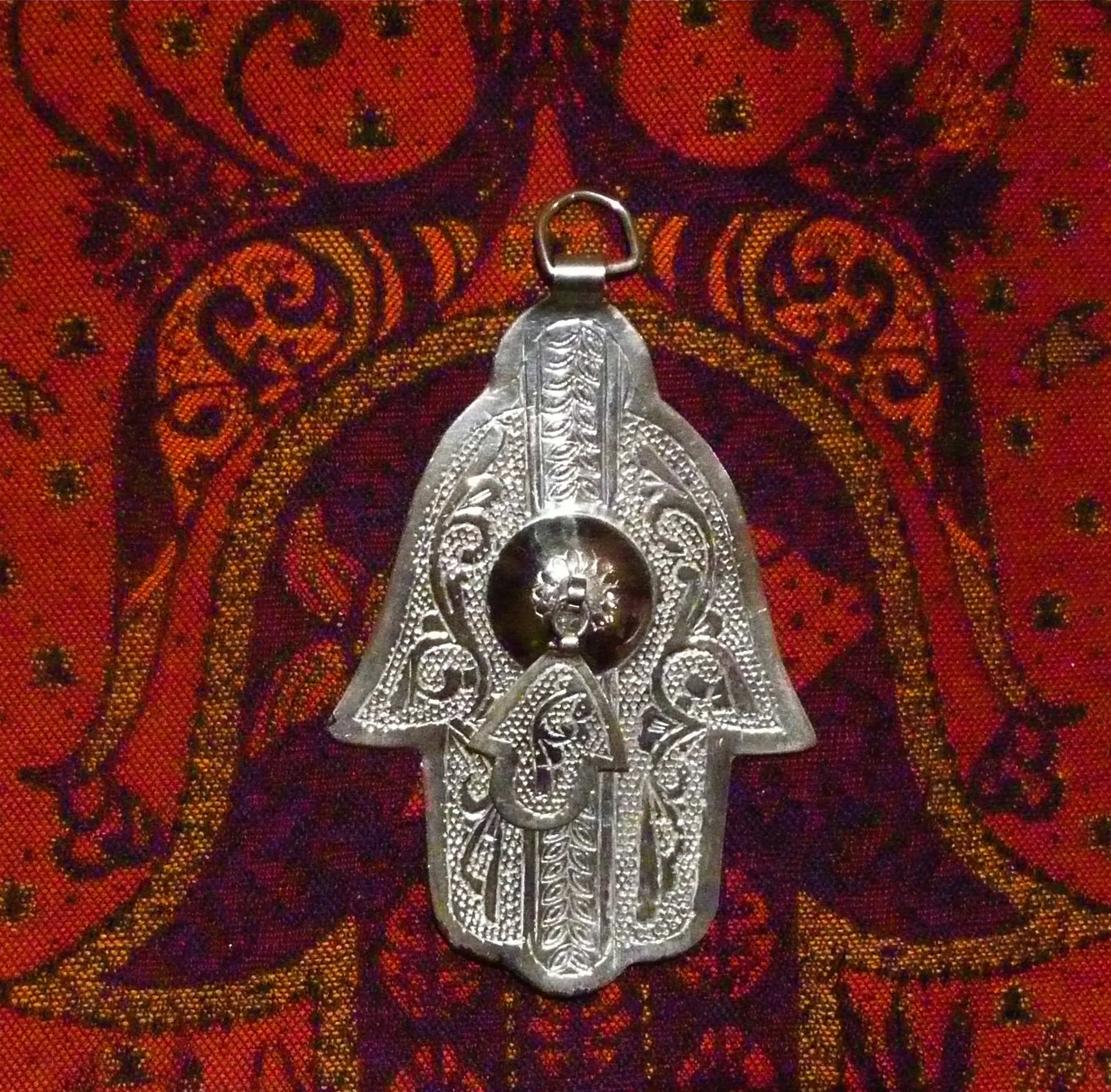
If her elder sisters have been eclipsed by history, the youngest, Fatima, lived in the spotlight. The hadith offers collected stories of her childhood, marriage, family, and alliances. History has saved both her words and those of her father speaking to her. After Khadija’s death, Muhammad leaned on her for support; later she was given the curious and weighty title, “Umm Abi-ha,” which translates as “the mother of her father.” She became a symbol of protection in the culture of Islam. The open hand, a defining symbol of protection for Muslim women, is called “The Hand of Fatima.”

Five poems on Fatima in the spring 2016 issue of “Knot Magazine”

http://www.knotlitmagazine.com/#!tamam-kahn-/c1rsb

Silver Hand

The Hand of Fatima

 
We forget the face 
but wear the silver hand,
forget the look
of a lighthouse,
but recall the beam; 
witness being lifted
on clear digits of light.
 
We concede
her rescuing face. 
Like her father’s,
we say.But we cannot
see either one.
 
Ya falak!  
We swim as stars
in orbit round his
daughter, a lamp
of whispered mercy.
 
When she extends
her hand, we are
met in unforgettable
 touch.

<>  <>  <>  <>  <>  <>

Wild Honey of adab 

Was there ever a better gesture for us than this? The way
Muhammad gets up when Fatima enters the room
and takes her hand to kiss it, then indicates his seat to her.
 
At her house, she reciprocates. Each garland of respect
 reveals the wild honey of adab;
inflorescent meadows spreading out, scented
 
with grace. Since we know the sting of a shrug,
how kindness can pivot and leave the room without a glance—
become the Bee Keeper. Stretch toward the buzz of others,
 
watch over each hive as the honey bees waggle.
Move slow, bee veil lowered. Honor the queen,
and hand a sweet jar to everyone you meet.
 
 
Notes:
Adab: (Arabic) important principle of refined behavior politeness, and doing the right thing at the right time for the right reason

 Waggle dance is a term used in beekeeping and ethnology for a particular figure- eight movement of the honey bee, communicating the direction of food.

<>  <>  <>  <>  <>  <>  <>  <>  <>  <>  <>  <>

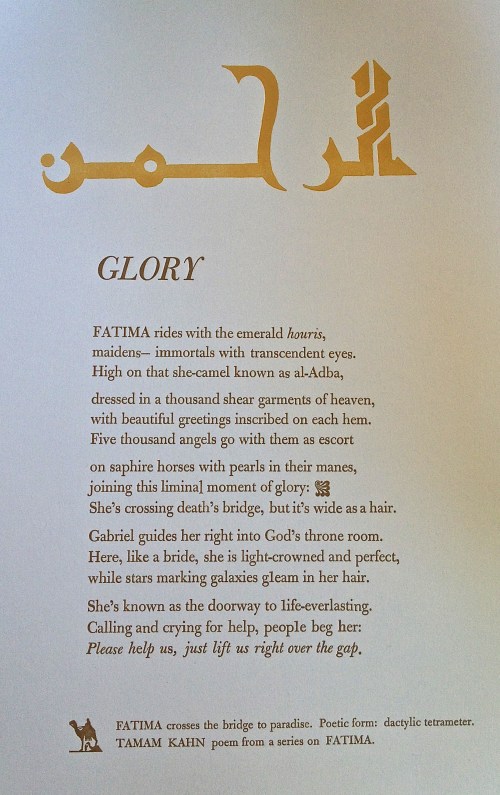
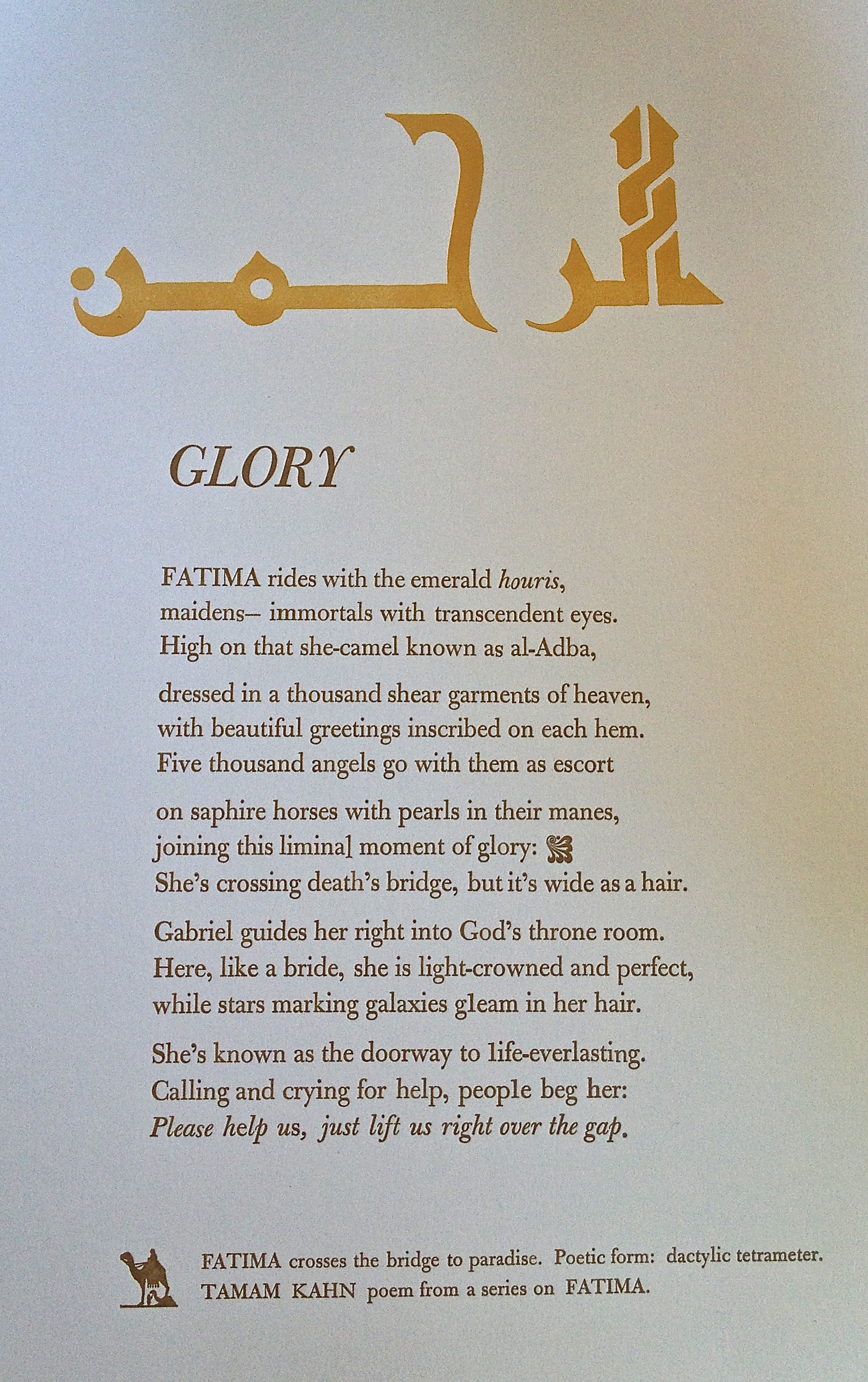
photo 1GLORY: Source: Fatima, Daughter of Muhammad, Christopher Paul Clohessy. Gorgias Press, 2009, pp. 168-173. Corrections: shear is sheer; stars marking galaxies is star-marked galaxies.

<>  <>  <>  <>  <>  <>  <>  <>  <>  <>  <>  <>

Shine

[one sentence sonnet, after Robert Frost “The silken Tent”]
 
 
The shining happened every day, in tent
and hut, in all the rooms, and while the breeze
would linger, Zahra’s glow, all white, relent-
lessly lit each scene with light that squeezed
out dark— she sparked delight, a living pole
star— lighthouse beaming, pointing toward
each heart as if to soothe and bleach the soul
of doubt as noon-prayer yellow sang a chord,
 
a citrine gem; that sound showed women bound
in Zahra’s golden ties of love and thought,
a unity of sound went round and round
and reddened as the sun passed through the taut                          
line of the earth— red stayed in land and air;
while Zahra’s face shone conscious and aware.
 
 
This description of Prophet Muhammad’s daughter, Fatima Zahra, and her “glowing,” comes from historical material known as “hadith.” Source: Fatima, Daughter of Muhammad, Christopher Paul Clohessy. Gorgias Press, 2009, p. 94. (Ibn Babuya – Shia hadith) <>   <> “Squeezed” replaces “ease” as an end-word in Frost’s sonnet.

<>  <>  <>  <>  <>  <>  <>  <>  <>  <>  <>  <>

 
<>   <>   <><>   poems from a new collection of  Fatima poems, 2012-2015      


Celebration in Delhi, India

25 Monday Jan 2010

Posted by Tea-mahm in Nizamuddin, The Urs of Inayat Khan, Uncategorized

≈ 2 Comments

This week, my husband, Shabda, leaves for India to co-host the eighty-third year celebration of Hazrat Inayat Khan’s passing. One hundred years ago this coming September, the young Inayat Khan, founder of our Chistia Sufi lineage, left India to bring “The Message” to America and Europe. Both of these events will be celebrated February 5 in Delhi, India. In honor of this journey Shabda is making with many Sufi friends, I am posting an article I wrote for “The Sound” three years ago.

Shanti Sharma

Since then, we have lost our sister Shanti Sharma, songbird of that beautiful time. Salam, Shanti, may you rest in peace!

Pilgrimage to Delhi, 2007 – “unprecedented!”

It began to feel like an Indian wedding. Pale lavender cloth stretched over bamboo scaffolding. The entire front yard and driveway of La Sagrita Guest House vanished. White sheets tightened over a dozen rugs that hid the lawn below. We walked out the front door into a kind of outdoor marriage pavilion with sunlight throwing tree and bird shadows on walls of the tent. A vine of large green leaves wound up an inside tree. Light bars appeared on the white ceiling. The small sound system came to life as Shabda stood in the center and tuned his guitar, and Gayan his djembe drum.

Gayan and Shabda

The travelers circled up for the first of the Dances of Universal Peace. There were familiar faces and new ones; seventy-four people made up the India celebration team, at the 80 year Urs of Pir-O-Murshid Hazrat Inayat Khan. This was our dance hall; morning Raga room where Shanti (the master Indian Raga singer) offered early morning raga practice; gathering place where Taj Inayat shared insights, where Shabda indicated what the day might offer and what we might bring to the day; and shrine room where Tai Situ Rinpoche sat surrounded by flowers and said to us that freedom-from-wanting-more comes from (spiritual) practice.

We walked to the dargah (tomb and surrounding area), through the small cared-for park, down the street through Sundar Nagar neighborhood, past the Sweets Corner, and out into fast and hectic traffic and uneven walking terrain. After crossing the last “highway” we were in the “Nizamuddin” world (great Sufi saint), among goats and beggars, barefoot children carrying babies, pan wallahs and slabs of meat; close by the Muslim rose garland sellers, the smells of frying oil and spice. Bright little ones sing-song’d, “Hello, hello!” and after a few days, we passed easily down that familiar street.The stone-work of the dargah, the entrance and the courtyard with its serenity and order allowed us to exhale with a sense of home-coming. We climbed the stairs, left our shoes and placed our foreheads on the rose-scented cloth or cool marble of the tomb. We were here at last, as at-home as we’ll be in India.

Tai Situ Rinpoche

Our program was ambitious. Our group, with Pir Shabda as leader, was host to fifty to one-hundred more Europeans, Americans, and Indians who felt the Inayti connection and came to the Urs to celebrate. A few days later, Pir Zia (grandson of Hazrat Inayat Khan) referred to the program and efforts as “unprecedented.” The concert hall was constantly packed, including the over-flow room and the outside chairs.

Our old friend Karunamayee opened with devotional singing Saturday morning. Sunday night closed the musical events with with Shri Bahauddin Dagar playing Rudra Veena accompanied by the stunning pakawash drum late into the night. Shanti gave a moving vocal concert. There were eight master musician concerts in two days.

After a weekend of concerts came the day of the Urs, or “wedding day,” the anniversary of  Hazrat Inayat Khan’s passing, February 5, 1927. We gathered at the large tomb area of Hazrat Nizammudin Aulia on a beautiful warm sunny morning.

at Nizamuddin

Pir Shabda was joined by Khawaja Hasan Sani Nizami, Pir Rashis ul Hasan Jili Kalimi, Pir Zia Inayat, Pir Sharif Baba, and Murshid Shahabuddin Less, Murshid Nawab Pasnak, and others. There was a strong women’s presence, with Dr. Farida Ali, guardian of the Hazrat Inayat Khan Trust advising Taj Inayat and myself what was the proper adab for women in a Sufi ceremony.The area, called Nizammudin, is open to devotees from all over India, as well as those who were there for the celebration. The qawwalis (dargah musicians who offer spirited devotional songs) began to sing, as they have for many years, and sweets were offered to all.  <>  Soon the Fateha (verse from the Qu’ran) was recited, the chaadar (cloth tomb cover) was blessed, then it was lifted and Taj and I each held an edge as the chaadar-carrying procession squeezed through the narrow lanes of the dargah onto the street while following the qawwalis to Hazrat Inayat Khan’s dargah several blocks away. Soon it was Taj, myself, Zuleika, and Zarifa in the front. Traditionally, it was a man’s privilege to lead, so we felt exhilarated breaking new ground. At the dharga steps, a European man darted in front of me to take the right corner. “Excuse me,” I said, “this year the women are leading, please step behind!” Shabda joined us and we placed the beautiful brocade cloth on the tomb, under the strings of marigolds and tuberoses. The qawwalis sang on, followed by a beautiful short kirana style vocal concert by Shabda, some words from Pir Zia and Taj, and finalized by everyone joining in Hazrat Inayat Khan’s sung zikr.  <>

<>   That afternoon, Khadija Goforth led a luminous Universal Worship service. After a courtyard meal for two-hundred or so devotees, we celebrated with Dances of Universal Peace in a long double oval just in front of the entrance to the tomb. Mevlevi dervishes whirled inside by the tomb. It was an amazing and fulfilling moment where Murshid Sam’s family brought music, dance, and joy in great measure, and many were carried by the wave of “love, harmony, and beauty.”

Like all beautiful Indian “weddings” this one seemed to go on and on. Tai Situ Rinpoche changed his schedule to come back a second time, Saraswati and Zuleika wowed us with beautiful dance performances, The Hope Project and The Memorial Trust school children performed theater and music. At the end, it began to rain.

Taj teaching

Taj opened her last morning talk with, “It’s good to see your bedraggled, glowing faces.” She went on. “How do we live a life that characterizes Love Harmony and Beauty? …You are the embodiment of the answer”. Her words were the small piece of cake we took away from the wet tent on careful plates, certain that we would hold the sweetness of this celebration for now and time to come.

Damascus Journal part II

15 Tuesday Dec 2009

Posted by Tea-mahm in Uncategorized

≈ Leave a comment

The Abu Nour Mosque, Damascus

(See part I under “November, 2009”)

I wanted ordinary street crossing. Cars stop, you cross safely in front of them. Here you thread between cars moving 25 mph or so. Not just the would-be matadors. Everybody. I stood on the inside of a scarf-headed grandmother and stepped when she stepped. We both turned a shoulder to the traffic as it zoomed past on both sides. We found the middle of the street. There seemed less than twelve inches between the hand that covered my heart and the side mirror of the car that passed. I worked on my breath so as to move purposefully, but the adrenalin was pumping and I couldn’t trust myself to be in charge of my limbs.  Reaching the sidewalk was a victory – We’re alive! I’m alive! I restrained the impulse to hug her for saving my life. This scene repeated after I bought 4 bunches of spinach, 2 carrots, 2 leeks and a kohlrabi – all for $.42 from the outdoor market.

RAMADAN: In the late afternoons I sat writing in my comfortable corner room with windows on two sides.  The hot sun was horizontal, held behind buildings, as all of Damascus focused a swallow of water to break the dry thirst, a sweet date to start up the collective digestion.Taxi drivers were grouchy and impatient (better to walk between now and sunset); Minutes ticked by toward darkness and tables laden with lamb and chicken and steaming vegetables, fruits, cheeses, bread and sweets.At exactly 4:40 on the clock, dusk arrived and a loud canon was fired, somewhere nearby, to signal the end of the Ramadan day. Then began the call to prayer from every mosque: ALLAH HO AKBAR! Tower by tower, green neon light lit up the minarets. Prayer and feasting began. It would have been good to be invited to a Ramadan meal, but it never happened. We’ve been made welcome, but not embraced. There may be anger and suspicion behind the good manners. After all, our government has given this land the humiliating title: “Axis of Evil”. To these people, proud of their history as one of the oldest cities in the world, that’s insulting.In the fast-breaking hours the streets were deserted, shops closed until 8:00 when the shopping began every evening during the month-long holiday. Families with strollers, groups of girls with linked arms, young men in twos – or trailing their large families – turned out and strolled the shops with the intention of buying something. There were sock, watch, and popcorn vendors in the middle of the walking areas. Corn-on-the-cob.  In the souk you could buy a forged damascene sword, beautiful children’s clothing, a hooka, prayer beads and the latest in fashionable covering scarves and modern clothing. I never discovered when the party stopped. By 10 pm I was headed for my room. Business was still open. Then there was a canon at 3:30AM, to wake the city, to give enough time to prepare food and pray and have a big meal before the sun rose.

One of the things that made me feel OK about going to Syria was the assurance that we were under the protection of the Grand Mufti of Syria. What a name! Who could that be? The man who received the Pope on his recent visit, had invited us to be guests at the Abu Nour Mosque for the Jumma (Friday) prayers. We were met in the VIP room and given a stunning welcome by Sheik Salah (Dr.) Kuftaro, head of the largest Muslim social service organization in Syria, son of the Grand Mufti, , and a Nakshabandi Sufi as well. He spoke to us with affection: “I can’t say to you  – you are welcome – because you are in your very home! There is a lot in common between each of us.

about to go into the Mosque

I think the most important thing that joins us is the mysticism of Sufism.” After he spoke, the men were escorted out and joined him on the dais on either side of his father, while the women were led upstairs to a glassed-in gallery with plush chairs and simultaneous translation headsets. The Mufti spoke commentary on a subject from Qur’an, then introduced Elias, our group leader,  to the thousand plus men seated on the vast carpet, 3 floors down from our seats.  I could see him clearly, and Shabda, in his yellow hat and shirt. Elias expressed how happy we were to be there and apologized to everyone there on behalf of the American people.  ~ We have come to break through this wall that is being built between the people of the West and the people of the Muslim world. We have been welcomed with kindness & hospitality even though my country has not been kind in its policy toward Syria. …The simple fact that you receive us with such generosity is a great strength of soul and character that is stronger than any weapon of war. Please know that your kindness is… evidence of living Islam.(The word Islam comes from salaam, and means peace.)

view from the women's VIP seats

We observed the scene and listened to this amazing speech being simultaneously translated into Arabic. I looked around at the faces of the Syrian women near me. They smiled back and nodded. Several of us were in tears. I thought of this as enormous, on the scale of my life-experiences, felt overjoyed to witness this message of peace.

To conclude… to protect our children we must do everything we can to break through the masks that are being painted on our faces.  When we truly meet each other, we will have Peace. Let nothing stop us from getting to know each other. Shukran. (thank you).   It was as if the great mosque had become a table of a thousand candles and the women kept lighting and re-lighting one another as we were led to the VIP area where Elias received an engraved plaque. I learned in Morocco to copy what’s done among Muslim sisters who have prayed together, so I began kissing warm cheeks and quietly repeating: As-Salaam Aleikim.

Elias receives plaque

Since the women are conservative here, it was a strong gesture on my part, but they seemed to appreciate the contact. Wa’leikim As-Salaam, They whispered back.

I want to wake up in Damascus with its 3:30 AM Ramadan canon (fired somewhere near the hotel, in the middle of the city – as an alarm clock!), Damascus with its pedestrian insanity, cheap vegetables and blocked internet reception for AOL. I am fond of our hotel – the Al Majed – where they make special day-time vegetable meals for me, where the fourth floor mysteriously floods at night; Damascus, with  its safe-to-walk-at-night streets; its kind citizens who said to us many times, You are from America? You are most welcome!

← Older posts
Newer posts →

Solomon Posts

Untold Book

Enter your email address to follow this blog and receive notifications of new posts by email.

Join 157 other subscribers

Tamam’s Links

- Poetry Group - Oracular Pear

- Youth Speaks: Poetry Slam

Links

  • Book: Physicians of the Heart the 99 Names of God – amazing book
  • Fred Chappell: short review
  • Gulf Coast Poems Poets for Living Waters
  • How a Poem Happens
  • Jamaica Osorio's website
  • Mari L'Esperance, poetry
  • Mark Doty, amazing poet read and listen to this poet
  • New Formalism Where is formal poetry today?
  • Oona and Maeve Granddaughters Oona Beatrix and Maeve Clementine
  • PoemShape Formalist Poetry
  • Poetry Out Loud! supporting the next generation!
  • Seven Pillars Book Review by Tamam Mother of The Believers by Kamran Pasha
  • Seven Pillars, POETRY poetry on Pir Zia’s blog/7 Pillars
  • Sufi Ruhaniat International Ruhaniat web site!
  • The Accidental Theologist Lesley Hazelton – a favorite writer and author…
  • The Sound Journal Tamam edits this Journal: NEW!
  • very like a whale good poetry reviews
  • West Marin radio show Sufism: The Heart of Islam, with Wendy McLaughlin

Archives

Blog at WordPress.com.
  • Subscribe Subscribed
    • CompleteWord
    • Join 157 other subscribers
    • Already have a WordPress.com account? Log in now.
    • CompleteWord
    • Subscribe Subscribed
    • Sign up
    • Log in
    • Report this content
    • View site in Reader
    • Manage subscriptions
    • Collapse this bar
 

Loading Comments...