• About Tamam
  • Poems
  • NEW BOOK! Reviews & Praise
  • UNTOLD: Book Trailer & Blurbs
  • Fatima’s Touch
  • Reading Schedule

CompleteWord

CompleteWord

Category Archives: Sufi

instructions for Jahiliyya

29 Tuesday Mar 2011

Posted by Tea-mahm in bookstores, Poetry, Sufi, Untold

≈ Leave a comment

I gave a book reading – introducing my book, UNTOLD,  in Portland on Thursday March 17th at the New Renaissance Bookshop, a wonderful counter-culture bookstore very different from the famous Powells City of Books, downtown.  Shabda offered a Sufi retreat over the weekend and invited me to give a presentation Sunday Morning. I kept it to 20 minutes and offer it here as an audio file.       <> TamamTalk3-30-11<>

As for the crocodiles, they seem to appear in all their reptilian glory when I say the magic word – JAHILIYYA, an Arabic term for a time that had an attitude. The time before Muhammad brought the antidote of al-halama — mild gentleness, nurturing love. One you might recognize in its own form today in some political moments. Here’s the poem:

instructions for Jahiliyya

…the jahil, a wild, violent and impetuous character who follows
the inspiration of unbridled passion and is cruel by following his
animal instincts; in one word, a barbarian. Ignaz Goldziher

Know you are right.
Think fist and knife-edge.
Do not appear
foolish, no matter what.

Control your woman
and your guests; keep them
a little afraid, and thankful
for your protection.

Guard your clan’s
honor. Carve a notch
on your weapon of choice
for each successful pay-back.

If someone calls you animal,
smile and answer — lion,
hyena, crocodile, fighting cock—
the meek are the pack animals of the ferocious.[i]

from Untold, A History of the Wives of Prophet Muhammad by Tamam Kahn, Monkfish Books 2010.

[i] Jahiliyya is an important term, usually mistranslated as “the time of ignorance”, instead, Ignaz Goldziher argues, He sees it as barbarism, not ignorance, citing halim (mild), not ‘ilm (knowing) as the opposite term. He quotes an old Arab proverb: The meek is the pack animal of the ferocious (al-halim matiyyat al-jahul.) He devotes an entire chapter of his cited book to this subject. ~~~

There is always the lion, hyena, and fighting cock and that juicy word “ferocious.” Keeps me on my toes.  <>


UNTOLD: Author Interview

13 Friday Aug 2010

Posted by Tea-mahm in A History of the Wives of Prophet Muhammad, bookstores, Marrakech, Morocco, Poetry, Sufi, Untold, Updates

≈ 8 Comments

Recent news about UNTOLD:

~ UNTOLD won an International Book Award for 2011.

~ UNTOLD was translated into Indonesian and may be in bookstores there as “Untold Stories,” Kaysa Publishers, and is being considered by Garnet Press, UK.

Monkfish Publishing House interviews Tamam Kahn (2010 interview):

Q: What prompted you to write about the wives of Muhammad?

Tamam Kahn: As I traveled in North Africa and the Middle East, I felt authority and earthy power from the women who recited sacred words and sang poetry about Muhammad and his family. I wanted to discover if Muhammad’s wives had that same fierce, elegant energy. I began to read about them. I found that – according to traditional history – they did.

Q: Why do you feel this information is valuable or necessary at this time? What does it have to teach us?

Tamam Kahn: This book is meant to balance History and Her-story.  My wish is that the women in these pages may emerge as vivid individuals vocalizing the first years of what came to be Islam; that they will replace the stiff and submissive stereotypes the media often displays. In this book, we see that Muhammad was married to women born into Jewish, Christian and pagan faiths. “Untold” may inspire us to be curious and keep a flexible attitude, and if we do, we may discover all people have the same hopes, dreams, fears, and disappointments.

Q: Do you consider yourself a Muslim?

Tamam Kahn: I would call myself a spiritual seeker who regards Islam as the path of peaceful surrender to the One. For me, a Muslim is a person who walks that path. This was the “Islam” embraced by the women I write about. I am a follower of the Message of Divine Unity as exemplified by the great Sufis such as Rumi, Hafiz, and Rabi‘a of Basra. They carry a sacred outlook not limited to the form, the time, or the place.

Q: How have Muslims responded to your research and publication?

Tamam Kahn: A California Muslim woman hosting a local radio show wrote me that Untold brought these women to life in a way that no standard biography did. Through the poetry, she now imagined them as real flesh and blood women who were courageous, jealous, and fierce – in a very human way. For those who question my right to write about the Prophet’s wives, I would say I have great respect for each woman and admiration for the life they shared. That respect has opened doors that made this book possible.

Q: Does your book have a message for Muslims?

Tamam Kahn: As-salaam ‘alaykum. This book greets you on the path of peace. Come and enjoy the stories of your Prophet and his family.

Q: Does your book have significance for non-Muslims?

Tamam Kahn: This book is about a forgotten piece of history that needs to be brought out and honored. But for me it is not about Muslim and non-Muslim. It’s about our human family and the strength of women. This book may bring ease to a mother whose children attend school with Muslim children, the shopper served by a grocery checker in a scarf, the office worker whose boss has a Muslim name. CNN tells us that nearly one in four people in the world today is a Muslim, although Fox Network said it was one in five.

Q: How has the process of researching, writing, and publishing Untold changed your life?

Tamam Kahn: I’ve spent my life changing my life, so this is just another chapter.  There is a big difference between holding a manuscript and reading from your own book. This book seems to have “a life of its own.” I feel like I’m just tagging along. The directive that these women need to be known is an important one. From the opening poem: “I am here with a message: conversation with these women will never end.”

Q: Can you tell us about the research for Untold?

Tamam Kahn: I was hooked as soon as I began to read contemporary authors, Karen Armstrong and Martin Lings. From there I went to the oldest sources such as Ibn Ishaq. I traveled to Syria and received my own library card from the Al-Azar National Library in Damascus. When I’d researched and written a few chapters, I met with Islamic Scholar Arthur Buehler back in America, and he was moved by what I was doing and offered to help, not only by correcting the Arabic, but also suggesting early scholarly material that was respected in the genre of what is called “the hadith literature.” In that way I had the advantage of an academic checkpoint.

Q: Talk about the form you use in this book – narrative prose interspersed with poetry.

Tamam Kahn: At one point I had seventy poems and notebooks of research on the wives and daughters of Prophet Muhammad. I thought I’d find someone to write the back-story. I asked the wonderful master writer and Poet Laureate of North Carolina, Fred Chappell, what he would do if he were in my place. He suggested a “prosimetrum.” No one I knew was familiar with that term. It was used by Boethius in the fifth century – in his Latin Consolation of Philosophy. Boethius placed poems – each like a tiny well – in the prose narrative thread. The Consolation influenced Western Medieval thought, Dante and Chaucer. The form is generally not in use today, but it served my purpose beautifully!

Q: Who should read this book?

Tamam Kahn: This book is for anyone who wants to transcend stereotypes about Islam. Untold paints this early history with a bold, broad stroke, including Prophet Muhammad’s close and colorful contact with Pagan, Jewish, and Christian women who became his wives. Like Reading Lolita in Tehran, Untold depicts Muslim women in a new light, with focus on their intelligence and creative outlook. Book clubs will find this is an optimistic book that empowers women –– the ones who are in it and the ones reading from it! After studying Untold in an Islamic Studies class, one student was inspired to write a term paper about the first wife, Khadija. I leave a trail of research markers, so the book can be enjoyed as simple biography or questioned and investigated further. Untold is for people who discover that they want to know –– who are these women?

For more information or to arrange an interview with Tamam Kahn, please contact: <tamam@completeword.com> 


Words and Redwoods

27 Tuesday Jul 2010

Posted by Tea-mahm in Poetry, Sufi, word-dancing

≈ Leave a comment

I just returned from teaching a poetry class for a week in the woods of Mendocino. It felt wonderful to be among words and redwoods, opening to both. Here are some thoughts from Dorianne Laux, a wonderful poet. Years ago at Flight of the Mind, [a woman’s writing retreat in Oregon] I studied with her:

Dorianne Laux  Why do I write?

…I work to find my subject, something I can sink my teeth into. I live for that flaring up of language, when the words actually carry me, envelope me, grip me. And all the above is why I read poetry, to hear the truth, spoken harshly or whispered into my ear, to see more clearly the world’s beauty and sadness, to be lifted up and torn down, to be remade, by language, to become larger, swollen with life.

I write to add my voice to the sum of voices, to be part of the choir. I write to be one sequin among the shimmering others, hanging by a thread from the evening gown of the world. I write to remember. I write to forget myself, to be so completely immersed in the will of the poem that when I look up from the page I can still smell the smoke from the house burning in my brain. I write to destroy the blank page, unravel the ink, use up what I’ve been given and give it away. I write to make the trees shiver at the sliver of sun slipping down the axe blade’s silver lip. I write to hurt myself again, to dip my fingertip into the encrusted pool of the wound. I write to become someone else, that better, smarter self that lives inside my dumbstruck twin. I write to invite the voices in, to watch the angel wrestle, to feel the devil gather on its haunches and rise. I write to hear myself breathing. I write to be doing something while I wait to be called to my appointment with death. I write to be done writing. I write because writing is fun.

<>

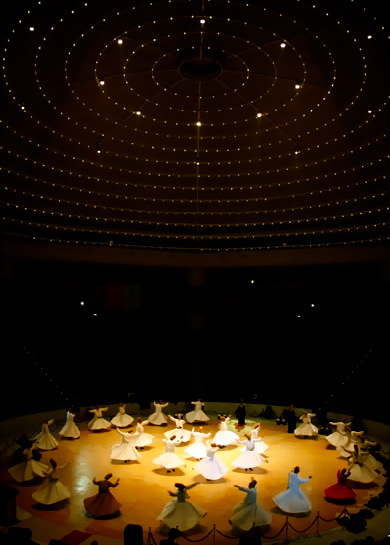
…When the Sufi poet whirled, was he looking            

outward, to the mountains so solidly there

in a white-capped ring, or was he looking

to the center of everything: the seed, the egg, the idea

Mevlevi Sema

that was also there,

beautiful as a thumb

curved and touching the finger, tenderly,

little love-ring,

as he whirled,

oh jug of breath,

in the garden of dust?

<>  <> excerpt from

Where Does the Dance Begin, Where Does it End ~ by Mary Oliver

-from Why I Wake Early (2004)  <>

09 Wednesday Jun 2010

Posted by Tea-mahm in A History of the Wives of Prophet Muhammad, Announcements, bookstores, Poetry, Sufi

≈ Leave a comment

Untold: A History of… three months later

21 Sunday Mar 2010

Posted by Tea-mahm in Naropa, Poetry, Sufi, Untold

≈ 2 Comments

Untold: A History of the Wives of Prophet Muhammad will be released Fall 2010 as a Monkfish Books  in paperback, available in bookstores and on Amazon at that time. ”Untold” is a biographical narrative based on actual historical material with 70 poems embedded in the prose.      <>   <>    <>   <>

from the opening poem:  who do you think you are:

…I am a pilgrim, a pen with child’s heart,

following the foremothers through

doors shut on centuries of stolen words, across

floors now hushed in Saudi cement, down

steps to the cellar filled with the Hijaz story-jars.

Unsealed, the jars open their mouths,

speak to me. I listen…..

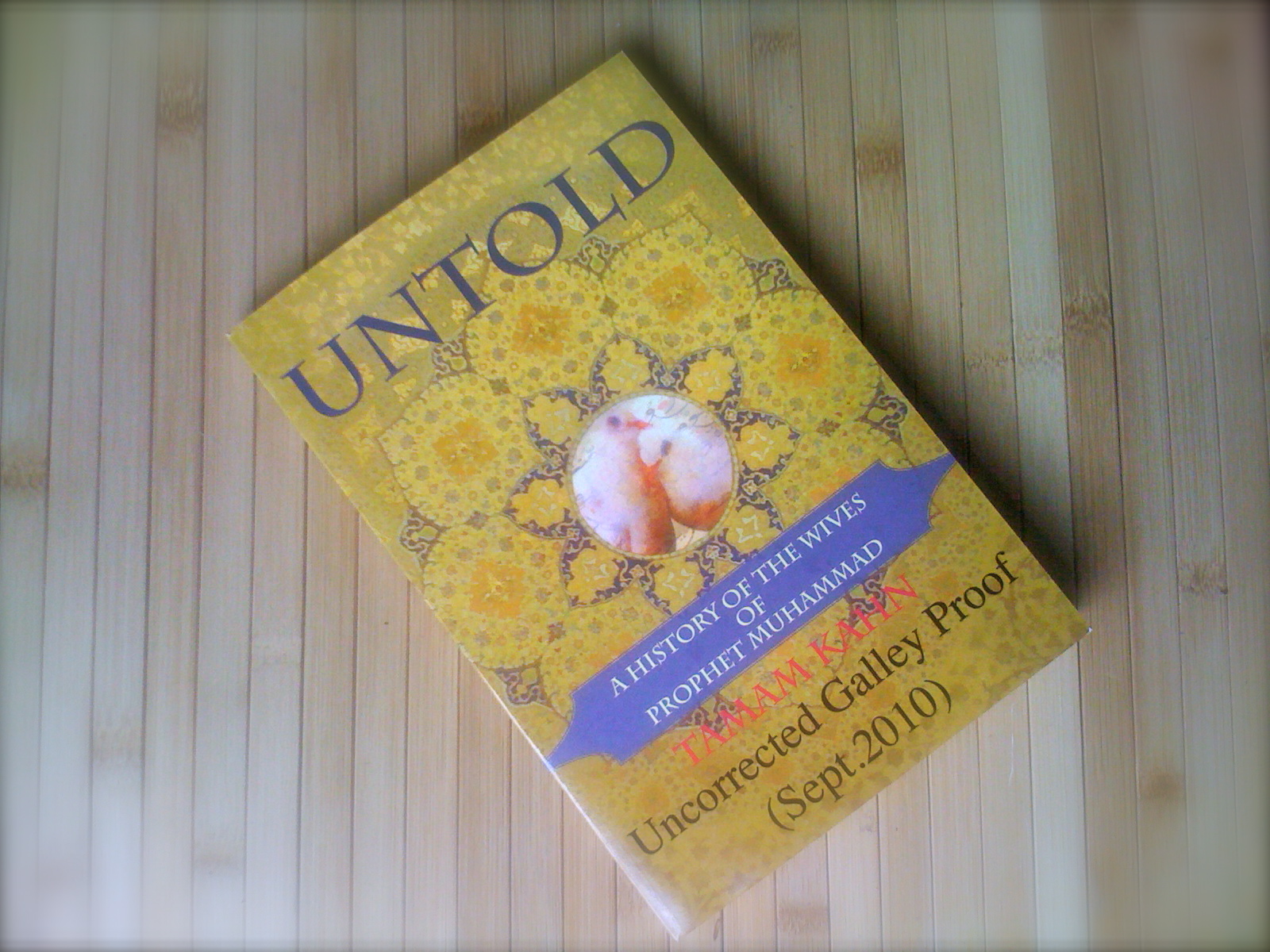
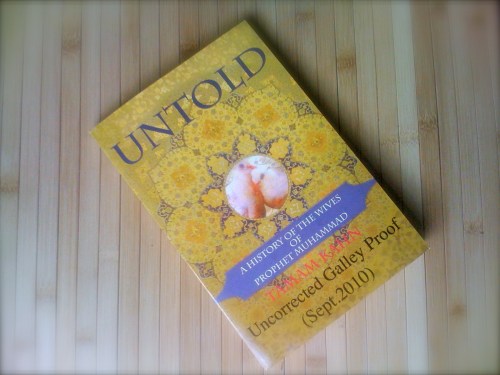
Note from the author: Untold has been out in Limited Edition Hardcover for almost three months. I am starting to get used to having a book in my life. There are readings, most recently in Colorado: Denver, Fort Collins, and Boulder. I presented at Patrick D’Silva’s Islamic Studies class at Naropa University in Boulder, and the “Allen Ginsberg Library” there ordered the book.  That was a great delight for me, as I feel this book belongs in libraries, where curious students can investigate the nearly 20 pages of end notes and learn about these brave women, nearly unknown except in Muslim communitites.  I read in Cambridge for 70 people last weekend, and prepare to go to Arcata, California in a couple weeks. Before that, a by-invitation reading in Petaluma. The “galleys” are here, and look like my book on a diet, slim and marked with black letters, as in the photo. I begin to contact bookstores for fall and winter readings. I am working up enthusiasm for “the business of books.” Remembering that “author” has to do with “authentic.”
These untranslated women, who stood in the first light of Islam, have buried stories. Here are several: Khadija is a wealthy businesswoman who hires young Muhammad; Hafsa is saved from divorce by Angel Gabriel, Zaynab, a married first cousin, experiences a moment of passion with Muhammad, Umm Salama saves a vital peace treaty and Aisha tells of death of the Prophet. These are stories known in the Arab-speaking world but not in the West. I am fortunate to have good resources: rudimentary Qu’ranic Arabic study; scholarly guidance, travel in the Middle East, and three decades as a seeker on the path of American Sufism.
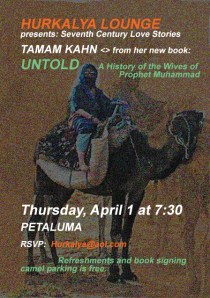
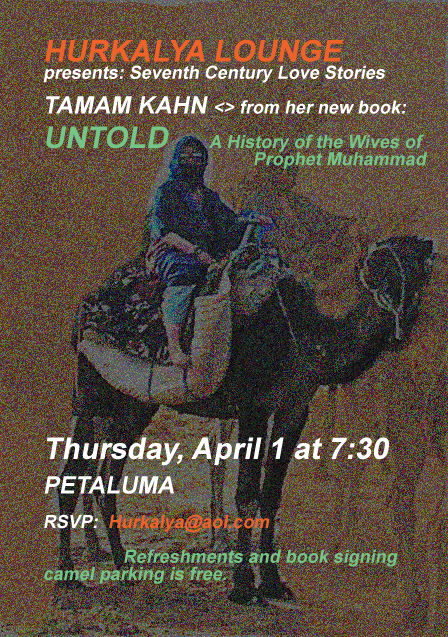
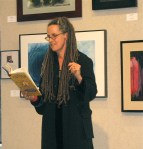
Reading in Petluma <> hurkalaya@aol.com

Comments from Distinguished Readers:

“Your book fills a great need, and does so with beauty.” Pir Zia Inayat Khan

<>”Untold is a riveting hen-house of delight, a book based on subjects our society finds endlessly confusing — marriage, matriarchy, and Muhammad. Finally, we get to meet the first women of Islam. Tamam, thank you for doing this brave book.” ~ Coleman Barks, author, The Essential Rumi.

<>”This book is a movement to remind us that the prophetic experience and revolution are inner as well as outer, and beyond time or place. The women on these pages have as much to tell us now as they did then. Tamam has created a new genre of Islamic literature. Through her poetry she draws us to the Mothers of Islam by illustrating, exemplifying, and embodying actual human beings. Her vibrant words provide a doorway to the Wives of the Prophet.” ~ Arthur F. Buehler (A.M., Ph.D. Harvard) Senior Lecturer, Islamic Studies, Victoria University, Wellington, New Zealand (2004–present),

<>”Untold takes us on Taman Kahn’s moving, personal journey of discovery, to unveil the hidden history of the wives of the Prophet Muhammad. The book frees the authentic voice of these women, who came from many different backgrounds and who played an essential role in the origins of Islam.  Ms Kahn steers a middle course between Western religious prejudice and uncritical hagiography by finding the poetry hidden between the lines of reported history, itself written mostly by men. As such, this book is part of a larger movement that seeks to reclaim the voices of women prophets and saints of all traditions.” ~ Saadi, Dr Neil Douglas-Klotz, author of The Sufi Book of Life and co-author of The Tent of Abraham.

<>”Swimming amid “the names of God,” Tamam Kahn has written a brilliant and illuminating book, equally awesome in the depth of its research, the grace of its prose, and the beauty of its poetic voices.  Untold should be read with joy by any reader who hopes to transcend current stereotypes about Islam.  It is a bridge between worlds.” ~ Alicia Ostriker, poet and critic, author of The Volcano Sequence, and of Feminist Revision and the Bible, The Nakedness of the Fathers: Biblical Visions and Revisions and Professor Emerita of English at Rutgers University.

“In a sustained act of spirited research and imagination, Tamam Kahn brings Muhammad’s wives and daughters out of the shadows and into the light.  The women of ‘Untold’ have at last found their perfect teller, in voices so gemlike and clear that one wants to chant them aloud, dance to them, celebrate with them.” ~ Lesley Hazleton, author, After the Prophet: The epic Story of the Shia Sunni Split in Islam.

Notes from generous readers!

“When I read the book, it made me so happy, because what you did was so brave – I’m sure I could never have done it.  But seeing you read from this book gives me a dose of courage that I now have under my belt – for later  …It opened a door onto my imagination about the women around the Prophet (saws) which brought them to life in a way that no standard biographical information had.  With your poetry, I realized that I too, could simply imagine them as flesh and blood women, with feelings of jealousy and grief and courage and fierceness and impatience.  …I thank you for opening that door for me.”  Salama Wendy McLaughlin, Host, KWMR Sufi Radio

“The prose was like sipping a sweet mint tea; delicious – then a poem would drop in like an ice cube, bringing crystal clarity and emotion, changing the experience but not the taste.” ~ Dechen

“I am amazed at your scholarship and courage to put this information out to the world.  Saadi used the adjective “brave” and I agree.  The poetry is lovely and helps me see what it was like  to be the wife of a controversial figure.  Thank you for helping me SEE. ~ Fadhilla

“I received Tamam’s beautiful book, Untold, yesterday. It is a real gem! What a treasure.” ~ Arlene

“Your wonderful UNTOLD is now in the woods of Maine. I will spread your words.” ~Henry

“The personal entwined with the historical narrative to hold the poems is so wonderful.  I didn’t know how starving I was for this until you let me taste!” ~ Basira
Guest of His Majesty King Mohammed VI of Morocco

22 Wednesday Jul 2009

Posted by Tea-mahm in Marrakech, Morocco, Poetry, Sufi, Uncategorized, Untold

≈ 13 Comments

Tags

Marrakech, Morocco

IMG_0274

Marrakech Sufi Gathering: The Sidi Shiker World Gatherings of Tasawwuf Affiliates. I just returned from Morocco. The Royal Government paid for airfare, hotel, and food for a week. I was invited to present my poetry to a conference of nearly 2,000 Sufis. It doesn’t seem possible – but it’s true. I was there in the triple digit heat, sharing a tajine, heaped with rich and delicious food or an elevator with people from Lebanon or France.

In 1998, my husband, Pir Shabda Kahn, and I went to the Sacred Music Festival in Fez, Morocco as leaders on a “sacred journey.” We returned the next three years with groups of American Sufis and visited sacred sites and caravan-ed on camels in the Sahara. Our good friend, who made this possible, was a man named Dr. Sidi Ahmed Kostas. Now he is the assistant to Dr. Ahmed Toufiq, the Minister of Religious Endowments and Islamic Affairs for the king. Around the Summer Solstice June 21, 2009, Dr. Kostas and Dr. Toufiq got the go-ahead from King Muhammad VI to assemble a Sufi Conference in Marrakech July 10-12. They had less than a month! I got a personal phone call from Dr. Kostas while in England, waiting to go to Germany and teach from my forth-coming book: Untold: A History of the Wives of Prophet Muhammad. Dr. Kostas wanted me to read my poetry at the conference. I IMG_1270_2said yes.

Dr. Kostas set out to invite Sufi groups from all over the world and on 10 days notice almost 2000 people accepted the all- expense-paid invitation of airfare, beautiful accommodations and banquet-meals – from Minister Toufiq on behalf of the King of Morocco. 100 Nigerians. Chinese and South Africans. Americans, Europeans, Middle Easterners. It was the Moroccan travel agent’s nightmare. The conference was tri-lingual, Arabic, French, and English, with simultaneous translation for all presentations. The weather – hot as West African summer; the hotels were well air-conditioned. Marrakech is as sophisticated as it is beautiful.  The reason for this whirlwind was echoed in the words of the presenters. Sufism is recognized as a hedge against fundamentalism in Morocco. Sufi teachers and their followers hold the notion of the true meaning of Islam as ” the inner state that causes the feeling of peaceful surrender to the protection, safety, and healing of the Divine.” The Sufi is one who carries the essence of love, harmony, and beauty, and pays attention to transforming the nafs (ego). He or she may be a warrior of the inner jihad (a phrase that means to contend, to challenge the unrefined self). Sufis are known to stand together and chant, la illaha illallah (There is no Reality but The Reality,) celebrating this in joyful assembly. My definition of Sufi mysticism is: “It is the fragrance over the flower of religion.”

The king, like his father before him, recognized it was in Morocco’s best interest to promote this fragrant fraternity for benefit, and bring together Sufis from everywhere to foster connection and mutual brother-sisterhood.

Dr. Kostas and a photo of the king

Dr. Kostas and a photo of the king

The Ministry further seeks to fund and promote publication and education toward this gentle reflection of Islam in the culture of Morocco.

Of the 2000 delegates, there were less than 50 women. Three of us presented; a Moroccan scholar, Dr. Zakia Zouanate, and an American scholar and long-time Sufi friend, Murchida Tasnim Fernandez, and myself.  Several times at the break I was the only woman in the vast, hotel restrooms. The women were a tiny minority, yet

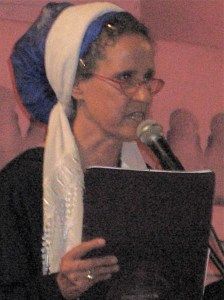
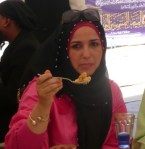
we made our presence felt. I had instant sisterhood with the few women I saw, nodding or introducing myself to Laurence from Paris, Ikram from Fez (in the photo on the left), Hafsa from Scotland, Fatima from Nigeria, Ora from New York.

P1090003_2 My poems were translated by Dr. Kostas, as we stood on the stage at the banquet close to midnight Saturday night. Dinner had just ended, but nights in Morocco seem to go on forever. Before I began to read, I thanked the King. (He was absent, but it’s not often you get chance to say, “I want to thank His Majesty, King Muhammad VI for his generosity ….”) Afterward, Dr. Toufiq expressed his appreciation to me for my work on the Mothers of Islam, and told me I was always welcome in Morocco. My friend and fellow poet Abdal-Hayy Moore read his poems as well.The next day, Arabic-speaking delegates called out to me in Arabic, smiled warmly, gave thumbs up or offered me their business cards.
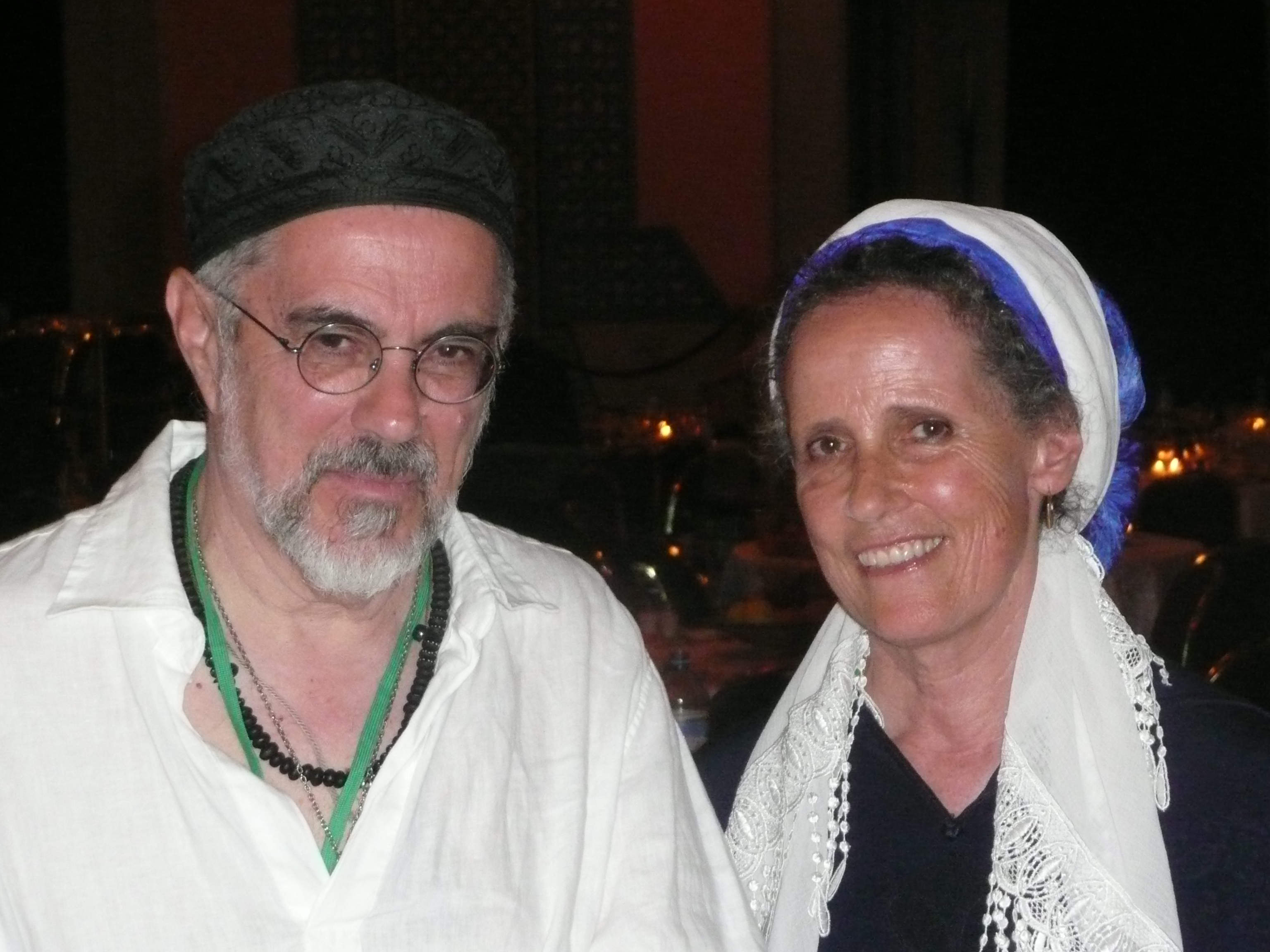
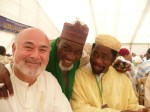
Abdal-Hayy and Tamam: banquet poets

The conference swag was amazing; the women received silver or gold brocade slippers and a stylish silk scarf; the men, an elegant white hooded burnous, a briefcase, leather slippers, an Arabic language Qu’ran, and a beautiful sacred manuscript book.

Because my name ends in a consonant, an Arabic “male indicator,” and my husband’s with the female “A,” our invitations read His Eminence Tamam Kahn and Her Eminence Shabda Kahn. Nice.

Murchida Tasnim on Sufi Ethics

Murchida Tasnim on Sufi Ethics

On Saturday, the international press was everywhere. I gave two interviews, one to Italian TV and the other to a journalist and photographer from Brussels. You could spot the women reporters in their casual hot weather clothes, while most delegates wore traditional robes called djelabas and some kind of head covering. The Nigerians dazzled – in vivid colored caftans and hats. The day we went to the desert, it was well over 105 degrees and all who went – nearly 2000 of us – ate lunch in tents with ceiling fans and a couple portable ACs. We were there all day. The women staged a take-over and claimed the large tent designated for us and provided with pillows, couches and a computer. Sleepy men left and went elsewhere. At 7:30 we all returned for dinner in a bus caravan accompanied by a police escort all the way into Marrakech, flashing lights and all.

The night before, we were driven to a palm garden just outside the city and entered the circle of tents on red carpets, lined with drummers and men playing long trumpets. We sat in chairs at tables of ten in twelve traditional Moroccan tents placed around a carpeted open space, desert style. The couscous and chicken arrived with a procession of tajine-carrying waiters. After dinner we listened to live Turkish music as the moon rose over the dark palms.

I return with new names and e-mails in my address file, my

Ahamed, Khalifa, and Sheik Tijani

Ahamed, Khalifa, and Sheik Tijani

luggage perfumed with amber from the souk, and most valuable –the gift of friendship. In this time when most people in the world are withdrawing financial largesse, when programs falter, I was conscious of how generosity on the scale of this event may bring expansion, blessing and God willing, insh’allah, the peaceful benefit of the open hand and heart.

For Italian broadcast of this event and 3 seconds while I answer the question, “What is Sufism?” see:  http://video.sky.it/videoportale/index.shtml?bcpid=1513658495&bctid=29219701001

Newer posts →

Solomon Posts

Untold Book

Enter your email address to follow this blog and receive notifications of new posts by email.

Join 157 other subscribers

Tamam’s Links

- Poetry Group - Oracular Pear

- Youth Speaks: Poetry Slam

Links

  • Book: Physicians of the Heart the 99 Names of God – amazing book
  • Fred Chappell: short review
  • Gulf Coast Poems Poets for Living Waters
  • How a Poem Happens
  • Jamaica Osorio's website
  • Mari L'Esperance, poetry
  • Mark Doty, amazing poet read and listen to this poet
  • New Formalism Where is formal poetry today?
  • Oona and Maeve Granddaughters Oona Beatrix and Maeve Clementine
  • PoemShape Formalist Poetry
  • Poetry Out Loud! supporting the next generation!
  • Seven Pillars Book Review by Tamam Mother of The Believers by Kamran Pasha
  • Seven Pillars, POETRY poetry on Pir Zia’s blog/7 Pillars
  • Sufi Ruhaniat International Ruhaniat web site!
  • The Accidental Theologist Lesley Hazelton – a favorite writer and author…
  • The Sound Journal Tamam edits this Journal: NEW!
  • very like a whale good poetry reviews
  • West Marin radio show Sufism: The Heart of Islam, with Wendy McLaughlin

Archives

Blog at WordPress.com.

  • Subscribe Subscribed
    • CompleteWord
    • Join 157 other subscribers
    • Already have a WordPress.com account? Log in now.
    • CompleteWord
    • Subscribe Subscribed
    • Sign up
    • Log in
    • Report this content
    • View site in Reader
    • Manage subscriptions
    • Collapse this bar
 

Loading Comments...