• About Tamam
  • Poems
  • NEW BOOK! Reviews & Praise
  • UNTOLD: Book Trailer & Blurbs
  • Fatima’s Touch
  • Reading Schedule

CompleteWord

CompleteWord

Category Archives: Poetry

Poet Kazim Ali reads in San Francisco

17 Saturday Jul 2010

Posted by Tea-mahm in Events, Kazim Ali, Lucille Clifton, Poetry, Shams-i-Tabriz

≈ Leave a comment

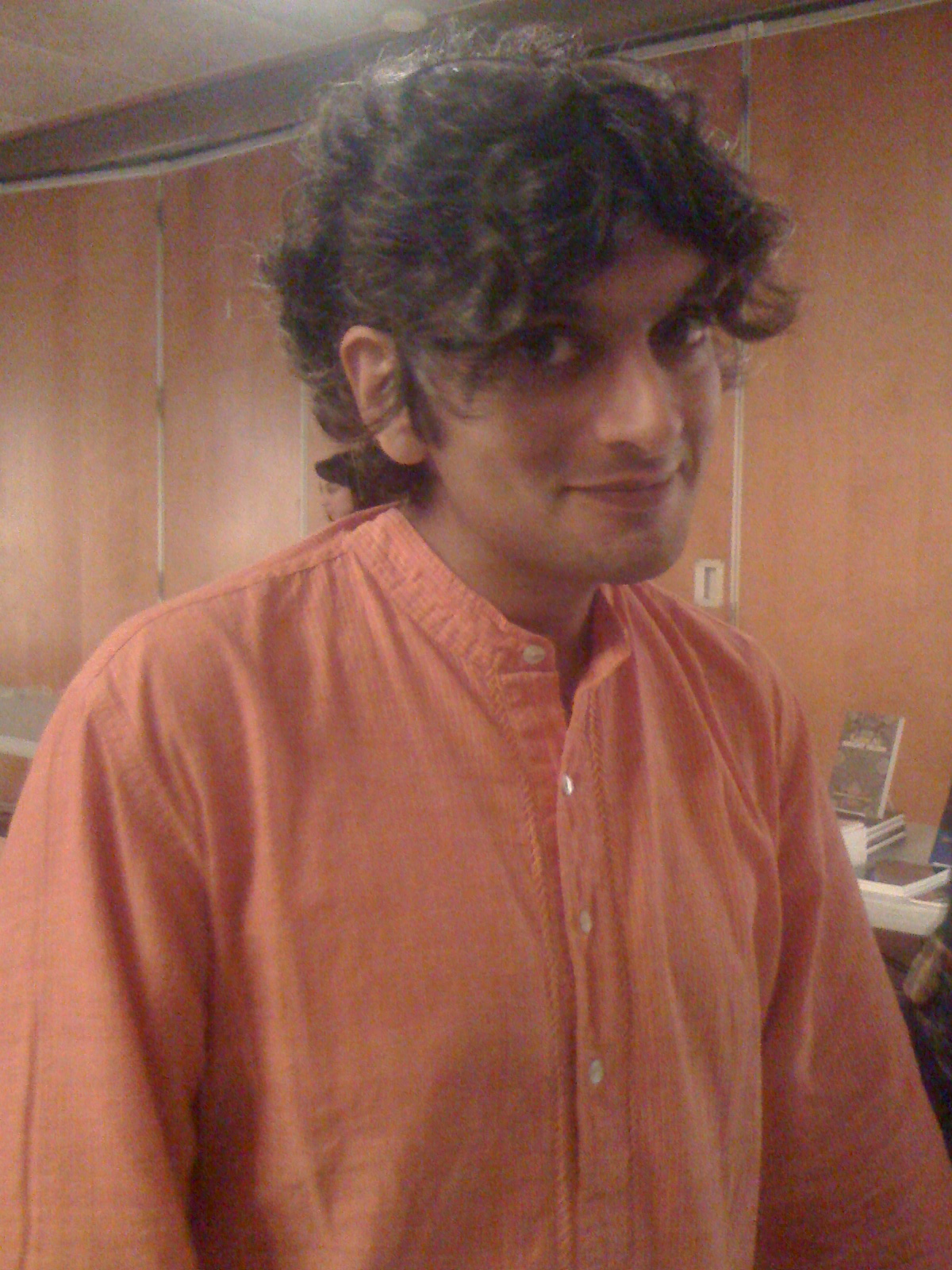
Tonight was the annual Fundraiser for the Squaw Valley Poetry Conference. The two hour reading takes place at The Starr King Room of the Unitarian Church in San Francisco.  The poets were Forrest Gander, Brenda Hillman, Evie Schockley and Dean Young. Also Kazim Ali, whom I wanted to meet. Last year I got his book, The Far Mosque, and liked some of the poems there. He was born in 1971, which makes him almost forty, and his manner is easy and relaxed, with  poetic presence that makes me sense he will continue to shine. After he read the poem Dear Shams –which appeared on the back page of APR Volume 39 – I shouted, YES!   (Oh yes!) Here it is: my favorite poem of the evening.

Dear Shams

There’s no answer to winter
watching the sun set over water

it falls so quickly
you have not been lost

branches, oligarchs of  the sky
everybody listening for silence

where and where did you go
twelve-stringed music, rejoin me

in the sun-year I swelled long shadows
in the moon-year the valley folded itself up

Poet Kazim Ali

you are the beloved I would not love
at the fountain witless and still

a stream pours over rocks making music
could the water rush over me

the sun drops so quickly into its banishment
could I please forget to breathe and drown

will the ocean rejoin me
you have not been lost

can I be reborn as a guitar
will you be reborn as music and hum inside me

one day you stopped looking at me
and I knew

the last note is lingering in the box
of my body

you did not vanish in the marketplace
I still imagine you in me as my breath

broken in thirds
corded to sound

I took your name when the sun came up
sun of winter, sun windless and wistful

come down across the water
undone sun give me the drunk go-ahead

last time I searched for you
this time I become wooden and resonant

prepare yourself in pure sound
last time I raved without senses

oh pluck me my angel my paper-maker
I want to feel you hum inside me

pluck me pluck me
and hum

<>    <>              …and he read the poem, Dear Rumi with the lines:

…At the fountain in the village square,/ the books are still sinking, bereft of your hands.

Even the mountains are bending down trying to save them...     [This guy is amazing!]

But there were other poets and poems.

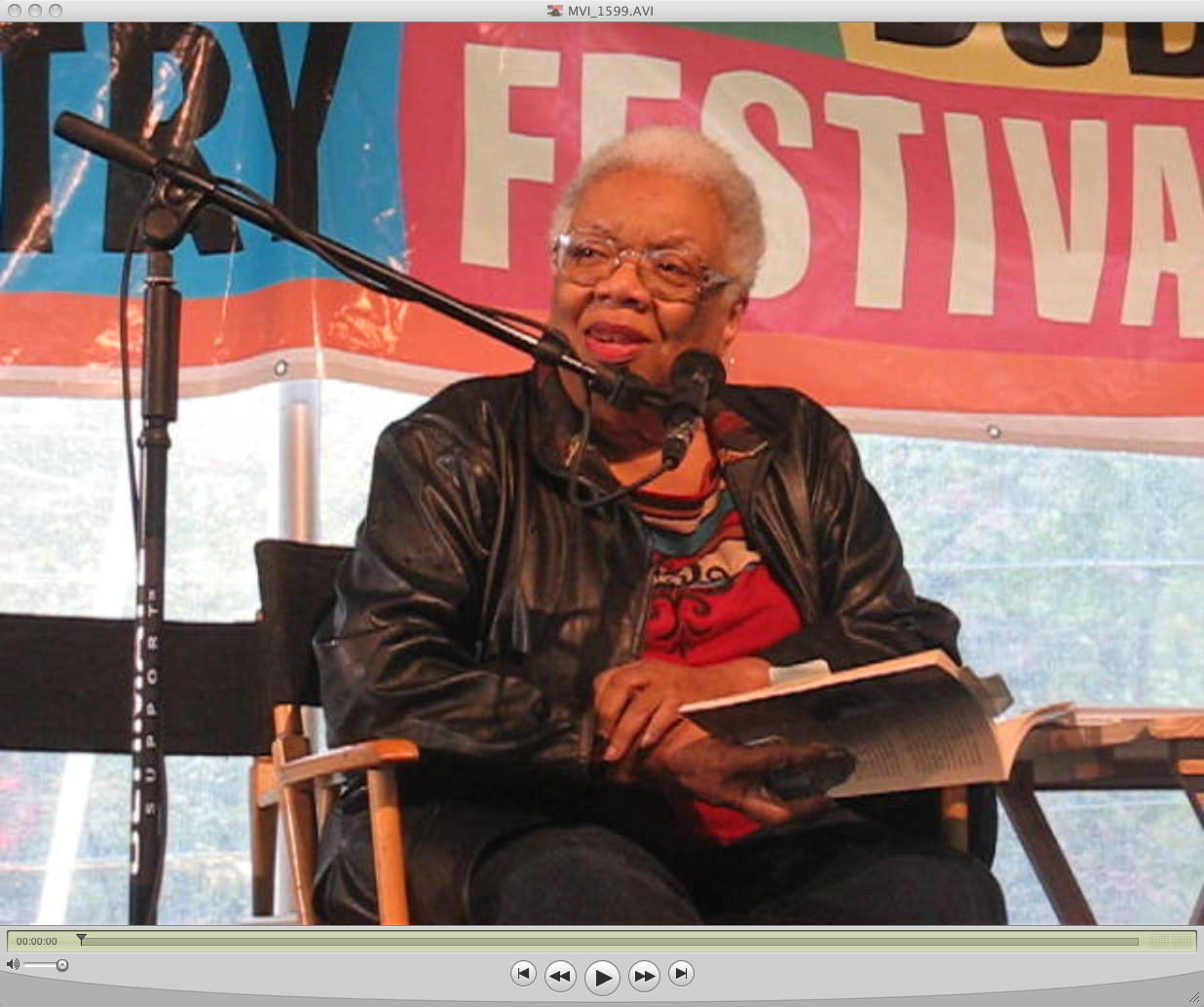
Last time I went to this event, Lucille Clifton read.  Tonight was a series of tributes and remembrances by the featured poets. Brenda Hillman read a couple of fox poems, both hers and Lucille’s poem:

one year later

what if,

then,

entering my room,

brushing against the shadows,

lapping them into rust,

Lucille Clifton 1936-2010

her soft paw extended,

she had called me out?

what if,

then,

i had reared up baying,

and followed her off

into vixen country?

what then of the moon,

the room, the bed, the poetry

of regret?

<>   <>

A wonderful evening of poetry from excellent poets! Lucille, you are missed!

Untold, wordled in a cloud of words

15 Tuesday Jun 2010

Posted by Tea-mahm in Poetry, Travel, Untold, word-dancing, wordle

≈ 3 Comments

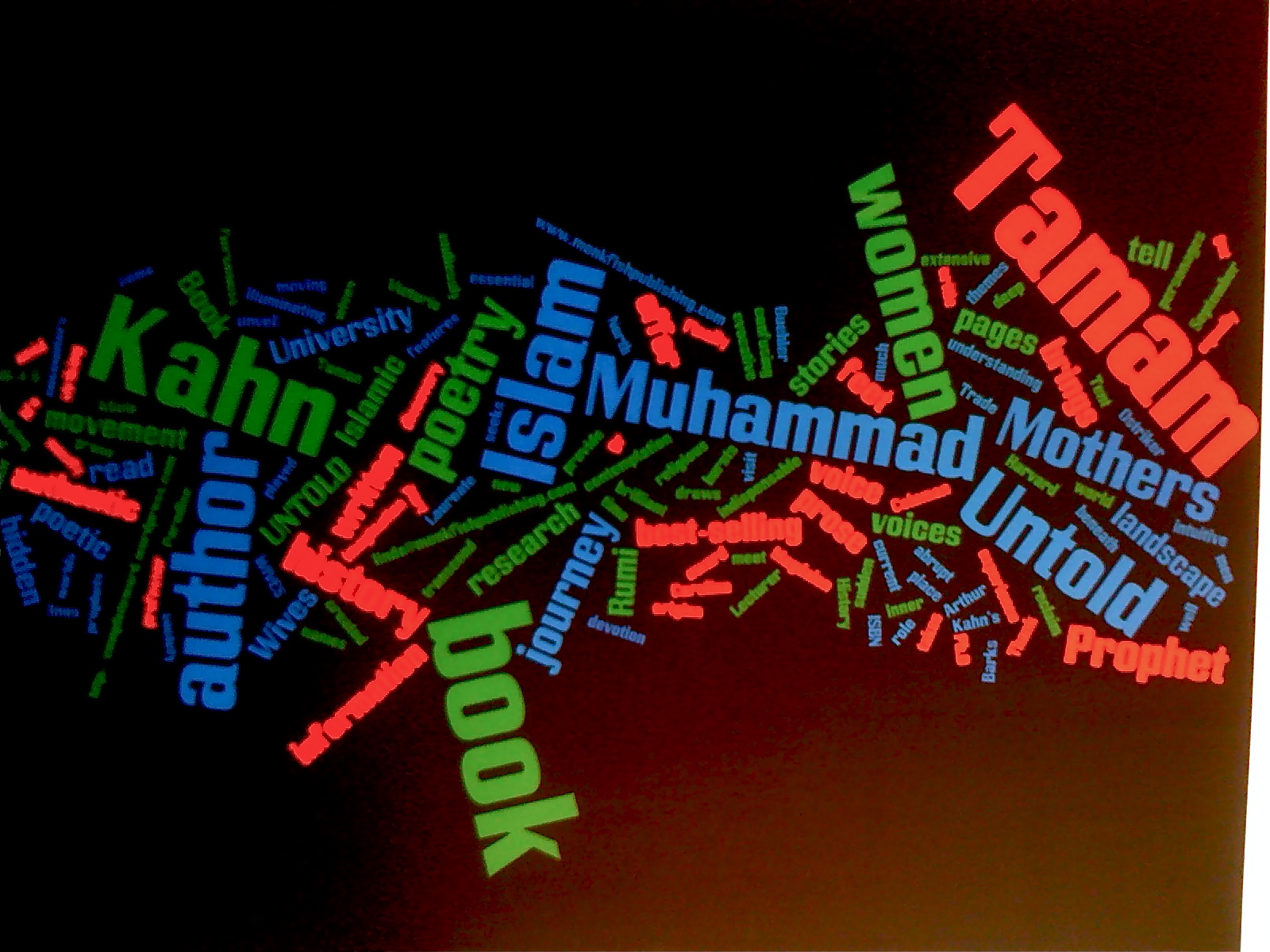
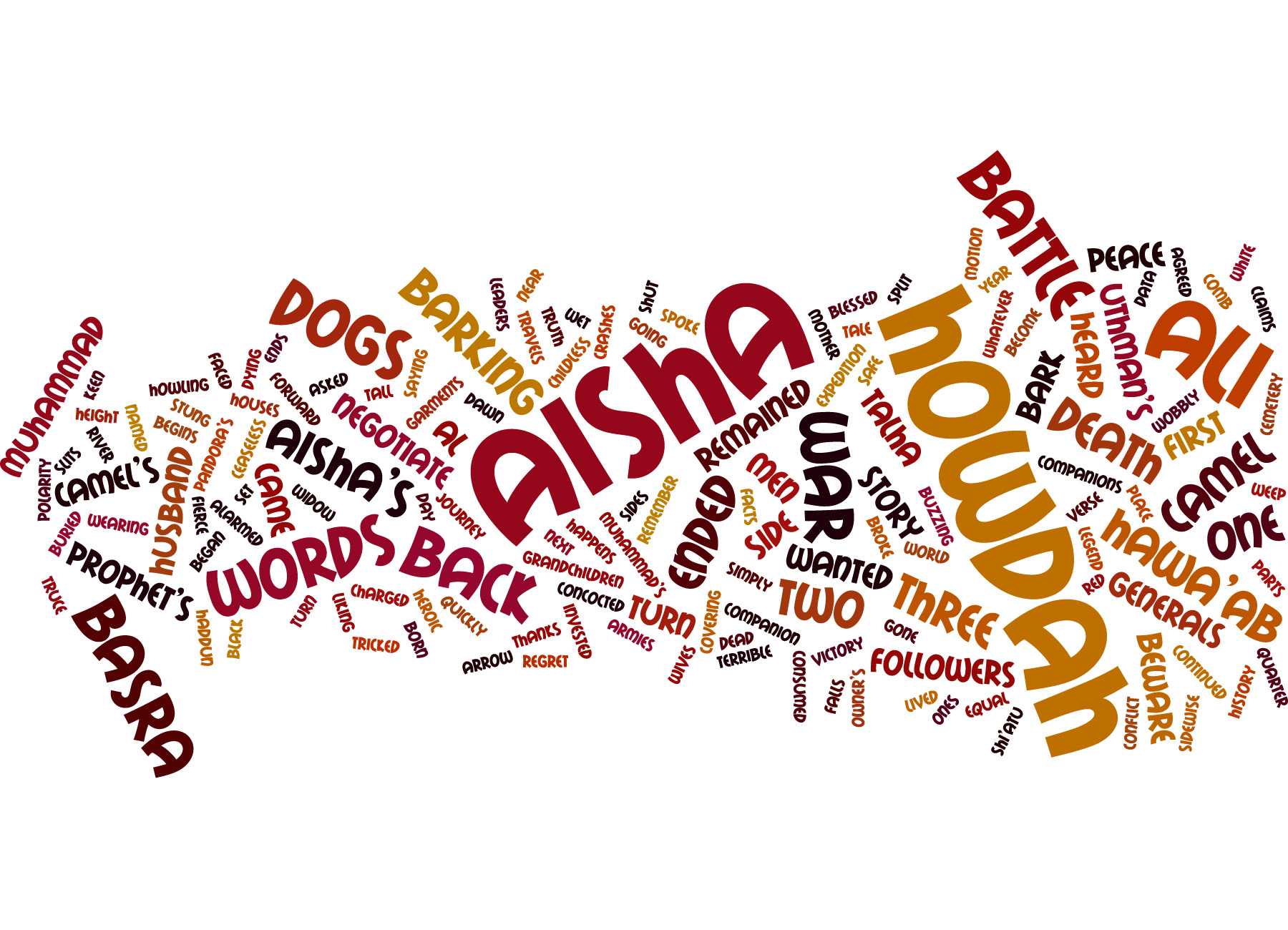
I’ve discovered wordle.net! To do this, go there and paste in some text. I dropped in my promotional material and the pattern above was chosen, with the most used words appearing larger. I decided to put in selections from the chapter on ‘A’isha, with “The Battle of the Camel”  featured, and here is what appeared:

‘A'isha and The Battle of the Camel

Here is some of the text from Untold: A History of the Wives of Prophet Muhammad:

“Beware the barking dogs of Hawa’ab” is a phrase from the legend of ‘A’isha’s journey to Basra. In this tale, there were dogs in the town barking or howling. This caused ‘A’isha to remember Muhammad’s warning. Alarmed, she wished to turn back. But her generals, men invested in war, tricked her into going forward. Was this a story concocted by ‘Ali’s followers to discredit her? Whatever the truth, she continued, riding first to Basra, then to a place near the Tigris River where the armies faced each other and the leaders began to negotiate a resolution to the conflict. During the night fighting broke out and the truce ended ended quickly — with war. Untold, p. 44.  [This is followed by a poem]

<><> owner’s manual: the howdah

The father of this howdah is dawn with no birds. Its mother is a lost prayer. This is the story of ‘A’isha, the ride to Basra, the sidewise motion of war. It is equal parts the camel’s wobbly stride and a woman’s keen eye.

The howdah is a covered platform strapped to a camel’s back. Some facts about the howdah:

ONE.              It’s arrow proof.

TWO.             One can peer out through the slits.

THREE.         Dismounting requires that the camel kneel or fall.

‘A’isha travels inside a howdah.

When her army comes to Hawa’ab, the local dogs

set up a ceaseless howl.

Beware the barking dogs of Hawa’ab She hears him say,

“Turn back and do it now!” Were those the Prophet’s words?

‘A’isha’s generals bark and bark around her. She wishes they’d shut up. She rides on.

More things to know about the howdah:

ONE.              It’s a fairly safe observation post in a battle

TWO.            Above the battle, it’s a rallying point for the troops.

THREE.        It’s a Pandora’s Box.

A war begins and ends in hemorrhage.

Ten thousand dead and dying men surround Aisha’s tall, red camel.

What happens to a howdah during a battle:

ONE.            In a fierce battle it can become a target.

TWO.            If the camel falls, the howdah crashes from a great height.

THREE.       al Hawdaj, al Haddun! The other side claims victory.

The daughter of this story is a crushed bird. Its son is a desire for peace

folded in to that unspeakable war. This is the story of ‘A’isha

as Shahada. The story over and over, between one breath

and the next, anywhere else than this.    Any other outcome. <><>

endnotes:~ This is a phrase that may have been yelled in battle as a great animal with a howdah fell heavily al-hawdaj,– the howdah, al-Haddun! – the heavy, tumbling, fall.~ “Beware the barking dogs…” was, according to some accounts, something Muhammad had prophetically told ‘A’isha years before (hadith). ~ Shahada means witness.

pages from Untold about Zaynab b. Jahsh

One morning Zaynab opened the door to greet Muhammad and something happened between them. Some say she was wearing only a single garment, and that he closed his eyes and said, “Praised be God the Great, praised be God who turns hearts!”…. Untold, p. 49.

<>~<>~<>

09 Wednesday Jun 2010

Posted by Tea-mahm in A History of the Wives of Prophet Muhammad, Announcements, bookstores, Poetry, Sufi

≈ Leave a comment

The Abode, Omega, and Monkfish Books

03 Thursday Jun 2010

Posted by Tea-mahm in Monkfish Books, Omega Institute, Poetry, Untold, Updates

≈ Leave a comment

The Ram Dass Library at Omega Institute

First we sat on the runway as the storm broke around us, closing Dulles Airport for an hour. Finally, around 10:30 pm, we rose into cumulous towers, as lightning lit every window. Soon we viewed the storm along side the right wing – a lightshow inside a gargantuan cloud, it’s black edges swollen with rain. For a good ten minutes we flew next to this vision. The full moon rode the wing.        The next morning I opened an E-mail sent on our travel day:

…the evolutionary reset begins today 9:44 pm (East Coast time), illuminated and amplified by the Full Moon. Uranus, (lightning bolt of awakening), is activating a new evolutionary cycle as it completes its 84 year journey from Aries through Pisces- and begins again, at this moment. Big celestial event…. Uranus into Aries: spontaneous innovation, unprecedented originality, adventurous experimentation!

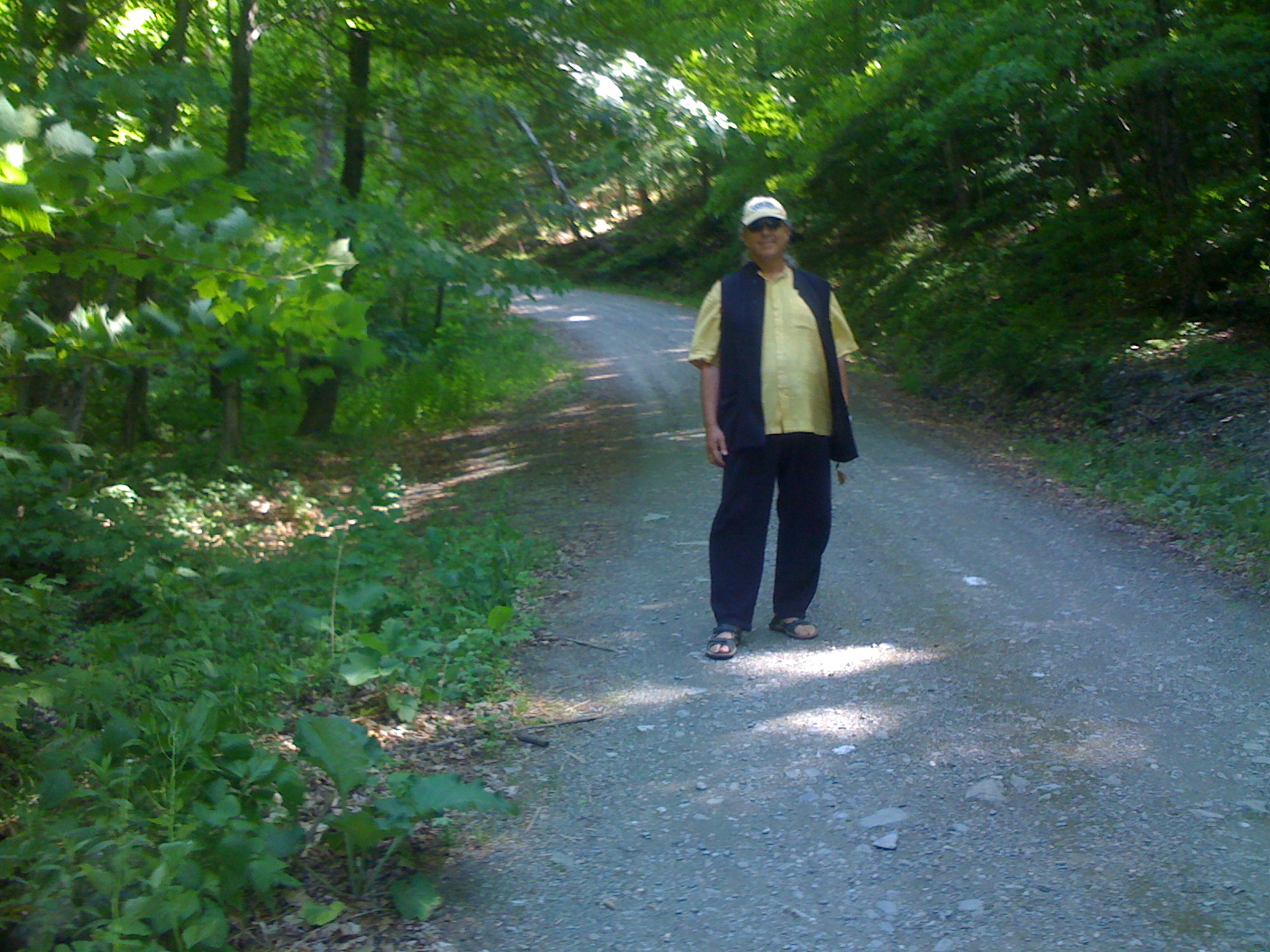
Shabda on the road up the mountain behind The Abode of the Message

Seven Pillars:  We traveled to Albany, New York on that energy, then drove to New Lebanon and arrived around 2:00 AM. We had come to participate in a Guiding Voices Conference of The Seven Pillars House of Wisdom. I kept turning over in my thoughts what wisdom might be. I felt it as rooted to the feminine and nature.

http://www.sevenpillarshouse.org  <> Seven Pillars exists to support the advancement of wisdom in the global culture.  By wisdom is meant knowledge that is rooted in the experience of the heart.  This is knowledge that recognizes the universe as the living expression of a sacred unity…

I took pages of notes on the two days of meetings, but I have misplaced them. Here are some highlights: Shabda and I hiked up the mountain behind the Abode, which is in the Berkshires near the Massachusetts border. We went to the place Pir Vilayat used for retreat when he was alive – The Pod. The woods were beautiful and full of delicious sounding streams and songbirds.

Here are some highlights from the conference: I connected with Paul Devereux’s talk on cosmology, and the notion of one’s place in the physical world. Dot and surrounding.

Conference of the Guiding Voices

I read from Untold, participated in a high energy evening of dance and Zikr, lead by Shabda; engaged in moments of personal sharing with members of the group; and finally was ceremonially handed a pomegranate by Janet Piedilato.

<>  Omega Institute. We met our old friend, Stephan and his lovely wife, Annette, had lunch and a golf cart tour of Omega Institute on Memorial Day.

The award-winningOmega Center for Sustainable Living

That evening I gave a reading from Untold at the Ram Dass Library at Omega with my Publisher, Publicist, and book designer present! I met Elizabeth Cunningham, Monkfish author of The Passion of Mary Magdalen.

Paul Cohen and Shabda at Monkfish

<> Monkfish Books! I met my publisher! We stayed next door to the Monkfish Books headquarters, on a beautiful property in Rhinebeck. A good time with excellent food and company!

Georgia's office at Monkfish Books

<> Our friend Wen drove us from the Abode to Rhinebeck then to the airport on Tuesday. We stopped at Sarah Lawrence College in Bronxville, New York, and delivered Untold to the Dean of the College. I had not been there since I graduated years ago.

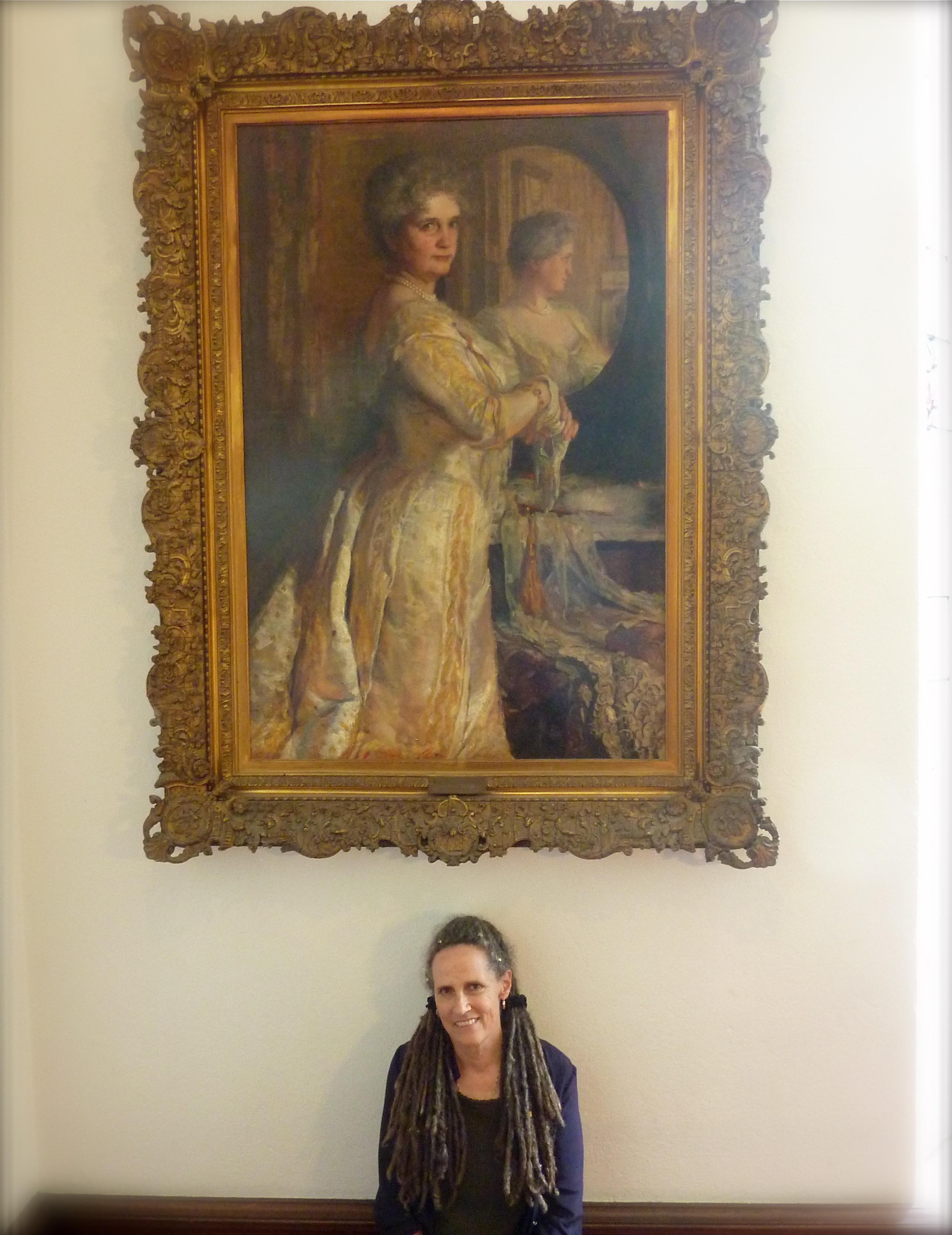
Tamam and Sarah Lawrence in Westlands

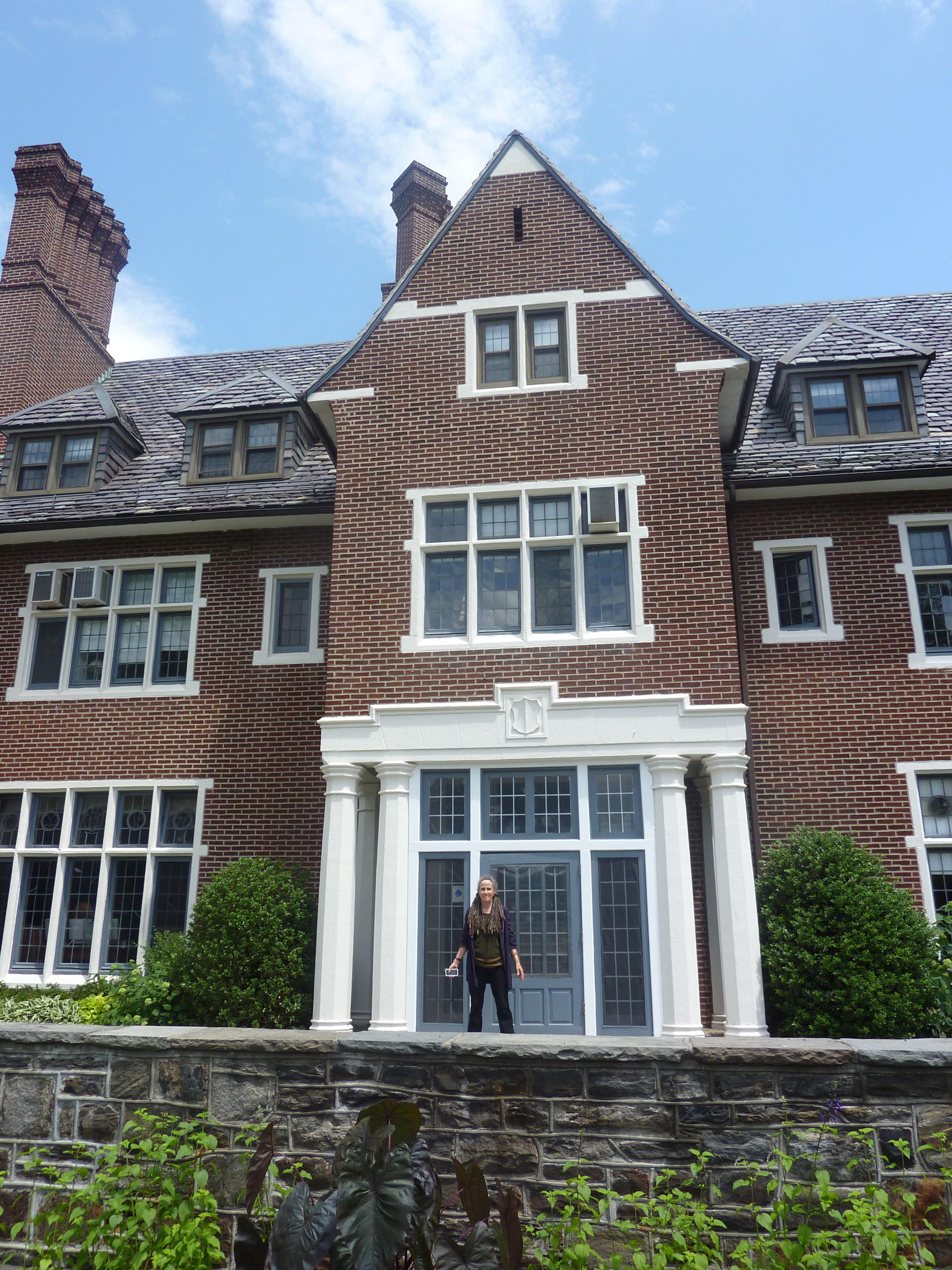
Through the window next to this painting I could see the New Dorms where I lived freshman year, and on the other side, the dorm at the library… where I shared  a suite of rooms with Karen Magid, next door to Bessie Huang and Nancy Houseman… where Tibor used to call up to me from the road, when he arrived on his Norton motorcycle.   In the place where I am standing in the photo below, I walked in my cap and gown decades ago…

Here I received my college diploma

Fred Chappell~ Shadow Box

16 Sunday May 2010

Posted by Tea-mahm in Poetry, Untold, word-dancing

≈ 1 Comment

I hesitate to write about this poetry book, because I am intimated by its brilliance and inventiveness. But then I want to stand on a soapbox and shout out –Shadow Box! Yes! It’s that good. It’s also rich, deep and chewy as a California coastal mountain Cabernet, so you need to sip and savor it. Admire the color and complexity.  Fred Chappell has written embedded poems – a poem within a poem – and made it seem effortless.

Fred Chappell is the author of a dozen other books of verse, including Backsass and Spring Garden; two story collections; and eight novels. A native of Canton in the mountains of western North Carolina, he taught at the University of North Carolina at Greensboro from 1964 to 2004. He is the winner of, among other awards, the Bollingen Prize in Poetry, Aiken Taylor Award, T. S. Eliot Prize, and Roanoke-Chowan Award for Poetry eight times over.

The Foreseeing~

If he could love her less, he might succeed in seeming unaware

of those fleet changes in her she herself would never recognize,

not seeing how her shadow that had bleached until it was

a bare half-shadow, until it was the color of morning rain, seeing nowhere

signal that it will now begin to overfill (the way that sighs

overfill breathing) its edgeless contours with a serene and depthless power,

a resistless immaculate azure-like sky-shine: and though he tries,

deception fails because she is in love again, and mist-cold

fear he can no longer flee or put from him the well-intentioned lies

comes on like April’s heartless frost to wither him once more.

Now just imagine Fred reading this with his wife Susan. He reads the non-italic phrases  and she reads the inside poem. [as in this photo.]

Here is a  review from the back of the book: “In this sharply innovative collection, renowned poet Fred Chappell layers words and images to create a new and dramatic poetic form—the poem-within-a-poem. Like the shadow box in the volume’s title, each piece consists of an inner world contained, framed, supported by an outer—the two interdependent, sometimes supplementary, often contrary. For example, the grim but gorgeous “The Caretakers” is a landscape that reveals another image inside it. Chappell also introduces sonnets in which the sestet nests within the octet. Play serves as an important component, but the poems do not depend upon gamesmanship or verbal strategems. Instead, they delicately or wittily trace human feelings, respond somberly to the news of the world, and rejoice in humankind’s plentiful variety of attitudes and beliefs. Just as an x-ray can show the inner structure of a physical object, so the techniques in Shadow Box display the internal energies of the separate works.

With this new form—the “enclosed” or “embedded” or “inlaid” poem—Chappell broadens the expressive possibilities of formal poetry, intrigues the imagination in an entirely new way, and offers surprise and revelation in sudden flashes. At once revolutionary and traditional, Shadow Box contains an Aladdin’s trove of surprises.”

<>  I met Fred in 2002 at a small workshop at UMD in Duluth Minnesota. I listened carefully to what he said. I laughed. I learned important basics about writing. I discovered trusted him more than nearly anyone with whom I had studied poetry. Then he taught at the WCU Formalist Poetry Conference in 2004. I went there just to see him. I told him I had dozens of poems about Prophet Muhammad’s Wives but no one knew their stories so I couldn’t just make a book of the poems. He wisely suggested “the prosimetrum.” I’d never heard the word but for me it was magic. I set the poems in a narrative, as Boethius did in the fifth century. I devoted several years to this. This November I will visit North Carolina on my book tour and offer thanks to my friend and  “Godfather” of Untold – Fred Chappell.

More word dancing from Mirage:

1   Somewhere sidewise lies the untitled time of earth/

before the mind becomes a work of art…

————————————————–

also recommended ~

Farewell, I’m Bound to Leave You by Fred Chappell, New York, Picador Press (a novel).

Understanding Fred Chappell, by John Lang. Columbia: USC Press, 2000.

The new Untold Trailer

09 Sunday May 2010

Posted by Tea-mahm in A History of the Wives of Prophet Muhammad, Poetry, Untold

≈ 2 Comments

I had this idea to create a book trailer after Diane Lockward posted one on the WOMPO poetry listserve. I couldn’t stop thinking about how it would help put a face to a book, the way movie trailers give a thumbnail of the film. I talked about it to all my close tec people and gathered pix and video clips, then finally we were ready and Shabda put the ideas together on imovie. Here it is –– 4 minutes with a soundtrack mostly by Hamza El Din and even some spoken word. I think this will be useful as the Publisher and publicist get ready to send UNTOLD out into the world of bookstores, etc….

Untold: A History of… three months later

21 Sunday Mar 2010

Posted by Tea-mahm in Naropa, Poetry, Sufi, Untold

≈ 2 Comments

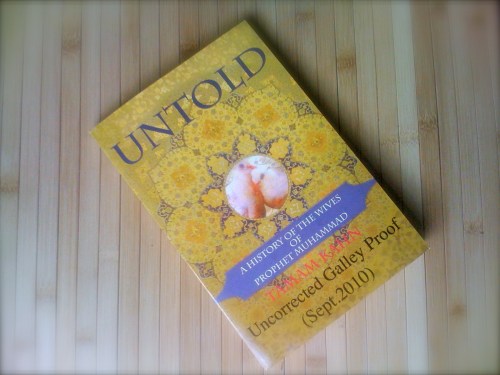
Untold: A History of the Wives of Prophet Muhammad will be released Fall 2010 as a Monkfish Books  in paperback, available in bookstores and on Amazon at that time. ”Untold” is a biographical narrative based on actual historical material with 70 poems embedded in the prose.      <>   <>    <>   <>

from the opening poem:  who do you think you are:

…I am a pilgrim, a pen with child’s heart,

following the foremothers through

doors shut on centuries of stolen words, across

floors now hushed in Saudi cement, down

steps to the cellar filled with the Hijaz story-jars.

Unsealed, the jars open their mouths,

speak to me. I listen…..

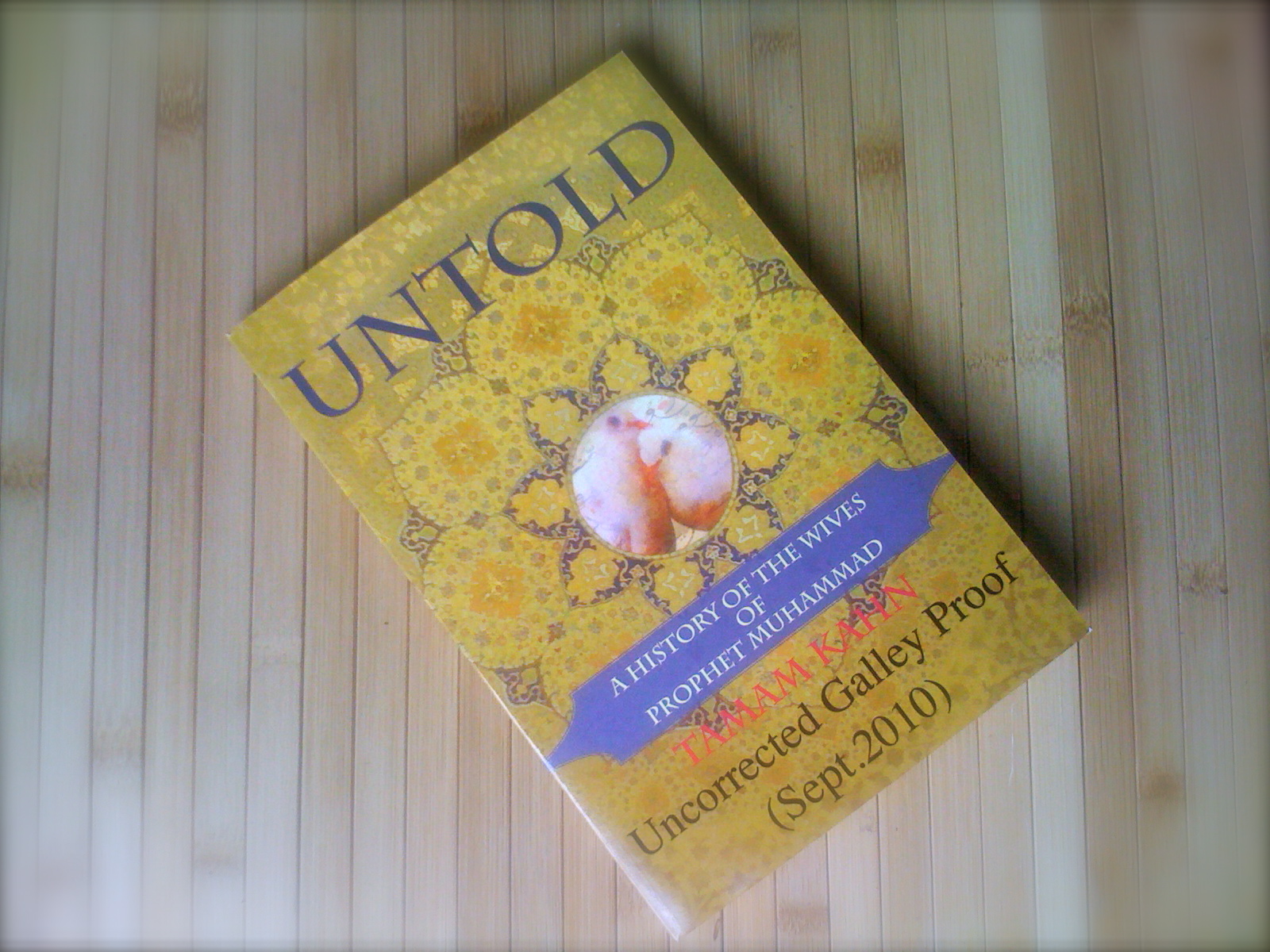
Note from the author: Untold has been out in Limited Edition Hardcover for almost three months. I am starting to get used to having a book in my life. There are readings, most recently in Colorado: Denver, Fort Collins, and Boulder. I presented at Patrick D’Silva’s Islamic Studies class at Naropa University in Boulder, and the “Allen Ginsberg Library” there ordered the book.  That was a great delight for me, as I feel this book belongs in libraries, where curious students can investigate the nearly 20 pages of end notes and learn about these brave women, nearly unknown except in Muslim communitites.  I read in Cambridge for 70 people last weekend, and prepare to go to Arcata, California in a couple weeks. Before that, a by-invitation reading in Petaluma. The “galleys” are here, and look like my book on a diet, slim and marked with black letters, as in the photo. I begin to contact bookstores for fall and winter readings. I am working up enthusiasm for “the business of books.” Remembering that “author” has to do with “authentic.”
These untranslated women, who stood in the first light of Islam, have buried stories. Here are several: Khadija is a wealthy businesswoman who hires young Muhammad; Hafsa is saved from divorce by Angel Gabriel, Zaynab, a married first cousin, experiences a moment of passion with Muhammad, Umm Salama saves a vital peace treaty and Aisha tells of death of the Prophet. These are stories known in the Arab-speaking world but not in the West. I am fortunate to have good resources: rudimentary Qu’ranic Arabic study; scholarly guidance, travel in the Middle East, and three decades as a seeker on the path of American Sufism.
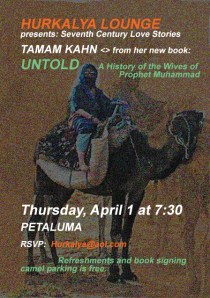
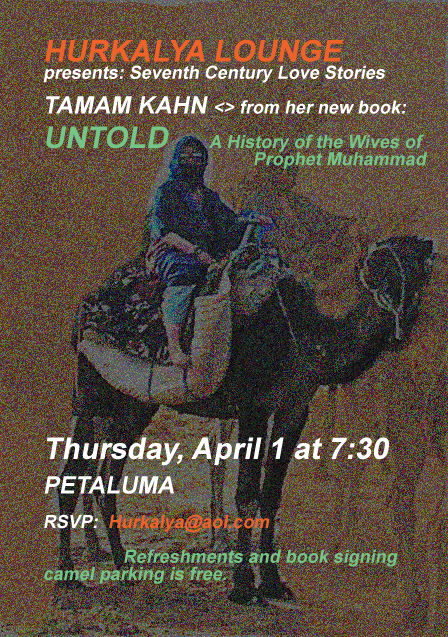
Reading in Petluma <> hurkalaya@aol.com

Comments from Distinguished Readers:

“Your book fills a great need, and does so with beauty.” Pir Zia Inayat Khan

<>”Untold is a riveting hen-house of delight, a book based on subjects our society finds endlessly confusing — marriage, matriarchy, and Muhammad. Finally, we get to meet the first women of Islam. Tamam, thank you for doing this brave book.” ~ Coleman Barks, author, The Essential Rumi.

<>”This book is a movement to remind us that the prophetic experience and revolution are inner as well as outer, and beyond time or place. The women on these pages have as much to tell us now as they did then. Tamam has created a new genre of Islamic literature. Through her poetry she draws us to the Mothers of Islam by illustrating, exemplifying, and embodying actual human beings. Her vibrant words provide a doorway to the Wives of the Prophet.” ~ Arthur F. Buehler (A.M., Ph.D. Harvard) Senior Lecturer, Islamic Studies, Victoria University, Wellington, New Zealand (2004–present),

<>”Untold takes us on Taman Kahn’s moving, personal journey of discovery, to unveil the hidden history of the wives of the Prophet Muhammad. The book frees the authentic voice of these women, who came from many different backgrounds and who played an essential role in the origins of Islam.  Ms Kahn steers a middle course between Western religious prejudice and uncritical hagiography by finding the poetry hidden between the lines of reported history, itself written mostly by men. As such, this book is part of a larger movement that seeks to reclaim the voices of women prophets and saints of all traditions.” ~ Saadi, Dr Neil Douglas-Klotz, author of The Sufi Book of Life and co-author of The Tent of Abraham.

<>”Swimming amid “the names of God,” Tamam Kahn has written a brilliant and illuminating book, equally awesome in the depth of its research, the grace of its prose, and the beauty of its poetic voices.  Untold should be read with joy by any reader who hopes to transcend current stereotypes about Islam.  It is a bridge between worlds.” ~ Alicia Ostriker, poet and critic, author of The Volcano Sequence, and of Feminist Revision and the Bible, The Nakedness of the Fathers: Biblical Visions and Revisions and Professor Emerita of English at Rutgers University.

“In a sustained act of spirited research and imagination, Tamam Kahn brings Muhammad’s wives and daughters out of the shadows and into the light.  The women of ‘Untold’ have at last found their perfect teller, in voices so gemlike and clear that one wants to chant them aloud, dance to them, celebrate with them.” ~ Lesley Hazleton, author, After the Prophet: The epic Story of the Shia Sunni Split in Islam.

Notes from generous readers!

“When I read the book, it made me so happy, because what you did was so brave – I’m sure I could never have done it.  But seeing you read from this book gives me a dose of courage that I now have under my belt – for later  …It opened a door onto my imagination about the women around the Prophet (saws) which brought them to life in a way that no standard biographical information had.  With your poetry, I realized that I too, could simply imagine them as flesh and blood women, with feelings of jealousy and grief and courage and fierceness and impatience.  …I thank you for opening that door for me.”  Salama Wendy McLaughlin, Host, KWMR Sufi Radio

“The prose was like sipping a sweet mint tea; delicious – then a poem would drop in like an ice cube, bringing crystal clarity and emotion, changing the experience but not the taste.” ~ Dechen

“I am amazed at your scholarship and courage to put this information out to the world.  Saadi used the adjective “brave” and I agree.  The poetry is lovely and helps me see what it was like  to be the wife of a controversial figure.  Thank you for helping me SEE. ~ Fadhilla

“I received Tamam’s beautiful book, Untold, yesterday. It is a real gem! What a treasure.” ~ Arlene

“Your wonderful UNTOLD is now in the woods of Maine. I will spread your words.” ~Henry

“The personal entwined with the historical narrative to hold the poems is so wonderful.  I didn’t know how starving I was for this until you let me taste!” ~ Basira
Guest of His Majesty King Mohammed VI of Morocco

22 Wednesday Jul 2009

Posted by Tea-mahm in Marrakech, Morocco, Poetry, Sufi, Uncategorized, Untold

≈ 13 Comments

Tags

Marrakech, Morocco

IMG_0274

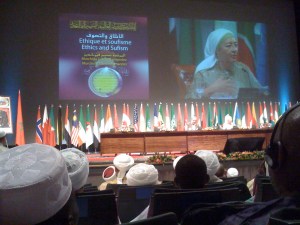
Marrakech Sufi Gathering: The Sidi Shiker World Gatherings of Tasawwuf Affiliates. I just returned from Morocco. The Royal Government paid for airfare, hotel, and food for a week. I was invited to present my poetry to a conference of nearly 2,000 Sufis. It doesn’t seem possible – but it’s true. I was there in the triple digit heat, sharing a tajine, heaped with rich and delicious food or an elevator with people from Lebanon or France.

In 1998, my husband, Pir Shabda Kahn, and I went to the Sacred Music Festival in Fez, Morocco as leaders on a “sacred journey.” We returned the next three years with groups of American Sufis and visited sacred sites and caravan-ed on camels in the Sahara. Our good friend, who made this possible, was a man named Dr. Sidi Ahmed Kostas. Now he is the assistant to Dr. Ahmed Toufiq, the Minister of Religious Endowments and Islamic Affairs for the king. Around the Summer Solstice June 21, 2009, Dr. Kostas and Dr. Toufiq got the go-ahead from King Muhammad VI to assemble a Sufi Conference in Marrakech July 10-12. They had less than a month! I got a personal phone call from Dr. Kostas while in England, waiting to go to Germany and teach from my forth-coming book: Untold: A History of the Wives of Prophet Muhammad. Dr. Kostas wanted me to read my poetry at the conference. I IMG_1270_2said yes.

Dr. Kostas set out to invite Sufi groups from all over the world and on 10 days notice almost 2000 people accepted the all- expense-paid invitation of airfare, beautiful accommodations and banquet-meals – from Minister Toufiq on behalf of the King of Morocco. 100 Nigerians. Chinese and South Africans. Americans, Europeans, Middle Easterners. It was the Moroccan travel agent’s nightmare. The conference was tri-lingual, Arabic, French, and English, with simultaneous translation for all presentations. The weather – hot as West African summer; the hotels were well air-conditioned. Marrakech is as sophisticated as it is beautiful.  The reason for this whirlwind was echoed in the words of the presenters. Sufism is recognized as a hedge against fundamentalism in Morocco. Sufi teachers and their followers hold the notion of the true meaning of Islam as ” the inner state that causes the feeling of peaceful surrender to the protection, safety, and healing of the Divine.” The Sufi is one who carries the essence of love, harmony, and beauty, and pays attention to transforming the nafs (ego). He or she may be a warrior of the inner jihad (a phrase that means to contend, to challenge the unrefined self). Sufis are known to stand together and chant, la illaha illallah (There is no Reality but The Reality,) celebrating this in joyful assembly. My definition of Sufi mysticism is: “It is the fragrance over the flower of religion.”

The king, like his father before him, recognized it was in Morocco’s best interest to promote this fragrant fraternity for benefit, and bring together Sufis from everywhere to foster connection and mutual brother-sisterhood.

Dr. Kostas and a photo of the king

Dr. Kostas and a photo of the king

The Ministry further seeks to fund and promote publication and education toward this gentle reflection of Islam in the culture of Morocco.

Of the 2000 delegates, there were less than 50 women. Three of us presented; a Moroccan scholar, Dr. Zakia Zouanate, and an American scholar and long-time Sufi friend, Murchida Tasnim Fernandez, and myself.  Several times at the break I was the only woman in the vast, hotel restrooms. The women were a tiny minority, yet

we made our presence felt. I had instant sisterhood with the few women I saw, nodding or introducing myself to Laurence from Paris, Ikram from Fez (in the photo on the left), Hafsa from Scotland, Fatima from Nigeria, Ora from New York.

P1090003_2 My poems were translated by Dr. Kostas, as we stood on the stage at the banquet close to midnight Saturday night. Dinner had just ended, but nights in Morocco seem to go on forever. Before I began to read, I thanked the King. (He was absent, but it’s not often you get chance to say, “I want to thank His Majesty, King Muhammad VI for his generosity ….”) Afterward, Dr. Toufiq expressed his appreciation to me for my work on the Mothers of Islam, and told me I was always welcome in Morocco. My friend and fellow poet Abdal-Hayy Moore read his poems as well.The next day, Arabic-speaking delegates called out to me in Arabic, smiled warmly, gave thumbs up or offered me their business cards.
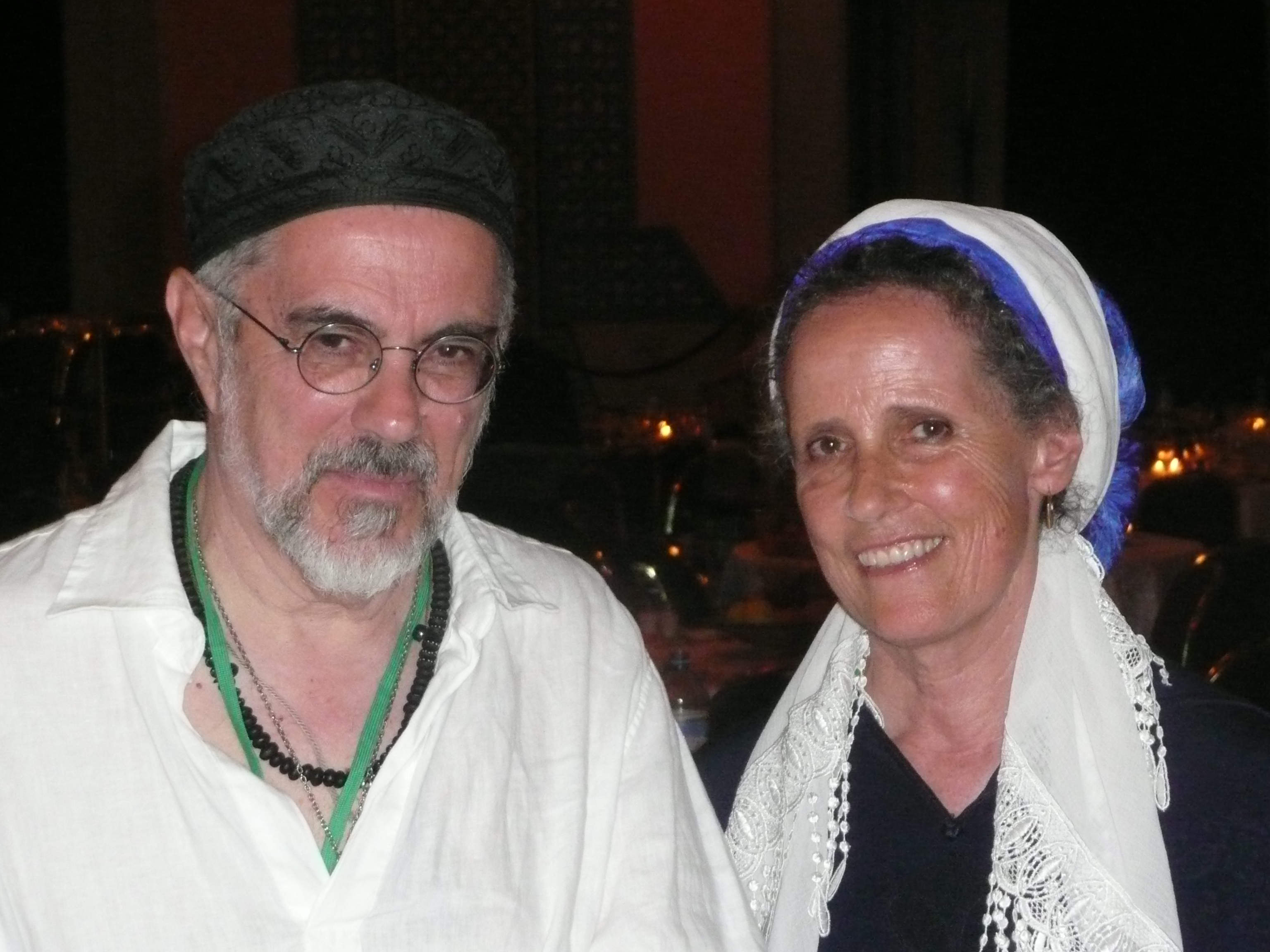
Abdal-Hayy and Tamam: banquet poets

The conference swag was amazing; the women received silver or gold brocade slippers and a stylish silk scarf; the men, an elegant white hooded burnous, a briefcase, leather slippers, an Arabic language Qu’ran, and a beautiful sacred manuscript book.

Because my name ends in a consonant, an Arabic “male indicator,” and my husband’s with the female “A,” our invitations read His Eminence Tamam Kahn and Her Eminence Shabda Kahn. Nice.

Murchida Tasnim on Sufi Ethics

Murchida Tasnim on Sufi Ethics

On Saturday, the international press was everywhere. I gave two interviews, one to Italian TV and the other to a journalist and photographer from Brussels. You could spot the women reporters in their casual hot weather clothes, while most delegates wore traditional robes called djelabas and some kind of head covering. The Nigerians dazzled – in vivid colored caftans and hats. The day we went to the desert, it was well over 105 degrees and all who went – nearly 2000 of us – ate lunch in tents with ceiling fans and a couple portable ACs. We were there all day. The women staged a take-over and claimed the large tent designated for us and provided with pillows, couches and a computer. Sleepy men left and went elsewhere. At 7:30 we all returned for dinner in a bus caravan accompanied by a police escort all the way into Marrakech, flashing lights and all.

The night before, we were driven to a palm garden just outside the city and entered the circle of tents on red carpets, lined with drummers and men playing long trumpets. We sat in chairs at tables of ten in twelve traditional Moroccan tents placed around a carpeted open space, desert style. The couscous and chicken arrived with a procession of tajine-carrying waiters. After dinner we listened to live Turkish music as the moon rose over the dark palms.

I return with new names and e-mails in my address file, my

Ahamed, Khalifa, and Sheik Tijani

Ahamed, Khalifa, and Sheik Tijani

luggage perfumed with amber from the souk, and most valuable –the gift of friendship. In this time when most people in the world are withdrawing financial largesse, when programs falter, I was conscious of how generosity on the scale of this event may bring expansion, blessing and God willing, insh’allah, the peaceful benefit of the open hand and heart.

For Italian broadcast of this event and 3 seconds while I answer the question, “What is Sufism?” see:  http://video.sky.it/videoportale/index.shtml?bcpid=1513658495&bctid=29219701001

Poetry Group – oracular pear

29 Thursday Jan 2009

Posted by Tea-mahm in Mark Doty, Poetry

≈ 4 Comments

I said “Oracular pear, and they looked startled. “Oracular pear,” I said again. Listen to the words.

Mark Doty’s craft talk at The Dodge Poetry Fest, September, 2008.

Saturday September 27, The Library Tent in Waterloo Villiage, Stanhope New Jersey 9:30-10:45,

A Conversation on Craft.  [This is my all-time favorite craft-talk.]

img_0581 Mark began with the poem “Apparition,” about a peacock named Hommer (with 2 “m”s)
at a garden center. He said, “The cry of a peacock isn’t a sound humans can make. It’s between the police car blast – when he pulls you over – and an axe murderer; not speech we can comprehend… A peacock.

…And then the epic
trombone slide-from-Mars cry
no human throat can mime…

from “Apparition” (fire to fire by Mark Doty)

Mark asks:  And what is that shining for? It stands in contrast with the influence of Modernism, say with the focus on the image, William Carlos Williams “so much depends upon a red wheel barrow…” What depends on that? Seems like everything in the perceptual world. Ezra Pound’s poem: “In a Station of the Metro,” the entire poem reads: “The apparition of these faces in the crowd; petals on a wet, black bough.” The haunted faces, all at once part of something but they have come apart.  You don’t get done with thatpoetry.

Show don’t tell. Prune back rhetoric and abstraction. Let the image do the work! But the peacock poem is about extravagance vs. necessity. Leonardo da Vinci said, “Nature never does anything unnecessary.” Hommer – a Chinese drag queen looking like a fish. How did those eyes in the peacock’s tail help it survive? If it looks like a divinity, what a nutty thing for natural selection to do! Is the peahen that difficult to attract?

The poem wants you to be involved with a person thinking about a peacock. Then there is the musicality of the poem.  Oracular pear. That’s not conversational. o-ra-cu-lar – music!  The poem wants you to experience it in a tactile way, that phrase announces musicality and complexity. Oracular pear. That’s elevated speech to ordinary discourse. Fussy language attends to the imperious, metallic topknot. This is a perennial part of the poetic impulse.  We want to have language that rises to the occasion.

He checks if anyone has a question, so I raise my hand, “What is the middle part of the process of crafting a poem?” He replies:

1. You start with a description.

2. You ask yourself, what is it that makes me want to talk about Hommer; sort of – so what?

3. What matters to me now? These are questions about the nature of being here. I remembered a comment from Darwin that those eyes in the feathers were too much. Then something began to happen, to respond to the strangeness. This is the territory for the poem to enter. I like the process of mediation between us and the world – phenomenology, where life meets between there and here. What is the splendor for? So we investigate the given.

We revise and work with poems to train and condition for inspiration.  You are teaching yourself, and that may allow something later to come together.  That will not last, but struggles are hinges that let you get to what you don’t know yet.

For the last draft, I grounded this poem by putting it at the garden center. That brings it more down to earth.

Mark’s book fire to fire, New York, Harper Collins, 2008 was the National Book Award winner for poetry in 2008. Here is an excerpt from this glorious book:

from  “Apparition” by Mark Doty

Oracular pear,
this peacock
perched in  a plywood roost
at the garden center,
magnificent behind a wire fence
marked with his name:
Hommer
(pronounced
without the extra m),
and hand-lettered instructions:
DON’T PROVOKE ME.
He’s the provocation:
of what use
the wroght extravagance
he’s not just now displaying?
Darwin: “The sight of a feather
in a peacock’s tail,
whenever I gaze at it,
makes me sick!”
No reason on earth
even eons of increments
would conspire to this,
and is the peahen
that hard to attract,
requiring an arc of nervous gleams,
a hundred shining animals
symmetrically peering
from the dim
primeval woods?
But if Hommer argues
by his mere presence
for creation, his deity’s
a little hysteric,
rampant attitude
contained in all that glory…
…And then the epic
trombone slide-from-Mars cry
no human throat can mime…

<>                        <>                        <>                        <>                        <>

More Suggestions from Mark at Dodge:

Write a long poem. Separate the “expansive process” from the “contractive.” After you have over-written your poem, then begin to reign it back in.

Rewrite your poem backward line by line (exercise Mark got from CD Wright). It frees up the poem.

On titles: get a title that doesn’t do the poem any damage. Best is a title that does work. “Apparition” provokes the reader. It is a door into the poem.

Read passionately. seek that work with which we can fall in love. Take from that influence. Style is made out of influence. Poetry is the place where your life still matters. You are on the line, putting your heart and soul on the page.

Rilke talks about making doubt your friend. What you don’t know how to say will propel you further. Then turn to artists who say so much that is unsayable.

I love the word “entirely.” Forbid yourself those words, they make easy habits. Break patterns. Confound your usual means, it will confuse and reward you. There are always new discoveries to be made when you pay attention to the world.

<>

Comments are appreciated!

<>          <>          <>          <>          <>          <>          <>          <>

Tamam’s radio interview broadcast: on-line Monday evening

15 Thursday Jan 2009

Posted by Tea-mahm in Poetry

≈ Leave a comment

Sources mentioned on the show:

 “Sufism: the Heart of Islam” with Wendy McLaughlin. I mentioned Karen Armstrong, Muhammad, A Prophet for our Time; Martin Lings, Muhammad, His Life Based on the Earliest Sources; and Reza Azlan, No god but God. These all have general material on Muhammad’s wives and daughters. I forgot to mention the classic: Nabia Abbott, Aisha, the Beloved of Muhammad.

If you search farther into the primary sources – Muhammad Ibn Sa’d, The Women of Medina; Al-Tabari, The History of al-Tabari (in thirty-some volumes); A. Guillaume’s translation of Ibn Ishaq’s Sirat Rasul Allah (The Life of Muhammad); and the Alim, CD ROM (for Hadith). Gordon Newby wrote A History of the Jews of Arabia.  From here on, road leads into road…. Ya Fattah (may the way open!)

The CD’s played on the show are: White Shade Cloud and The Woman with Muhammad – to order contact http://www.marinsufis.com   click on – music for sale and Hear a sample! .
~          ~          ~          ~          ~          ~          ~          ~          ~          ~          ~          ~          ~                            

img_0649_2><    ><     ><     ><     ><     ><     ><     ><    ><     ><     ><     ><     ><     ><     ><    ><     ><
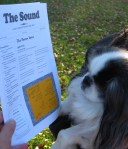
 The Sound – the annual poetry issue   
In this issue, between the digital pages:
<> Featured Poet, Philip Dacey
(On Writer’s Block and On Nonsense and Metaphor and
Shaharazad interviews Philip Dacey)
<> Drinking Poetry: The Dodge Poetry Fest
<> 14 pages of poetry, including High School Poets
<>  photographs by prize winning photographer Laura Plageman

••••••••••••••••••••••••••••••••••••••••••••••••••••••••••••••••••••••••••••••••••••••••••••••••••
Download the Annual Poetry Issue of The Sound – here.
**********************************************************************************
 img_12991 
Walter, discerning reader of good poetry catches a first look at golden
 Farsi translation of the poem “Light’s Voices” – only available in hardcopy. 
Even so, the download is a worthwhile read.
← Older posts
Newer posts →

Solomon Posts

Untold Book

Enter your email address to follow this blog and receive notifications of new posts by email.

Join 157 other subscribers

Tamam’s Links

- Poetry Group - Oracular Pear

- Youth Speaks: Poetry Slam

Links

  • Book: Physicians of the Heart the 99 Names of God – amazing book
  • Fred Chappell: short review
  • Gulf Coast Poems Poets for Living Waters
  • How a Poem Happens
  • Jamaica Osorio's website
  • Mari L'Esperance, poetry
  • Mark Doty, amazing poet read and listen to this poet
  • New Formalism Where is formal poetry today?
  • Oona and Maeve Granddaughters Oona Beatrix and Maeve Clementine
  • PoemShape Formalist Poetry
  • Poetry Out Loud! supporting the next generation!
  • Seven Pillars Book Review by Tamam Mother of The Believers by Kamran Pasha
  • Seven Pillars, POETRY poetry on Pir Zia’s blog/7 Pillars
  • Sufi Ruhaniat International Ruhaniat web site!
  • The Accidental Theologist Lesley Hazelton – a favorite writer and author…
  • The Sound Journal Tamam edits this Journal: NEW!
  • very like a whale good poetry reviews
  • West Marin radio show Sufism: The Heart of Islam, with Wendy McLaughlin

Archives

Blog at WordPress.com.

  • Subscribe Subscribed
    • CompleteWord
    • Join 157 other subscribers
    • Already have a WordPress.com account? Log in now.
    • CompleteWord
    • Subscribe Subscribed
    • Sign up
    • Log in
    • Report this content
    • View site in Reader
    • Manage subscriptions
    • Collapse this bar
 

Loading Comments...