• About Tamam
  • Poems
  • NEW BOOK! Reviews & Praise
  • UNTOLD: Book Trailer & Blurbs
  • Fatima’s Touch
  • Reading Schedule

CompleteWord

CompleteWord

Category Archives: Poetry

A Taste: Napa Valley Writers’ Conference

29 Sunday Jul 2012

Posted by Tea-mahm in Arthur Sze, Brenda Hillman + Bob Haas, Events, Forrest Gander, Napa Valley Writers Conference, Poetry, Wendy Taylor Carlisle

≈ Leave a comment

Tags

brenda hillman, writing

Every year there is a delicious writers’ conference in St Helena, about an hour and 15 minutes from my house. A couple of times I’ve attended for the week, but usually I go up for a day and immerse myself in a poetry craft talk offered at 9:00 in the morning by an admired poet.  This year I joined my friend poet Wendy Taylor Carlisle and her husband David for a talk by Brenda Hillman. Brenda is a poet with a brilliant mind and very good heart. My mind and body loves the way her talk makes me feel – often on the edge of aha – that’s it, but deeply relaxed in my own trust of her surprising word choices.

The talk began with a “bacteria” conversation, linked by scientific statements. Then she picked up the six questions listed below. There were poems to illustrate her points. Forrest Gander read a Cesar Vallejo poem in  Spanish. Eavan Boland read Cascando by Samuel Beckett. Brenda mentioned this poem touched her long ago and still does:

…the hours after you are gone are so leaden
they will always start dragging too soon
the grapples clawing blindly the bed of want
bringing up the bones the old loves
sockets filled once with eyes like yours….
 

Brenda spoke rapidly and the mic was lower than I’d have preferred, so I can only throw out a few kernels of her
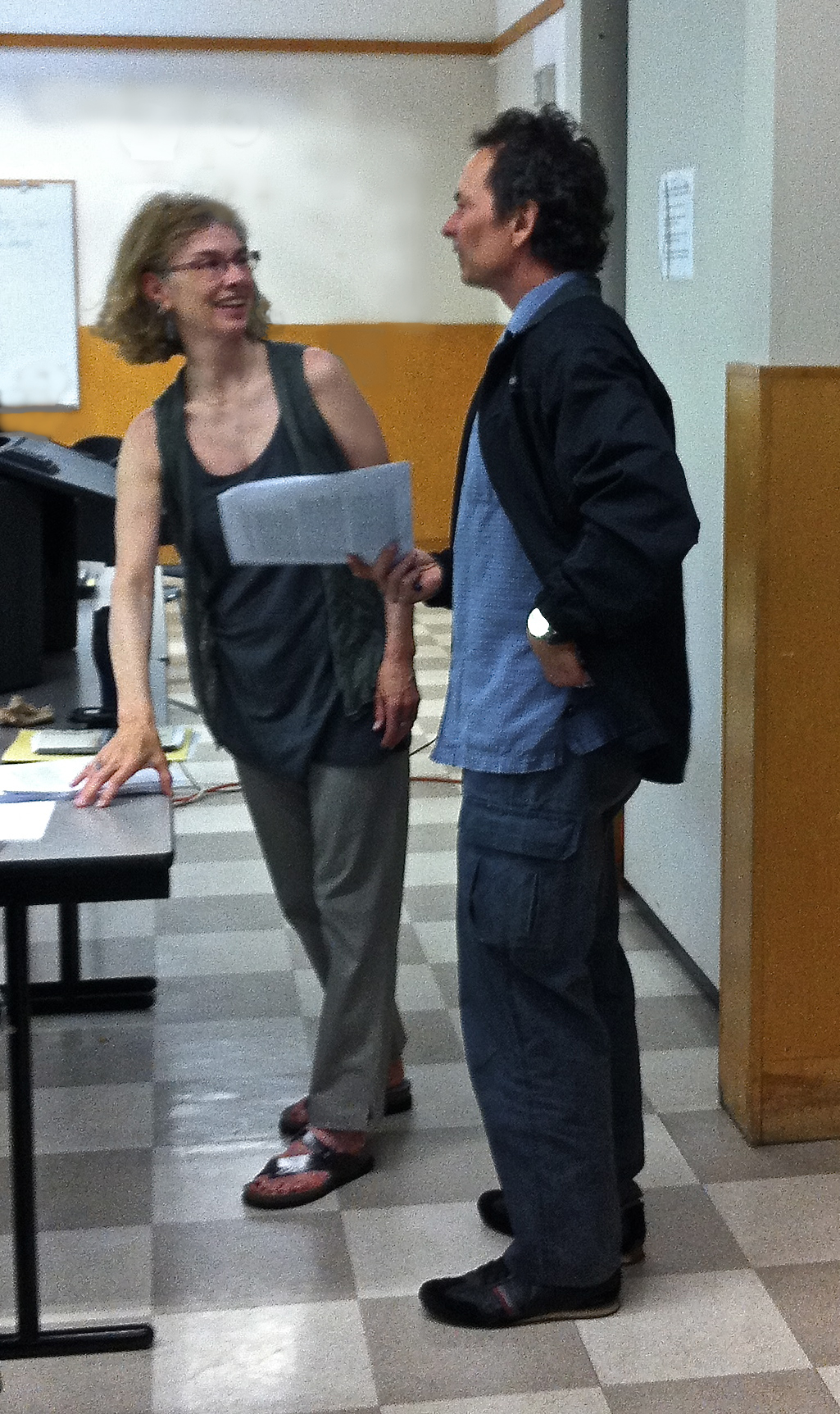
Brenda Hillman and Forrest Gander

talk: something about the mysteries of sound and sense, the balance of sound and image in her poetry. Some phrases: “Poetry that does not connect to the heart is worthless.”  ~~ “Is there an original mystery?  Mystery of language (goes into creating poetry), mystery of the non-human world, including everything that is observable that is not us. That is the shape upon which my observations and longings are formed.” ~~~ “I think of myself as disheveled wildflowers rather than a single poppy.”

She created her lecture around 6 questions to begin and end with. I loved copying them for this blog, since they are thought provoking and profound.

1  How do we find a balance between the use of language combinations chosen for their sound qualities(weird / cool diction) vs. meaning based or more image-based word combinations…?

2  The dilemma is how to write about the mystery without destroying it… This is what I know about poetry–– it is the shape on which my observations and longings are formed.

3  As a narrator, I frequently feel unreliable. Sometimes I read my own writing and I don’t know who wrote it. Might I write as someone for whom kindness is an instinct? My poems can tell stories which are true but not mine.

4  Poems as individual units and also as parts of a collection: I’m wondering about the process of putting together a poetry collection (or different ways of conceptualizing a whole made up of these individual poems or sets of poems). [I’m] wondering how much of this is determined in the initial writings vs. while you are putting together a collection… I can’t quite formulate a question, but my poems have been coming in sets for a while.

5  When / how to try to structure poems in relation to each other (rather than just as individual units)?

6   How is it going?  (Depression? Energy?  All energy in poetry is your guide). Here is a poem I like by Brenda:

Street Corner  by Brenda Hillman

There was an angle
where I went for
centuries not as a
self or feature but
exhaled as a knowing
brick tradesmen engineered for
blunt or close recall;
soundly there, meanings grew
past a second terror
finding their way as
evenings, hearing the peppermint
noise of sparrows landing
like spare dreams of
citizens where abstraction and
the real could merge.
We had crossed the
red forest; we had
recognized a weird lodge.
we could have said
song outlasts poetry, words
are breath bricks to
support the guardless singing
project. We could have
meant song outlasts poetry. 
<>   <>   <>

Other excellent poets were at the conference. Here is a taste of Forrest Gander and Arthur Sze:

A fragment from prize-Wining Poet and translator, Forrest Gander:

Citrus Freeze by Forrest Gander
 
To the north, along Orange Blossom Trail,   
thick breath of sludge fires.   
Smoke rises all night, a spilled genie
who loves the freezing trees   
but cannot save them.
Snow fine as blown spiders.   
The news: nothing……

Words from Forrest: “Art is not the waging of taste only nor the exercise of argument, but like love the experience of vision, the revelation of hiddenness.” ~~  “Perhaps eros is the fundamental condition of that expansion of meaning necessary to poetry, and of cognition itself. The father of western logic, Socrates, claimed that he had only one real talent: to recognize at once the lover and the beloved“…. from essay: Nymph Stick Insect: Observations... http://forrestgander.com/poetry

<>   <>   <>

A poem and some words from poet Arthur Sze:

The Shapes of Leaves  by Arthur Sze
 
 Ginkgo, cottonwood, pin oak, sweet gum, tulip tree:
our emotions resemble leaves and alive
to their shapes we are nourished.
 
Have you felt the expanse and contours of grief
along the edges of a big Norway maple?
Have you winced at the orange flare
 
searing the curves of a curling dogwood?
I have seen from the air logged islands,
each with a network of branching gravel roads,
 
and felt a moment of pure anger, aspen gold.
I have seen sandhill cranes moving in an open field,
a single white whooping crane in the flock.
 
And I have traveled along the contours
of leaves that have no name. Here
where the air is wet and the light is cool,
 
I feel what others are thinking and do not speak,
I know pleasure in the veins of a sugar maple,
I am living at the edge of a new leaf.  
 

 Sze said it is important to study poetry for many reasons. ~~  “Regardless of whether you go on to become a writer, all students need to understand language,” he noted, adding poetry is the most compressed and expressive writing form. “(Poets and aspiring poets) use a small number of words to create a large effect.” ~~  “Poetry asks us to  slow down and experience deeply that connection to ourselves and our world.”
Writing in Mendocino with Wendy Taylor Carlisle

14 Saturday Jul 2012

Posted by Tea-mahm in book awards, Lama Foundation, Poetry, Sufi, Untold, Wendy Taylor Carlisle

≈ Leave a comment

I leave Saturday, July 14 for Mendocino Woodlands for our annual Sufi Retreat. This year I will have Wendy Taylor Carlisle, my favorite poetry companion, to teach the afternoon writing class with me. We have traveled together and studied the written word since the mid-1990’s. I organized a small book tour in California for her when her second, award-winning poetry book, Discount Fireworks was released in 2008. After years of reading my prose and poetry,  She edited Untold. Every word. I could not have done it without her. I am lucky. She is as good an editor as she is a poet! Wendy received five Pushcart Prize Nominations, and many awards. < http://www.wendytaylorcarlisle.com/&gt; She just moved from Texas to Eureka Springs Arkansas.

If you are coming to Mendo for the week and plan to write, you are in for a treat.  If you would like to come for a day or 2 you are welcome to join the class. It goes from 4:30 until dinner in Dining-room Right. Here is a sample of Wendy’s words, a stretchy modern sonnet: Please note that the format is not exact.

THE CIRCUS OF INCONSOLABLE LOSS

There is only one ring for those sweating horses with the preternaturally                                                                                            
flat backs and the fat smooth rumps from which ladies
            in stained tights vault onto the sawdust
                        or another horse.
 
Only one ring for the hung-over clowns and their Volkswagen,
a car so old it must be pushed into the one ring
            which is also the one for the acrobats and the tigers and contortionists
                        and dogs that walk on their hind legs,
 
then stop to scratch their necks, itchy under spangled ruffs. Above them
wire walkers and trapeze guys swing,
                        mayfly-graceful. Under them the one ring
                                    reminds the audience to celebrate, each in their own
 
constrained and special way,
the emptiness they’ve come to in the spaces where other rings should be.

                                                            –from Rattle #32, Winter 2009

Wendy shows humor and skill in equal measures.

 
Snow White reconsiders (two versions: the first became a sonnet)
 
At first I knew nothing about him, imagined
his wide shoulders, his eyes dark as cloves.                                                                                                                                         
My hand tightened on doorknobs;
he could be in any room. On the dining
 
table, the plates waited for his thumbprint,
each single knife yearned toward his grip,
 
I made the seven beds: I swept,
a trace of aftershave seduced a napkin.
 
The old woman brought me a coffin.
I bit, climbed in, was caught and paned, a kiss
galloped toward me carrying salvation.
 
Impact. My lashes sprung, inaction
was out of the question. The apple had been irresistible
but what woman doesn’t later regret her appetite for fruit?
 
An early version: After She Finds Her Prince, She Reconsiders
 At first I knew nothing about you,

Tamam and Wendy in Quito…

eyes dark as cloves.  My hands tightened
on doorknobs.  You could be in any room.
Every table was set for you.  Each decorative platter
waited for your thumb-print, every perfect cloth
lacked only a trace of your aftershave
I swept the kitchen, I made these seven beds.
Eating an apple, my eyes widened impossibly
imagining  you, galloping toward me through the trees.
 

Wendy at Murshid Sam’s Dargah, Lama Foundation

Ragdale, a place for writers and artists

02 Wednesday May 2012

Posted by Tea-mahm in Announcements, Events, Fatima, Poetry, Ragdale Residency

≈ 1 Comment

I’ve been at Ragdale Foundation residency as a writer for the last two weeks. Tomorrow I leave this succulent green view from my window in the historic Barnhouse, the quiet brick courtyard below, familiar yellow walls, the ample desk, and the comfortable bed piled with papers, for my life in California, with its warm afternoons and demands on my time.

kitchen remodel, Ragdale main house

Every night but Saturday, Linda prepares a careful meal. Last night stuffed eggplant, gluten-free biscuits (she baked), salad and a chocolate-y desert. There’s wine, for those who wish. Barbara and Allison – both artists and Brett – non-fiction writer join me for dinner, the social moment of the day. Roland was here for the first week while he put the finishing touches on the renovated main house. Howard Van Doren Shaw, the architect made this his summer home around 1900. The restoration is complete and beautiful. Writers will stay there in the coming months.

For two weeks I’ve had a routine. I write, then wrap myself against the forty-something degree chill, and  walk on the prairie trails, write and eat and write. At night I choose a book from the vast library and read. Tonight it will be Mommies Who Drink, resident Brett Paesel’s funny funny book, and New and Select Poems by Gregory Orr, poems written in the seventies.

Barbara, me, Brett, Allison

Allison’s beautiful pieces light up the wall behind the 4 of us. My work has blossomed in this gentle place. Today I just sat down and wrote a poem. Straight through. An hour and fifty minutes. Usually a poem will take me all day long, in fits and starts. Me running down the stairs to print it out, then back for more revisions. Here is a sample:

Tell me darling Fatima, something about
separation. That weaning you are named for is good.
We are all homesick for before.
…The milk of knowing has nourished me.
Separation has passed through me.
I am home.

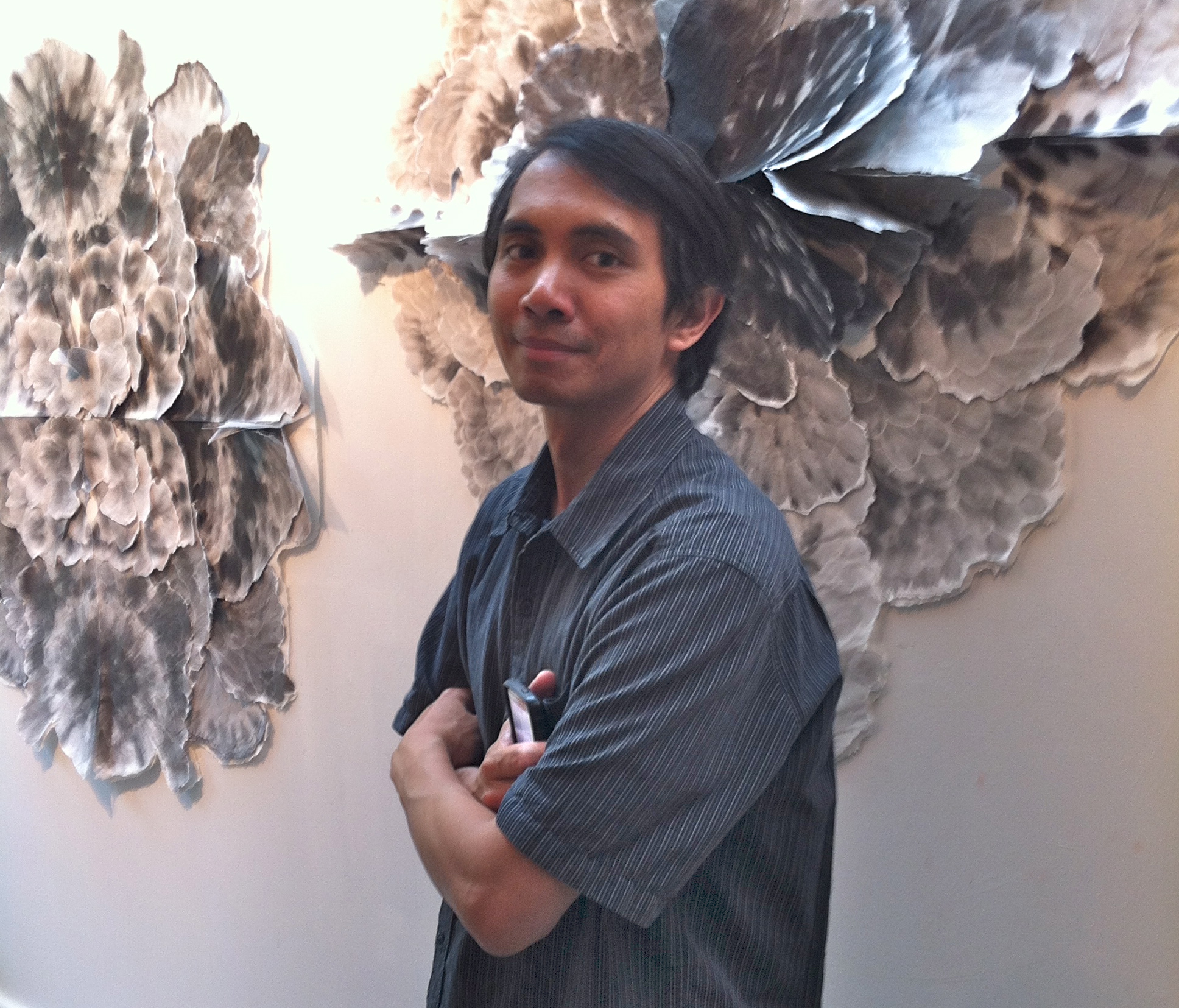
Regin Igloria - Director of Artists in Residence

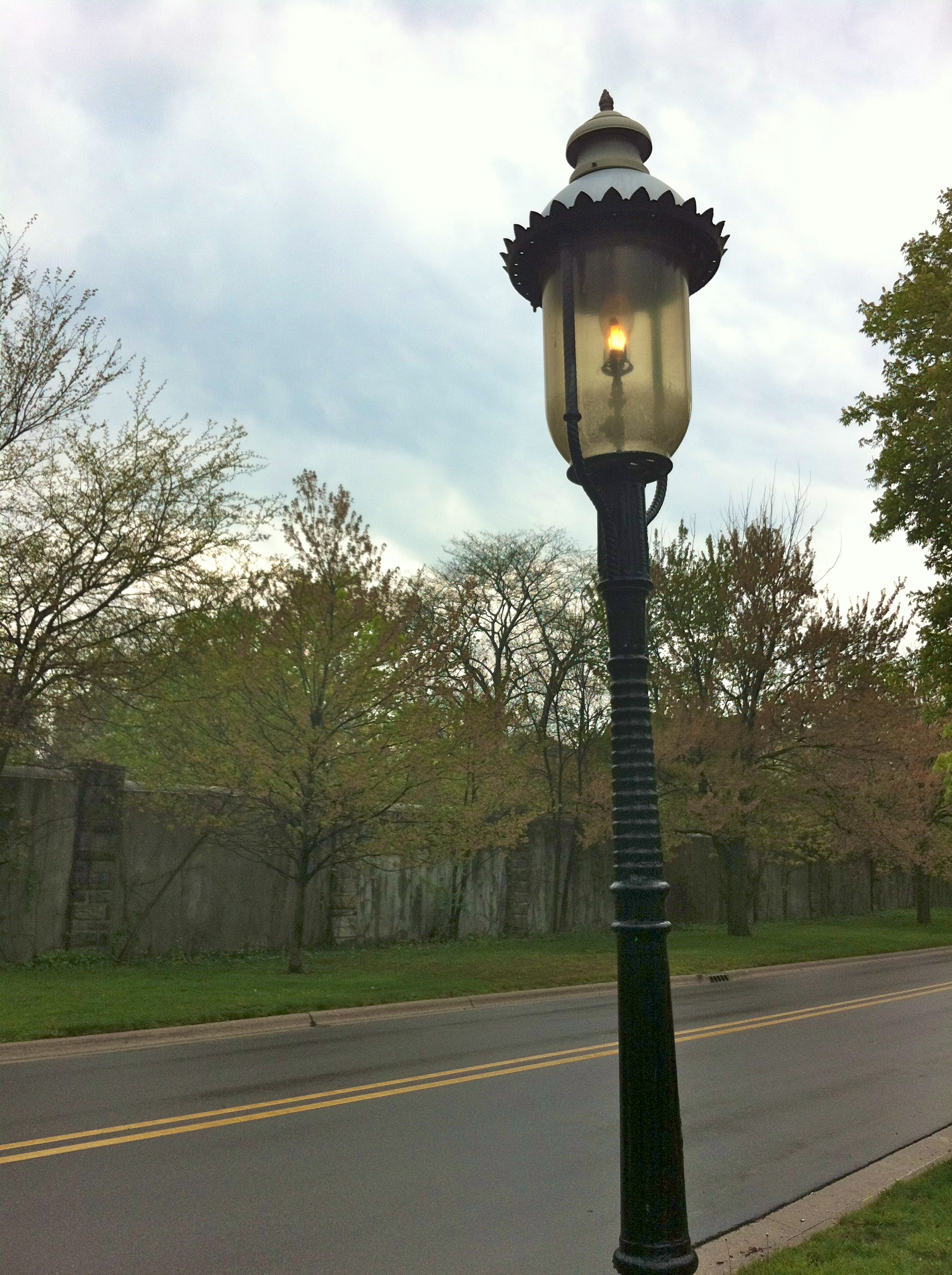
There’s a strange thing about this place. Along the straight long trail, I see the roof of the hospital where I was born. I lived here 21 years after that, and haven’t been back since the early seventies. Some part of me is at home here every day. Lilies of the Valley like my mother had around the back porch, the old gas lights on Greenbay Road. Elm trees.  Thank you Ragdale!

Writing Residency

11 Wednesday Apr 2012

Posted by Tea-mahm in bookstores, Monkfish Books, Poetry, Ragdale Residency, Travel

≈ 5 Comments

Tags

artist residency

In a few days I will fly to Chicago to enjoy a two week residency at Ragdale Artist Residency in Lake Forest. The town, thirty miles north of the city, is where I was born and lived until I turned twenty-one. California has been my residence since the sixties, and my last visit there was in about 1975, so this is a journey to my youth and childhood, as well as a time to work on my poetry.

I’m giving a talk at a bookstore in Chicago and reading from my book, UNTOLD. Here is the flyer. Will share my adventures here over the next few weeks.

Beauty at the museum

17 Saturday Mar 2012

Posted by Tea-mahm in Art Museum, Events, Poetry

≈ Leave a comment

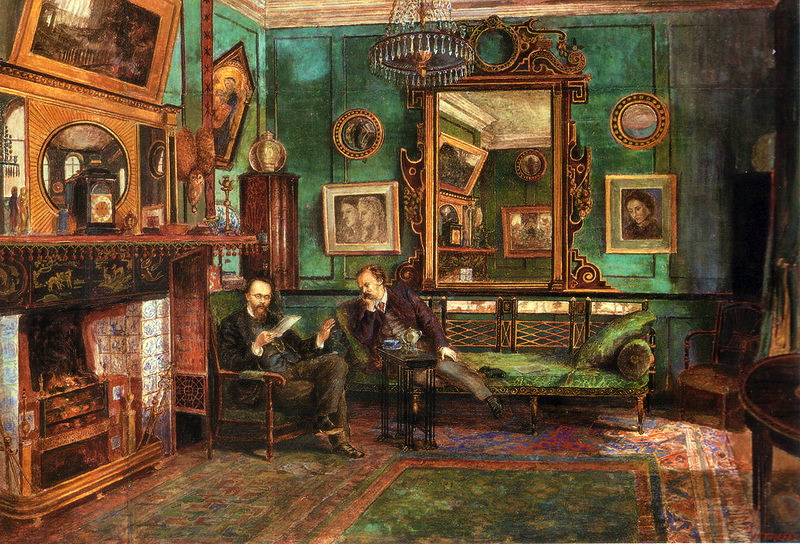
Henry T. Dunn: Rossetti Reading Proofs of Sonnets...

THE CULT OF BEAUTY: THE VICTORIAN AVANT-GARDE 1860-1900 At the Legion of Honor Museum, San Francisco February 18, 2012 – June 17, 2012. It’s time for some moments looking at beautiful art. My friend Moon Granoff had come in from Philadelphia, and today, a rainy afternoon was perfect museum time. This genre pulls you right in ––

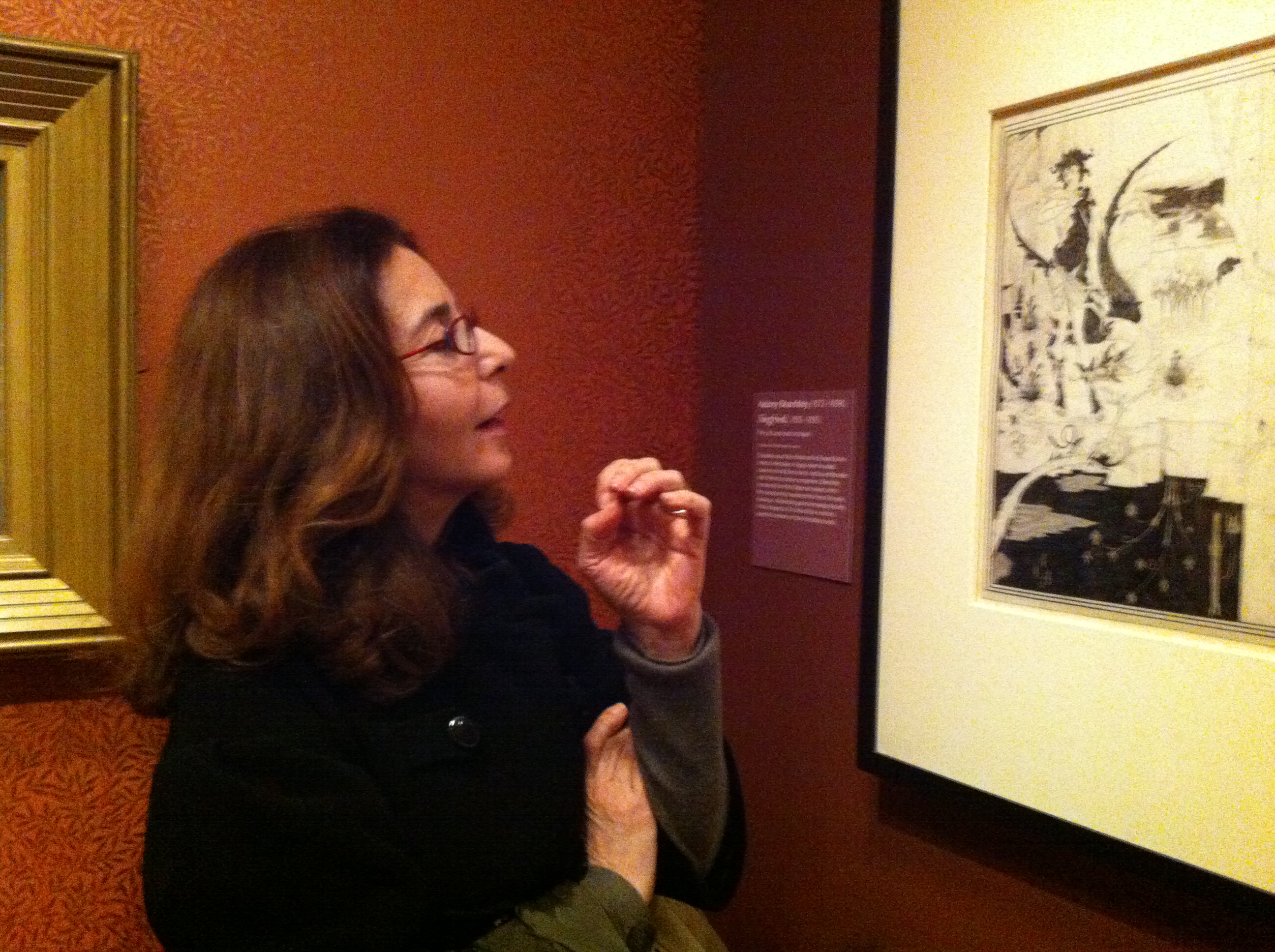
Moon marveling at Aubrey Beardsley

I followed a thread of looking at art that showed private places, quiet rooms, or intimate moments; close ups, with the focus on the mouth of a beautiful girl, or a beautiful design like the wall with Arabic and Andalusian designs. My photos are stealth, as the guards are frequent and vigilant and the signs say “no photos!” So I didn’t get all the names. But here are some things that were beautiful to see. The painting of the room (above)  has Rossetti, a painter and poet reading poetry to a friend in his drawing room.

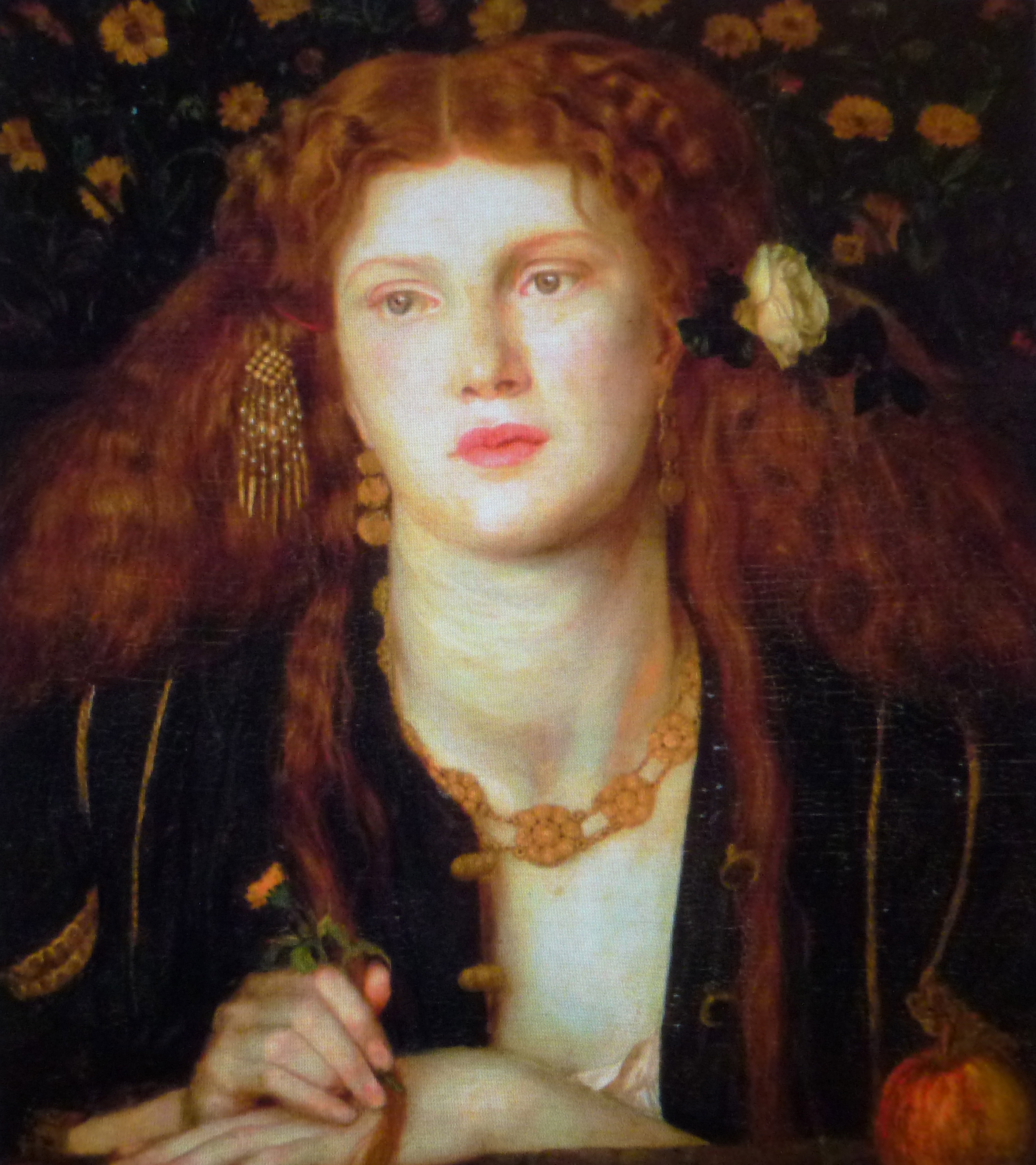
Rossetti: Bocca Baciata

<> Here is a stunning picture of  Dante Gabriel Rossetti’s mistress, Fanny Cornforth. The title of the picture (1859) Bocca Baciata translates “Lips That Have Been Kissed.”

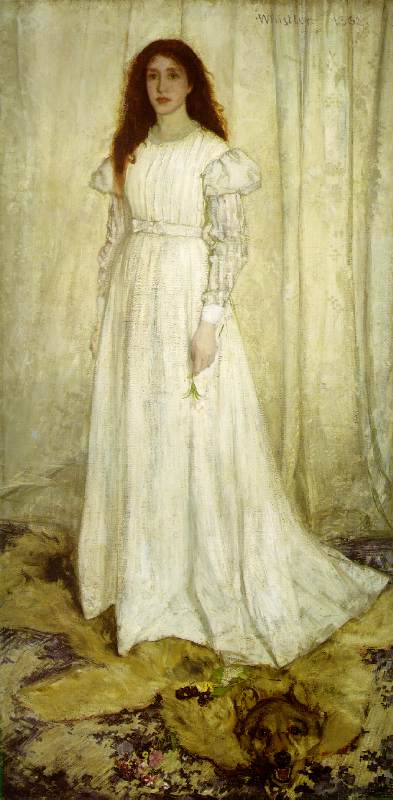
James McNeill Whistler’s 1862 Symphony in White No. 1: The White Girl (notorious for its inclusion in Paris’s famed Salon des Refusés of 1863), showing his paramour and muse Jo Hiffernan. Wow, is this beautiful! [See below]. It seems to stand larger than life. There is the relaxed abstract brushwork of the painting – except for the hands and face – similar to Manet. That is hard to see in art books. Whistler was an American who spent time in Bohemian France and England.

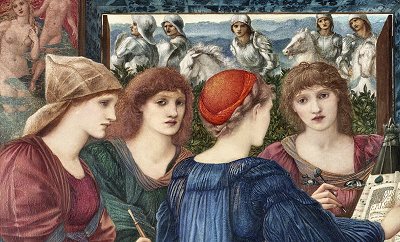
Laus Veneris (detail) by Burne-Jones 1868 seems to have come out of a poem by Swinburne, written in 1868 called From the Hill of Venus, which is about Tannhauser and his knights (see background) at the legendary home of Venus. These are her attendants, with the knights in the background. From the poem:

Laus Veneris (detail)

Between her lips the steam of them is sweet

The languor in her eyes of many lyres… …

Her beds are full of perfumes and sad sound,

Her doors are made with music, and barred round

With sighing and with laughter and with tears…


The show has many art objects, furniture, interior design, tea sets and a fantastic iron gate. What a time for beauty! But it was the light in the paintings that I carried home with me.         Enjoy! <>  <>

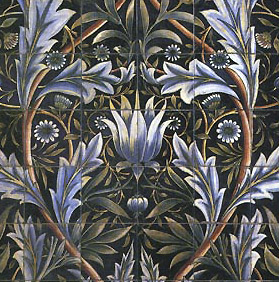
Memblandt: tile panel and design

Whistler: Symphony in White #1

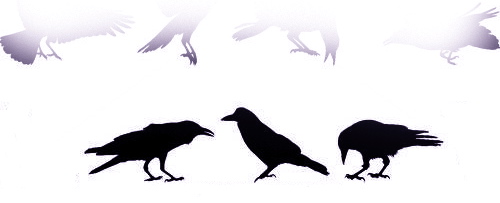
Jamaica Osorio: Three Crows a Wedding

19 Thursday Jan 2012

Posted by Tea-mahm in "Jamaica Osorio", Events, Poetry

≈ Leave a comment

Tags

three crows

I admire Jamaica as a word-crafter. I admire her bravery in the edgy political and taboo subjects she offers us. Her beautiful singing voice  and her Spoken Word invokes her beloved Hawaii. At eighteen she was invited to recite her poetry at the White House for the Obamas. That kind of opportunity for some – that moment of fame – is a flashy feather in the hat. For Jamaica, it seems to have sobered her, given her a chance to be a true and serious artist of the spoken word. She seems to have dedicated herself to speaking truth to power.  I have written of her before. I met her two years ago at a Stanford Slam. Here she is again.

Jamaica at the Loft

Jamaica Osorio at the Loft Literary Center

in Minneapolis December 3, 2011. This is a half hour piece on Youtube with Jamaica.

<http://www.youtube.com/watch?v=fxwEzMQm2xI&gt;

The last poem of the evening is THREE CROWS A WEDDING  Spoken Word. Here is an excerpt.

One crow means sorrow
two crows mean joy,
three crows a wedding,
four crows a boy,  five crows mean silver,  six crows mean gold,
seven crows a secret that’s never been told…
… Do stars leave traces of the places they’ve traveled
Do the other stars remember them when their gone
or are there enough to fill the darkness left
Are people like stars,
easily forgotten unless in constellations
Do the ones that make pretty pictures ever die
If I was a piece of the big dipper would I be immortalized
Shine there even after my space was filled with night…


Jamaica, apologies for punctuation errors… I leave for the islands tomorrow (on business) and will be sending you ALOHA  and mahalo  for all you do and are!

Blog: http://jamaicaosoriopoetry.blogspot.com

SAPPHICS and the poetic source

03 Tuesday Jan 2012

Posted by Tea-mahm in Fatima, Marilyn Hacker, Poetry, Sapphics

≈ Leave a comment

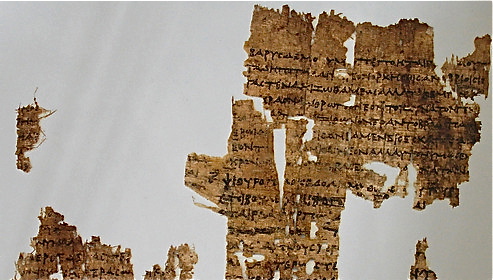
fragment of Sappho's poem on old age, assigned to Book IV, based on its meter

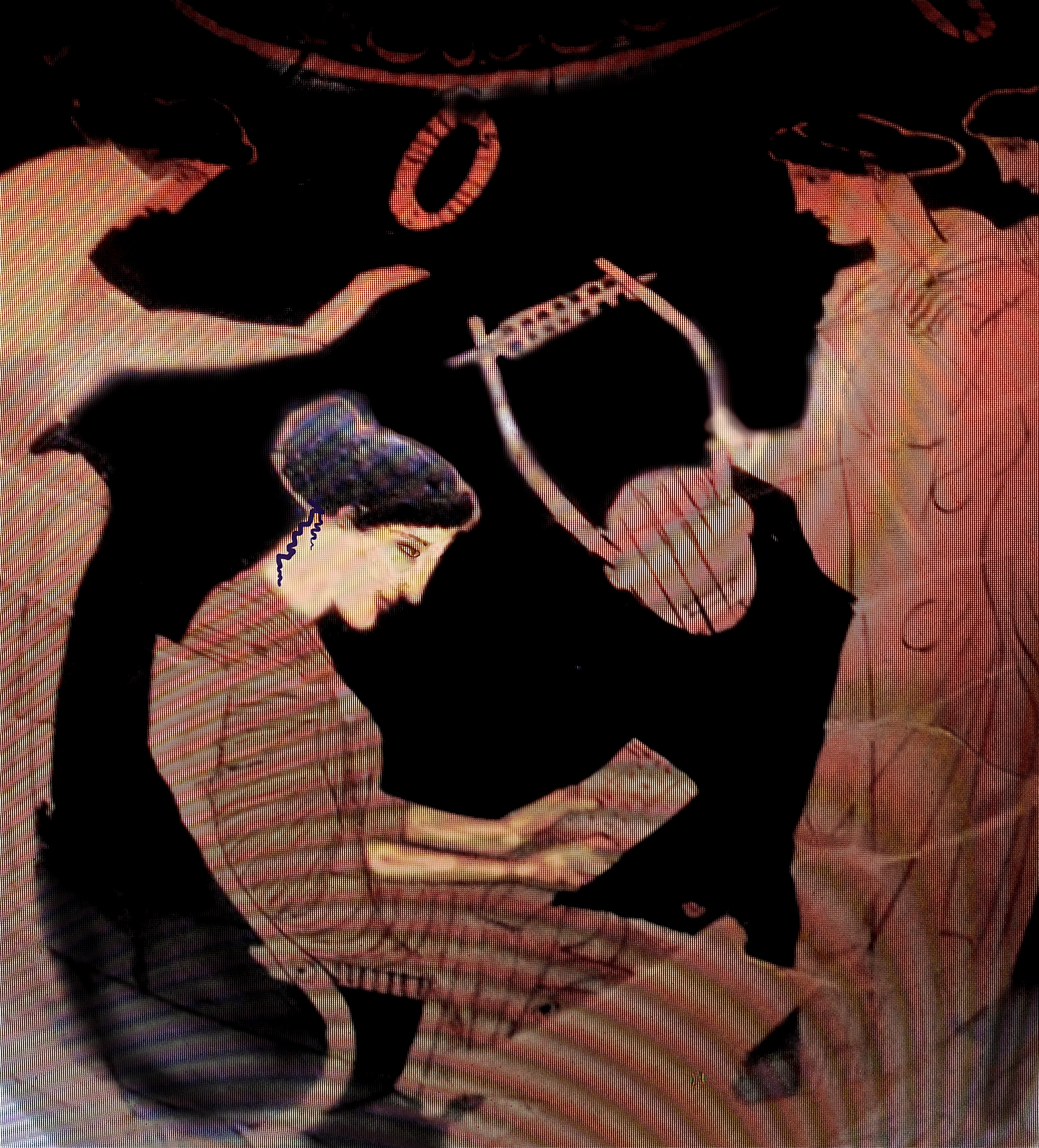
Papyrus strips with bits of Sappho’s poems used to wrap mummies, stuff sacred animals, and wrap coffins in Egypt… What?

The so-called sapphic stanza or strophe snagged me as I read along the other day. Poems by Marilyn Hacker started it.

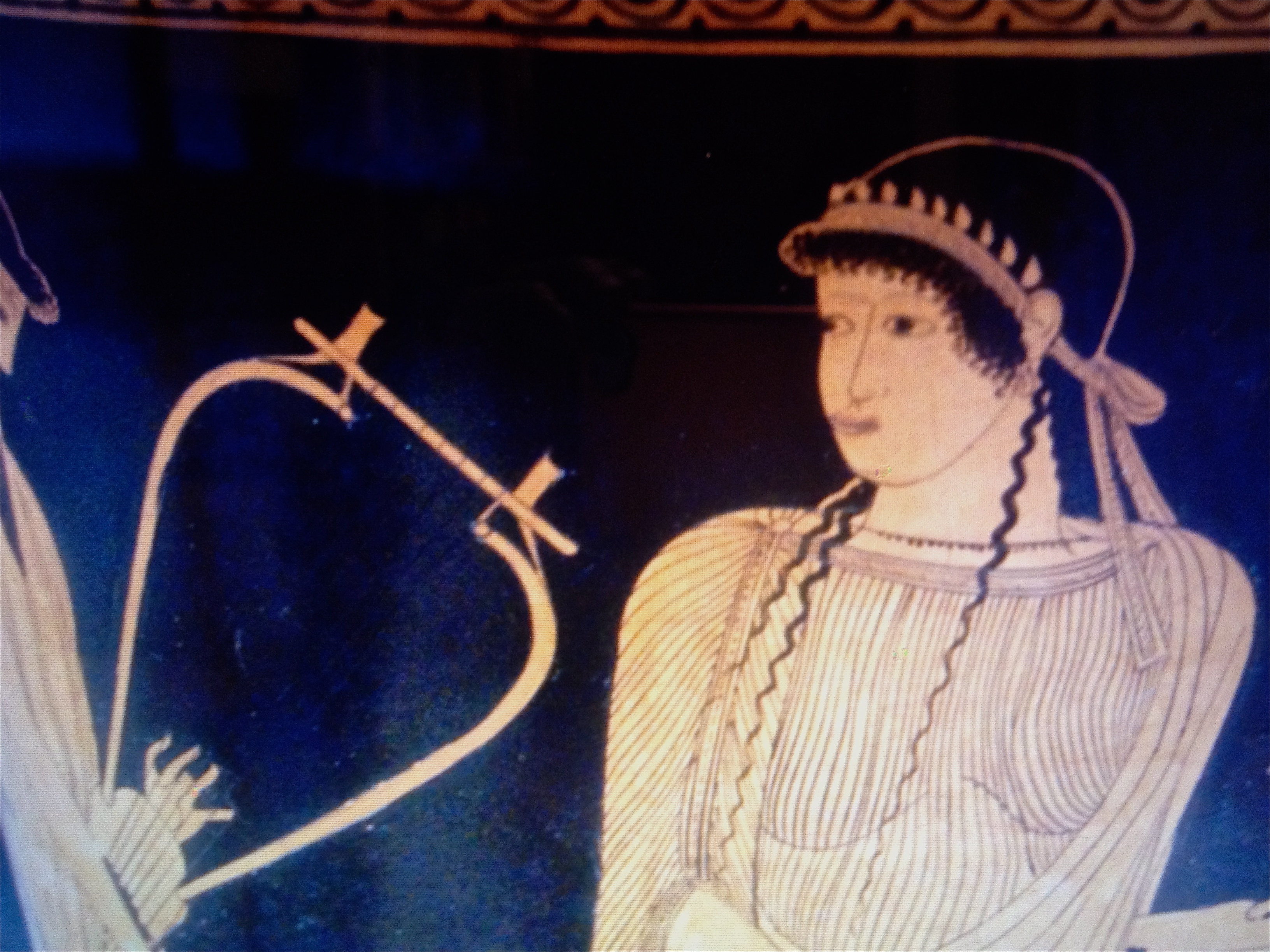
Sappho. They say there once were nine (poetry) books of hers at the Alexandrian library. She was called “the tenth muse.”

One of the great Greek lyrists of the ancient world, Sappho was born some time between 630 and 612 BC… Given the fame that her work has enjoyed, it is somewhat surprising to learn that only one of Sappho’s poems is available in its entirety–all of the rest exist as fragments of her original work… Late in the 19th century, however, manuscripts dating back to the eighth century AD were discovered in the Nile Valley, and some of these manuscripts proved to contained Sappho’s work. In the excavations that followed, strips of papyrus–some containing her poetry–were found in number… The work to piece these together and identify them has continued into the twentieth century.                                                       From < http://www.sappho.com&gt;

“Sappho fascinates us because she is there at the beginning of literature, rooted as deeply into the history of human imagination as any other writer. …she is a slate upon which anything can be written, about whom anything can be imagined, and from whom anything, therefore, is possible. Of her 189 fragments, twenty are only one word long, thirteen are only two words long, thirty-three are under five words long, and fifty-nine are under ten. There is in fact so little we know about the poet that upon approaching her work we must at least first acknowledge the extraordinary predicament of having neither text nor context with which to read it.” This is from John D’Agata, “Stripped Down Sappho,” his review of Anne Carson’s book: If Not, Winter: Fragments of Sappho.

I once spent an hour with Carson’s book. I think it was at Poetry at Round Top Festival in Texas. Pages are etched in my mind. Here’s one:

Fragment 92 (The bracket marks a lost line, torn apart or full of holes):
]
]
]                                                                     
]
robe
and
colored with saffron    
purple robe
cloaks
beautiful
]
purple
rugs
]
]

 But this is a side track – the remarkable historical figure and her mysterious writing.

 SAPPHICS: the definition from Timothy Steele ~

“Sapphic Stanza: in ancient poetry, a stanza of four lines, the first three of which have eleven syllables… and the last of which has five syllables. The stanza’s named after its most famous practitioner, Sappho of Lesbos.”

Here is the pattern./x  /x  /xx  /x  /x, three times, then /xx  /x  No end rhymes.

I offer one section of a poem I’m working on. Four lines of blank verse followed by a sapphic stanza. The metrics are in contrast, the plodding camel moves in iambic pentameter: x/ 5 times; while interruption and danger speak in trochees /x, and dactyls /xx.

 …Detained, a caravan could be at risk,
but he’s not brisk with her, and keeps her close.
She rides behind him on his mount; the way
is toward a vital well and next night’s camp.
 
        Fatima sees the dust up ahead, a worry.
        Clouds like that can mean that the well is held and
        thirsty travelers slapped with a hefty tribute.
        Outlaws and water…
<>

 Marilyn Hacker writes powerful Sapphic verse. This from “A Braid of Garlic.”

 At the end of elegant proofs and lyric,
incoherent furious trolls in diapers.
Fragile and ephemeral as all beauty:
The human spirit–

<>   <>   <>

Prophet Muhammad’s Jewish Wives

22 Thursday Dec 2011

Posted by Tea-mahm in Poetry, Untold

≈ Leave a comment

With great respect to the Miracle of the Lights, which is Hanukkah, I post this good review of my book, UNTOLD, by Pamela Frydman.  The review appeared in Tikkun Magazine March 2, 2011: http://tinyurl.com/4vvwvxb.

Part of the new material this book brings out is the relationship between Prophet Muhammad and his two Jewish wives Rayhana and Safiyya. This is a story that rarely is mentioned, but can lead to a more universal view of the early days of Islam. Here is an excerpt of the review:

A Refreshing Perspective on the Wives of Muhammad

by Pamela Frydman    March 2, 2011

Untold: A History of the Wives of Prophet Muhammad 
by Tamam Kahn, Monkfish, 2010

With ease and beauty, Untold gives readers a different perspective of Islam and its beginnings. As author Alicia Ostriker writes: “Untold should be read with joy by any reader who hopes to transcend current stereotypes about Islam. It is a bridge between worlds.”
 

 ….Muhammad had two Jewish wives among the eleven he married after Khadija’s death. Kahn begins her chapter about them by comparing the stories of Sarah and Hagar as they are told in the Torah and the Qur’an. She then shares her research about the Jewish communities in Arabia in the seventh century. Following an early battle during which Muhammad is betrayed by a Jewish tribe, he chooses Rayhana from among the captives as a wife, and he begins to learn from Rayhana about Jewish customs. When Muhammad brings home Safiyya, his next Jewish wife “from the family of Sarah,” Safiyya takes an unfortunate spill off Muhammad’s camel just as she rides through a crowd of “Hagar’s descendents.” Kahn described the scene in poetry:

…They keep looking at the unconcealed

woman, spilled out, bruised. They stare at her ankle, cheek,

leg, shoulder, arm, neck, all the shock of luxurious curls,

at the trickle of blood down her arm. Safiyya will

spend the rest of her life dusting herself off, getting up

again and again as if tripped by the shadow –

Sarah’s words to Hagar — I’ll stay, you have to go.
 

 The last line of the poem refers to Sarah, who asks her husband Abraham to send away Hagar, his other wife or concubine, together with Abraham and Hagar’s son Ishmael. The story of the Hebrew Sarah and her son Isaac, and the Egyptian Hagar and her son Ishmael, are recounted in both Torah and Qur’an and figure prominently among the stories of the founders of Judaism and Islam. In Kahn’s poem, she reverses the image, alluding to two of Muhammad’s Muslim wives who apparently taunted Safiyya for being Jewish. In the prose surrounding the poetry, Kahn writes that she suspects that Safiyya nevertheless created friendships with other wives of Muhammad and with Muhammad and Khadija’s daughter Fatima. As evidence of this, Kahn recounts that Safiyya is said to have offered Fatima precious gold earrings.

Kahn quotes author Reza Aslan from his book No god but God in which he states: “If Muhammad’s biographers reveal anything at all, it is the anti-Jewish sentiments of the prophet’s biographers, not of the Prophet himself.” In fact, positive stories about Muhammad’s Jewish wives seem to be missing from the Hadith — a compilation of stories from the community that expound on the Qur’an and the life of Muhammad and his wives and others important to the founding of the Muslim faith. Nevertheless, according to Kahn, Moroccan Sufis regard Safiyya as a murshida (spiritual teacher), who taught Torah to the women and girls in the inner circle of Muhammad’s family….

Rabbi Pamela Frydman, the director of the Holocaust Education Project, Academy for Jewish Religion, California, helped to found Or Shalom Jewish Community in San Francisco and OHALAH, international trans-denominational Association of Rabbis for Jewish Renewal.

New Poems in Santa Cruz

09 Friday Dec 2011

Posted by Tea-mahm in daughter of Prophet Muhammad, Events, Joe Milford, Poetry

≈ Leave a comment

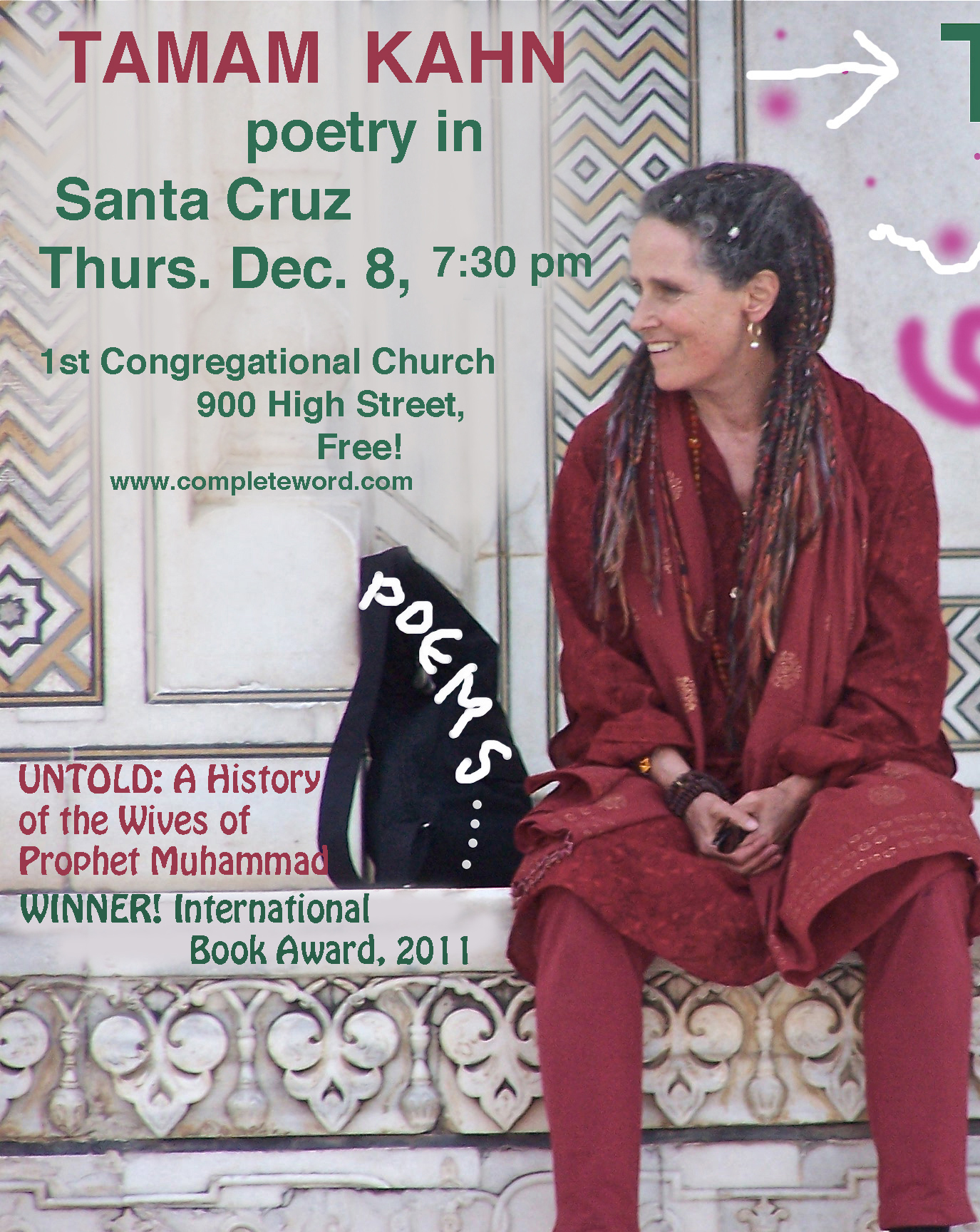
poetry reading in Santa Cruz, December 8, 2011

Last night I had the privilege of reading my recently finished poems in Santa Cruz. It was a fortunate thing, since quite a few writers-of-poetry were in attendance, as well as old, dear friends and new. Thanks to Len Anderson for attending and giving me his book of poems, Invented by the Night.

I learned which material strong and heard the ones which need some power or clarification. It felt like I’m at the beginning of a new writing time. With the poems that have classic meter – like iambic pentameter – I’m not sure that rocking motion translates verbally as well as it does for the eye on the page. Here is new one about Fatima, the daughter of Prophet Muhammad, that surprised me with its directness, given the strange, surreal subject.

Written there 


One fool for love wrote words where none should be.
Just scribbled on the leg of God’s own throne:
Fatima, guide for women of the worlds ~
 
This writing: could it be a dream or dare?
Dare mark the throne? Audacious, wild conceit!
A place so deep, so high, what eye can read?


The hadith tells the words but not the scribe.
The throne – it is the heart: and poetry
the pen. Fatima, they say, can intercede


for every woman at her time of death;
demise from childbirth, sickness, or a fall,
each bone-yard bride who asks her – please – please help.


She is the guide, a mercy seen as if
she rides a pure white horse across death’s bridge
to lead the supplicant to Judgment Day


and intercede with God on her behalf.
She’s Best of Women, Adam told Rasoul,
the taste of universes on his tongue.


NOTES:  Hadith (the source of this material on Prophet Muhammad and his family) : Arabic source from a paper on Fatima by Christopher P. Clohessy. Rasul ~ a title for Prophet Muhammad. Adam refers to the first man or “Prophet Adam.”

Just added: excerpt of my Radio interview with Joe Milford, see tab “PRESS” at the top of this page.

<>


Santa Cruz Poetry Reading

04 Sunday Dec 2011

Posted by Tea-mahm in A History of the Wives of Prophet Muhammad, Announcements, Morocco, Poetry, Untold, Updates

≈ 2 Comments

This Thursday evening I’ll talk about poetry and read the new material I’ve been writing.. Over the last year I’ve spoken frequently to promote my book, Untold, which is going into its second Christmas season. I just sent one book to Western Australia, one to Reading, England, and two to Rabat, Morocco, and I still love to talk about the stories and read poems about the first women of Islam.

Here’s a new poem about Fatima, the famous daughter of Prophet Muhammad. I’ve taken a description which comes from a hadith [canonized conversations by Muhammad and his inner circle].

“Fatima would glow. Her (other) name, Zahra, means radiant. Three times each day she shone: on those in morning prayer and on the people in their beds. Their Medina walls turned white. They asked the Prophet why, and he sent them to Fatima’s house where she prayed. The light radiated out from her. The light of her face shone on the people of the heavens and the people of earth…  When she lined up for noon prayer her face shone yellow and all those in the line shared that glow. At sunset, her face took on a reddish color, entered the rooms and the walls glowed pinkish red. The light did not leave her face until Husayn (her youngest son) was born.” Fatima, Daughter of Muhammad, Christopher P. Clohessy, Gorgias Press, 2009.

 Shine, a sonnet
         ~After Robert Frost’s The Silken Tent
 
The shining happened every day, in tent
And hut, in every room. It seemed the breeze
would linger there, as Zahra’s glow relent-
lessly lit up those praying, those at ease.
That light reached sky and earth just like a pole
star, glowing here and gleaming heavenward.
Her face. At dawn so white, it bleached the soul
of doubt. By noon-prayer yellow plucked a cord
of joy. As if the women there were bound
in Zahra’s golden ties of love and thought.
And when the swallows flew as sun’s round
ball turned red and sank below the taut                                   
line of the earth, red stayed in land and air;
Zahra’s face shone conscious and aware.
 

Robert Frost’s poetry t is entwined with this poem. Look at the last words, all 14 of them. If you get a good last word, it helps with the process of a sonnet and in this case each end-word is found in Frost’s famous and beautiful Silken Tent. There may be a term for that kind of poetic borrowing. I don’t know. But writing inside Frost like that felt like moving down a playground slide. It’s a gratifying exercise.

The other poetry I’ve been working with is Blank Verse. I talk about it in my last review G. Schnackenberg’s Heavenly Questions. You can read  my new  poem in iambic pentameter, Bequest, at the on-line Literary Journal, Scythe:  Fall, 2011 –Tamam Kahn <http://scytheliteraryjournal.com/&gt;

I’ve moved the reviews I’ve been writing to a tab at the top of this site called, “REVIEWS.”  I hope you will visit the authors I am sharing there. <>

← Older posts
Newer posts →

Solomon Posts

Untold Book

Enter your email address to follow this blog and receive notifications of new posts by email.

Join 157 other subscribers

Tamam’s Links

- Poetry Group - Oracular Pear

- Youth Speaks: Poetry Slam

Links

  • Book: Physicians of the Heart the 99 Names of God – amazing book
  • Fred Chappell: short review
  • Gulf Coast Poems Poets for Living Waters
  • How a Poem Happens
  • Jamaica Osorio's website
  • Mari L'Esperance, poetry
  • Mark Doty, amazing poet read and listen to this poet
  • New Formalism Where is formal poetry today?
  • Oona and Maeve Granddaughters Oona Beatrix and Maeve Clementine
  • PoemShape Formalist Poetry
  • Poetry Out Loud! supporting the next generation!
  • Seven Pillars Book Review by Tamam Mother of The Believers by Kamran Pasha
  • Seven Pillars, POETRY poetry on Pir Zia’s blog/7 Pillars
  • Sufi Ruhaniat International Ruhaniat web site!
  • The Accidental Theologist Lesley Hazelton – a favorite writer and author…
  • The Sound Journal Tamam edits this Journal: NEW!
  • very like a whale good poetry reviews
  • West Marin radio show Sufism: The Heart of Islam, with Wendy McLaughlin

Archives

Blog at WordPress.com.

  • Subscribe Subscribed
    • CompleteWord
    • Join 157 other subscribers
    • Already have a WordPress.com account? Log in now.
    • CompleteWord
    • Subscribe Subscribed
    • Sign up
    • Log in
    • Report this content
    • View site in Reader
    • Manage subscriptions
    • Collapse this bar
 

Loading Comments...